




Money Talks: Session Two
Tackling feed costs.
December 15, 2025
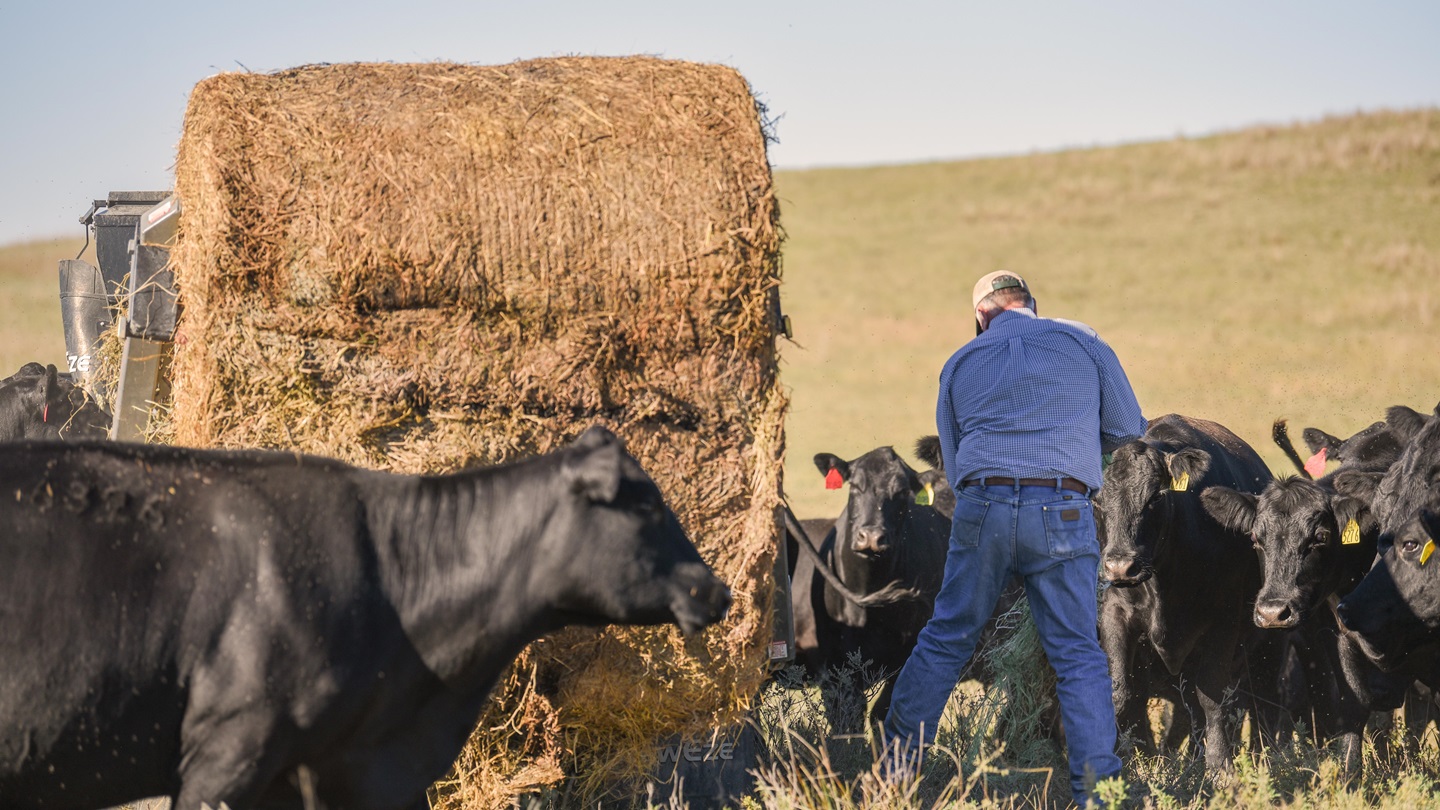

For six nights in early 2025, Aaron Berger, beef extension educator at University of Nebraska-Lincoln talked to a group of cattlemen about the one thing that’s king in every business: money. More specifically, the process of calculating annual cow costs to create a profitable business. Equipped with a thick black sharpie and an easel pad, Berger shared economic wisdom and left attendees thinking in a new light. This series walks through each of the six sessions and shares some of the concepts Berger explained.
Session 2: Calculating Feed Costs
In the second session, Berger dives into the largest expense category for most cow-calf operations: feed costs. Using Nebraska as a reference point, he explains that feed often accounts for 40–70% of annual cow cost and shares strategies for how producers can evaluate the costs of grazed and harvested feed on an economic basis. Berger introduces tools like the Feed Cost Cow-Q-Lator and walks through real-world examples comparing hay, distiller’s grains and other supplements to show how to calculate cost per pound of nutrient consumed.
Five Key Takeaways
- Feed is your biggest cost. Guessing isn’t enough. Feed often represents the largest expense in a cow-calf operation. Ignoring it or estimating loosely can be the difference between a year in the red or the black.
“When I look at annual feed cost economically, it’s usually 40-70% of annual cow costs,” Berger says.
He says one of the best things you can do it take the time to calculate annual feed cost per cow, including summer grazing, winter forage, supplements, everything. Then compare that number to local benchmark data, and if you’re high, identify areas to adjust.
- Bigger cows eat more (and cost more). Land rental rates don’t always reflect cow size, but costs do. A 1,400 pound (lb.) cow eats about 40% more than the standard 1,000 lb. cow, and when paying by the pair, that extra consumption adds up fast. Berger advises calculating what cows actually consume and converting that to a cost per ton of forage, then comparing that to hay prices.
“There's not many thousand pound cows out there anymore, at least not in Nebraska,” Berger says.
- It’s not just the cost of feed, it’s the cost of feeding. Hauling, storing and feeding hay adds up fast. That $90 of hay might cost $140 by the time it’s actually consumed. Berger encourages tracking the true cost of feeding, including items like storage, hauling, labor and waste.
Because of the additional costs harvested feed brings, he puts it like this: “Almost always, grazed feed is less expensive than harvested feed when we think about getting it into the belly of the cow.”
- Summer grass is costly. Although grazing is often the cheaper option due to lower input costs, Berger warns against the assumption that it’s a bargain in every season.
“Our price per ton for summer grass in Nebraska is equal to or even a little more than what you can buy hay for,” he explains.
Each ranch should run the numbers and compare grazing cost per ton to the true cost of hay per ton. If grazing is high, think about shortening the season or using crop residue in winter to balance costs.
- Compare feeds on a price per pound of nutrient consumed. Price per ton doesn’t tell the whole story, factors like nutrient density and waste matter in the big picture. That’s why Berger recommends calculating feed on a basis of price per pound of nutrient, not overall cost.
UNL offers a free tool, an excel spreadsheet called the Feed Cost Cow-Q-Lator. This tool allows producers to compare feed options on cost per pound of items like crude protein and energy (TDN) while factoring in waste and delivery. Convenience products like lick tubs may be easy, but they’re often the most expensive way to buy nutrients.
“It can be eye opening,” Berger says. “Sometimes what you thought was a not-that-expensive option becomes expensive.”
Want to learn more about session three, the cost of cow depreciation and replacement? Click here to see more!
The following summarizes what to expect from each of the series articles in the “Money Talks” series:
Session 1: Foundational Mindset
Berger lays the foundation for the series, talking about the economic principle of unit cost production. Click here to read more.
Session 2: Calculating Feed Costs
Berger demonstrates how to compare feed options and make the best choice for your operation.
Session 3: Cow Depreciation and Replacement
Berger discusses a cost often left off of balance sheets, cow depreciation and replacement. Click here to read more.
Session 4: Labor and Equipment Costs
Berger talks about ways to manage what are frequently second and third largest economic expenses for a cow-calf enterprise. Click here to read more.
Session 5: Breeding Costs
Berger shows how to use the Breeding Cost Cow-Q-Lator to evaluate and minimize breeding costs. Click here to read more.
Session 6: Benchmark Data
For the final session, Berger analyzes benchmark data from North Dakota, Kansas and Colorado to show the difference between productivity and profitability. Click here to read more.
Topics: Management , Business , Record Keeping
Publication: Angus Journal
Related Publications


Current Angus Journal
Keep up on the latest stories of the people and programs in the breed.

Latest Podcast Episode
Don’t miss conversations with breeders and industry experts.