




Money Talks: Session One
Laying the ground work for calculating cow cost.
December 15, 2025
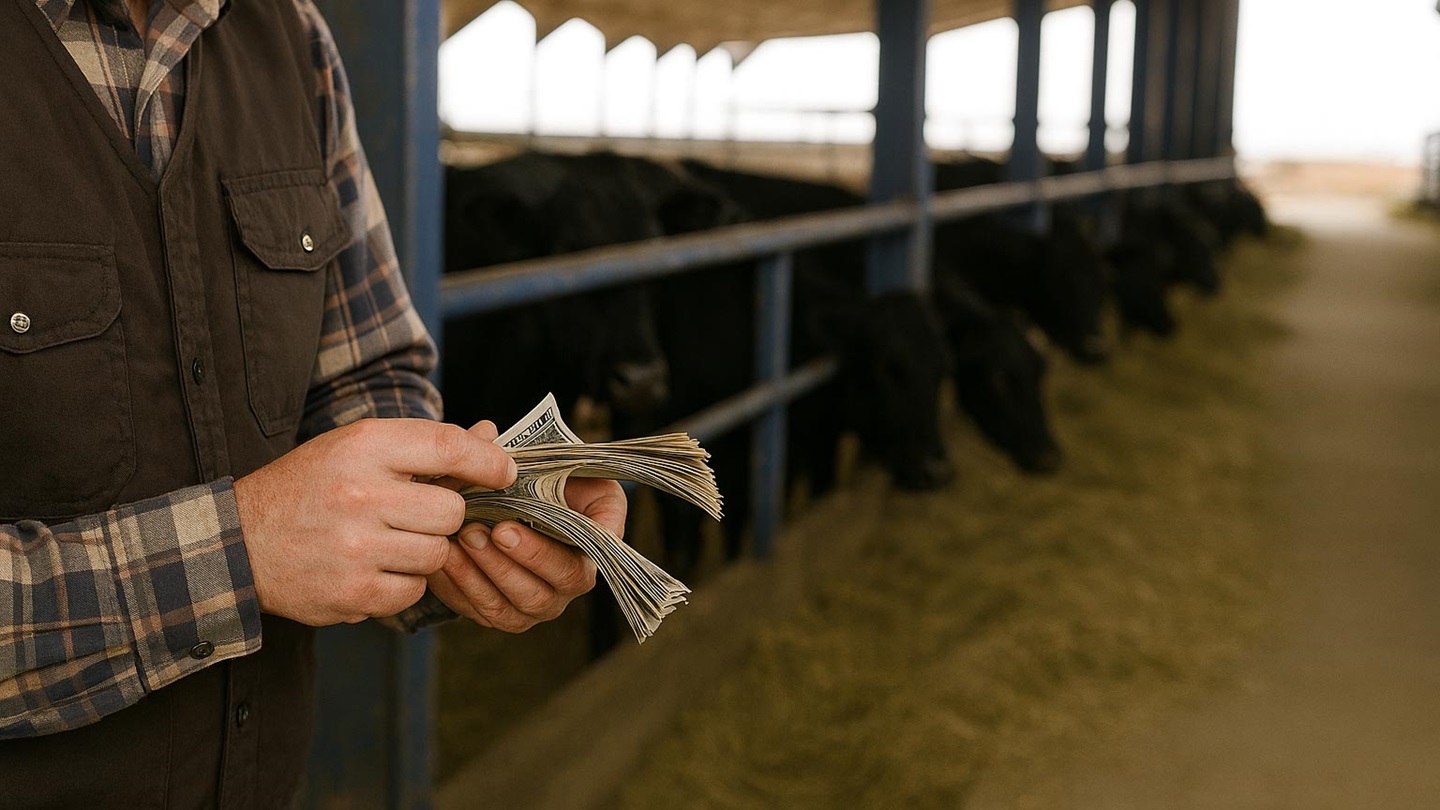

For six nights in early 2025, Aaron Berger, beef extension educator at University of Nebraska-Lincoln talked to a group of cattlemen about the one thing that’s king in every business: money. More specifically, the process of calculating annual cow costs to create a profitable business. Equipped with a thick black sharpie and an easel pad, Berger shared economic wisdom and left attendees thinking in a new light. This series walks through each of the six sessions and shares some of the concepts Berger explained.
Session One: Foundational Mindset
Berger kicked off the first session by explaining some basic economic concepts to lay the groundwork for the rest of the webinar. He also encouraged producers to enter these sessions with an open mind. Rather than relying on tradition or assumptions, he asked attendees to evaluate their operations through an economic lens where every resource has a cost and every decision impacts profitability.
“I think there's a lot of value inthinking about your thoughts,” Berger says. “Meaning, why do I think this way? Why do I have this mindset? Why do I evaluate the business decisions from this perspective?”
Five Key Takeaways
- No free land. No free labor. No free money. Inputs are never free, even if they’re owned. Cows should pay fair market value for the grass they consume, labor — including your own — should be valued at a competitive wage and capital invested in cows and equipment should earn a return. Ignoring these costs creates a distorted view of profitability.
Berger explains: “You can lease that grass out to somebody else. If the cows cannot pay fair market value for the grass and add value to that, then you need to ask the question: Should I own cows?”
- Understand the relationship between cost and production. Unit cost production is the total cost of producing one unit of a product; in the beef industry that is total cost to produce one pound of a weaned calf. Adding more cows or increasing weaning weights lowers that cost, improving profitability.
It’s a simple concept, Berger says, but an essential one.
“If I can find a way to reduce cost and increase production … that’s a home run every time.”
- Wage war on overhead costs. Labor and equipment are considered “fixed” costs, but they can make or break profitability. These costs don’t double when cow numbers double, meaning larger herds can dilute costs per cow. Overheads are one of the biggest drains on profitability, and Berger says it’s important to think about how to make your overhead costs work for you.
“Sometimes people refer to those [overhead costs] as fixed costs,” he explains. “I don't like the term fixed because fixed almost implies that it can't be changed and I don't believe that.”
- Direct costs should deliver a return. Variable expenses like feed, fertilizer and vaccines should be evaluated for their economic payoff. Each dollar spent should return more in added production value. If additional inputs only yield marginal gains — or worse, losses — Berger says to stop investing there.
He uses inputs into grass as an example.
“There comes a point in time when additional units of water and additional units of fertilizer do not grow more,” he says. “That’s called the point of diminishing returns. For every additional unit of water and fertilizer I'm putting on I'm getting less and less response in terms of production.”
- There are five key ways to reduce unit cost production. Again, most of these seem like common sense. But Berger says while the principles are simple, implementing them is where producers find difficulty.
He outlines the five strategies:
- Reduce costs while maintaining production.
- Increase production without increasing costs.
- Increase production faster than costs rise.
- Reduce costs significantly with only minor production loss.
- Reduce costs and increase production.
“If you can get this concept … you’re going to be in a very strong position as you begin to think about decision making on your operation.”
Want to learn more about session two, calculating feed costs? Click here to see more!
The following summarizes what to expect from each of the series articles in the “Money Talks” series:
Session 1: Foundational Mindset
Berger lays the foundation for the series, talking about the economic principle of unit cost production.
Session 2: Calculating Feed Costs
Berger demonstrates how to compare feed options and make the best choice for your operation. Click here to read more.
Session 3: Cow Depreciation and Replacement
Berger discusses a cost often left off of balance sheets, cow depreciation and replacement. Click here to read more.
Session 4: Labor and Equipment Costs
Berger talks about ways to manage what are frequently second and third largest economic expenses for a cow-calf enterprise. Click here to read more.
Session 5: Breeding Costs
Berger shows how to use the Breeding Cost Cow-Q-Lator to evaluate and minimize breeding costs. Click here to read more.
Session 6: Benchmark Data
For the final session, Berger analyzes benchmark data from North Dakota, Kansas and Colorado to show the difference between productivity and profitability. Click here to read more.
Topics: Business , Management , Record Keeping
Publication: Angus Journal
Related Publications


Current Angus Journal
Keep up on the latest stories of the people and programs in the breed.

Latest Podcast Episode
Don’t miss conversations with breeders and industry experts.