



Keep Livestock Away from Poison Hemlock
Commonly found in wet, wooded areas and open fields, along roadsides and railroad tracks, this poisonous plant could cause abortions and death in cattle.
June 23, 2010

by Candace Pollock, Ohio State University
The carrot family, which boasts a variety of familiar edibles such as parsley, celery, carrots, anise, fennel and cilantro, also contains a highly poisonous plant that many people confuse for its nontoxic counterparts.
Stan Smith, an Ohio State University (OSU) Extension program assistant in agriculture and natural resources, said people should learn to recognize poison hemlock. The noxious weed looks similar to and smells like other plants in the carrot family (Apiaceae, formerly known as Umbelliferae). Poison hemlock (Conium maculatum) originated in Europe, but is now commonly found in Ohio, growing in wet, wooded areas and open fields, and along roadsides and railroad tracks.
“The population of poison hemlock along field edges, in fence rows, around barn lots, and now even growing throughout hay fields seems to have reached new proportions this year,” Smith said. “Producers should be especially mindful of poison hemlock growing in proximity to their livestock herds.”
Poison hemlock, most famous as the plant that was used to execute the Greek philosopher Socrates, can be fatal if ingested. The plant was used through the 19th century as a narcotic, an anticoagulant and to treat inflammatory diseases, but it was discontinued because of the uncertainty of the dosage required. Coniine, the active ingredient in the plant, is also a poison that causes paralysis of the muscles, including those used for breathing. There is no known antidote.
“All parts of the plant are poisonous, including the leaves, stems, seeds and roots. Simply handling the plant can cause toxic reactions in humans,” Smith said. “Thankfully, the taste of leaves and seeds to livestock is unpleasant, so toxic quantities are seldom consumed when ample desirable feed is available for the animals.”
Smith said cattle can usually survive poison hemlock if consumed in amounts less than 0.4% of their body weight, although abortions are possible at lower rates.
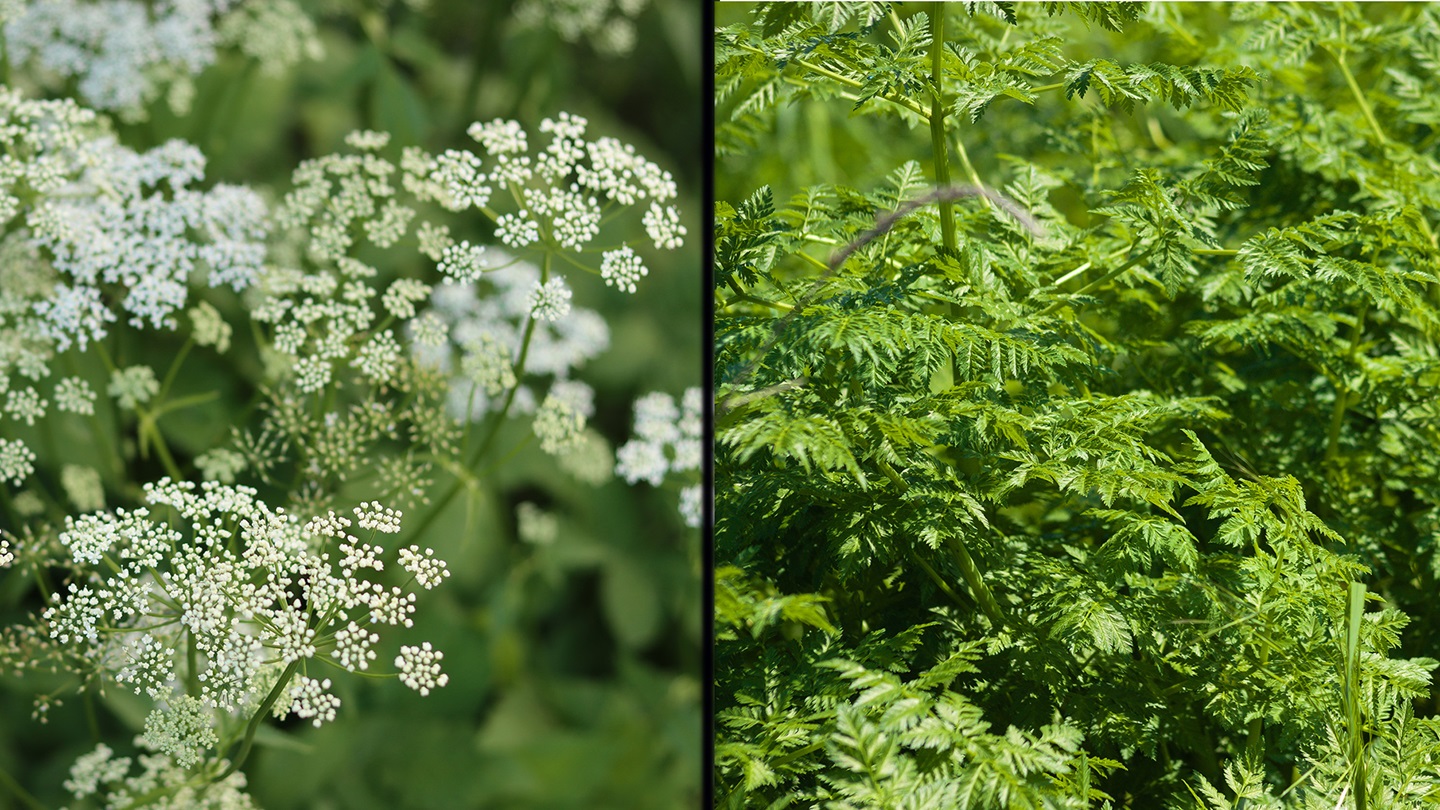
The main feature that distinguishes poison hemlock from other carrot family members is its tall size, growing upwards of 10 to 12 feet in moist conditions. The plant produces small white flowers that are typical of the carrot family, and has a smooth, purple-spotted stem and dark, glossy-green and fern-like triangular leaves. It has a fleshy white taproot. Both the leaves and roots have a disagreeable parsnip-like odor.
Smith said that herbicides are the best way to control poison hemlock.
“Crossbow and Banvel are fairly effective on small poison hemlock. Taller plants may need to be controlled with glyphosate,” Smith said. “Mowing after the plants have bolted and before setting seed will prevent seed production.”
Smith said that poison hemlock is often confused with giant hogweed, a plant exhibiting many similarities and one that is also spreading rapidly across Ohio.
UK also warns of hemlock poisoning
Many farmers across the state of Kentucky have just made or will soon make their first hay of the season. While making hay, it is important for growers to notice and remove any poison hemlock from their hay or pasture fields.
Native to Europe, poison hemlock is an invasive weed that was introduced as an ornamental in the United States during the 1800s. It is potentially poisonous if ingested by livestock or humans in both its vegetative growth stages and when dry.
“This is a classic example of one invasive plant problem that has gotten out of hand, but people may not be as alarmed about it as with other invasive plants because they may not know what it is,” said J.D. Green, Extension weed scientist with the University of Kentucky (UK) College of Agriculture. “There are no state laws that mandate control of it by landowners or along rights-of-way areas.”
The weed is often found along fencerows, roadways and other areas not used for cropland across most of Kentucky and the United States. However, in the past several years, its presence has increased across Kentucky and is now found more frequently in some hay and pasture fields.
If consumed, poisoning symptoms appear rather quickly and include nervousness, trembling, muscle weakness, loss of coordination, pupil dilation, coma and eventually death from respiratory failure. While livestock typically refrain from eating poison hemlock in its natural growing state because of its unpalatable taste, they will more likely eat it if no other forage is available or when consumed through hay.
Poison hemlock is often confused with Queen Anne’s lace, a non-toxic weed. Both plants produce leaves and clusters of small, white flowers. However, poison hemlock has smooth stems with purple spots throughout while Queen Anne's lace has hair along its stem and leaf bases. Peak bloom for poison hemlock is in late May and early June; whereas, Queen Anne's Lace is just beginning to produce flowers.
Ideally, growers can control poison hemlock with herbicides applied during the plant’s vegetative growth stage in the late winter or early spring or with a herbicide treatment in the fall. When plants are in full bloom, growers can still control poison hemlock by mowing before it produces new seeds, which occurs soon after flowering. Forage producers who find poison hemlock in their fields will want to either mow around the weed when cutting hay or mow and separate it from the other forages.
Editor's Note: This news release written by Katie Pratt was provided by the UK College of Agriculture.
Editor's note: [Lead photo is a composite of two photos taken by Francesca Leslie and Silviu Carol Cerusa from Getty Images.]
Angus Beef Bulletin EXTRA, Vol. 5, No. 1
Topics: Health , Management
Publication: Angus Beef Bulletin
Related Content


Current Angus Beef Bulletin
Our September issue focuses on the females of the herd and the records that validate them.