




Tips for Calving and Calving Facilities
From stall size to the little things that help an assist, Lauren Christensen offers tips to ease calving day.
December 17, 2025
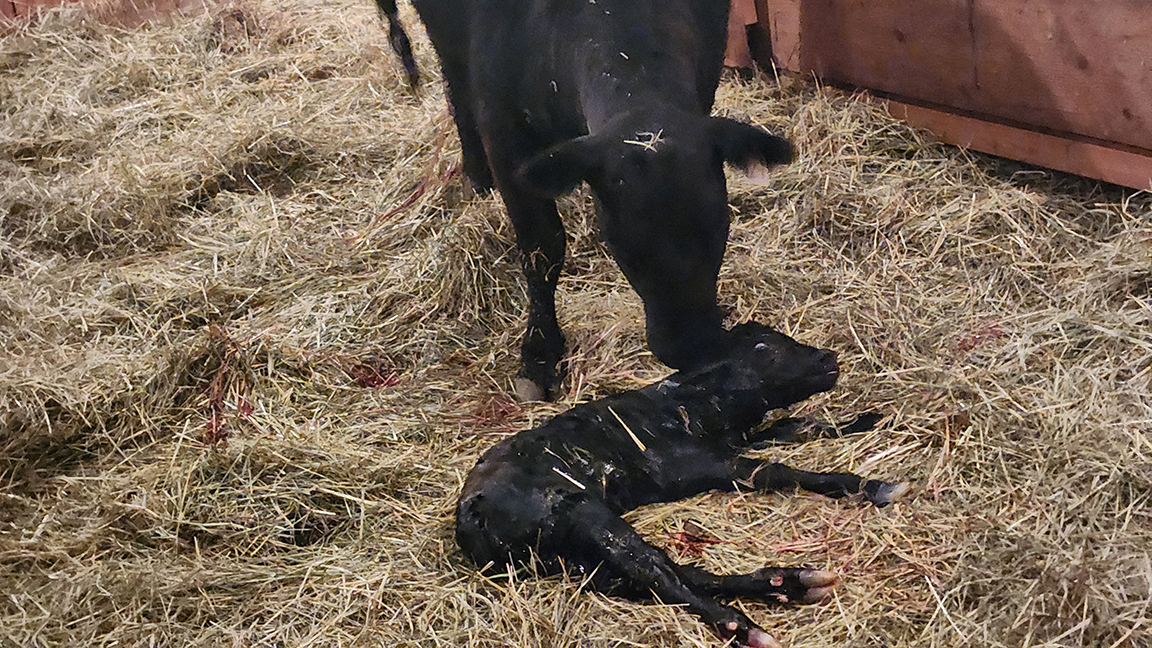

Looking at calving barns from a veterinary perspective, Lauren Christensen has several suggestions.
“All too often a barn is designed by someone who didn’t have to work in the barn,” says Christensen, now assistant professor within the College of Agricultural and Life Sciences at the University of Idaho.
For stall size she recommends pens be about 12 feet (ft.) by 12 ft.
“You don’t want stalls too small, or a cow that is turning around may step on her calf. Standard 12-foot panels provide a decent size, and if you need more space you can remove a panel to make one pen 24 by 12 feet,” she says.
“My favorite barns have a headcatch in one corner, or a place where you don’t have to run a cow down a long alley or outside the building,” she says. The headcatch can be incorporated into one of the panels and is sometimes positioned between two pens, providing access from either side. If it’s positioned in a corner pen, a panel could be hinged, allowing you to swing it to make a cow walk into the headcatch.
“My preference is a dairy headcatch or stanchion that’s V-shaped. When the cow puts her head down, it locks it in upright position,” Christensen says, adding that she prefers that to self-catching headcatches that lock when the cow’s shoulders push on them.
“The V-shaped ones should be low enough that a cow that lies down won’t choke herself,” she cautions. “When not in use, these can be locked upright and don’t take up much room. They are handy if a heifer doesn’t mother her calf, and you have to catch her several times to help her calf suckle.”
Wheels underneath
If Christensen is pulling a calf and the cow is standing, she catches the calf as it comes out and gently flops it into a wheelbarrow she puts next to where the cow is restrained. That way the calf doesn’t end up on the ground or fall on concrete — or manure.
“You always have to move that calf after you pull it, so this makes it easier than trying to pick a big slimy calf up off the ground,” she explains. “I just pull the calf and put it directly into the wheelbarrow.” Then it’s easy to move it to a nearby pen or stall.
A little warmer
“For calving season, I like the hot water kettles you can plug in, that have a temperature setting and don’t just boil,” says Christensen. “You can program it to heat water to 110°, the correct temperature for making milk replacer or a colostrum substitute. That way you are not guessing on how warm it should be for a calf.”
Christensen says she has stopped mixing milk or colostrum replacer in bowls, preferring to use a big plastic pitcher that is deep and less likely to slop out. It has a spout on one side, which makes it easier to pour into a bottle or tube feeder.
Another tip for when you have to assist a cow: Use a big slow cooker with warm water to warm the lube if you don’t keep it in the house, Christensen advises. Placed on the warm setting, it works like a warm-water bath for a gallon jug of lube.
Finding a footing
For stall bedding, straw is better than shavings or sawdust — if it’s good clean straw, she says. Shavings and sawdust can get stuck in eyeballs. When they stick to a wet newborn, the cow has to lick them off.
“If cows are not in the barn very long and the floor is dirt, I’ve seen some people use stall mats, like for horses,” she says. “In a 12-by-12 stall you could probably put several mats with a little space between them (for drainage) and a little straw over the top. These can be cleaned out very easily as long as the manure isn’t freezing to the mats.”
Editor’s note: Heather Smith Thomas is a freelance writer and cattlewoman from Salmon, Idaho. [Lead photo by Heather Smith Thomas.]
Angus Beef Bulletin EXTRA, Vol. 17, No. 12-B
Topics: Equipment / Facilities , Health , Management
Publication: Angus Beef Bulletin
Related Content


Current Angus Beef Bulletin
Our November issue focuses on the females of the herd and the records that validate them.