



Management Tips for Fall-Calving Cows
Here are tips to combat the challenges of maintaining cow body condition through breeding season.
October 6, 2025

by Rick Rasby, Nebraska Extension
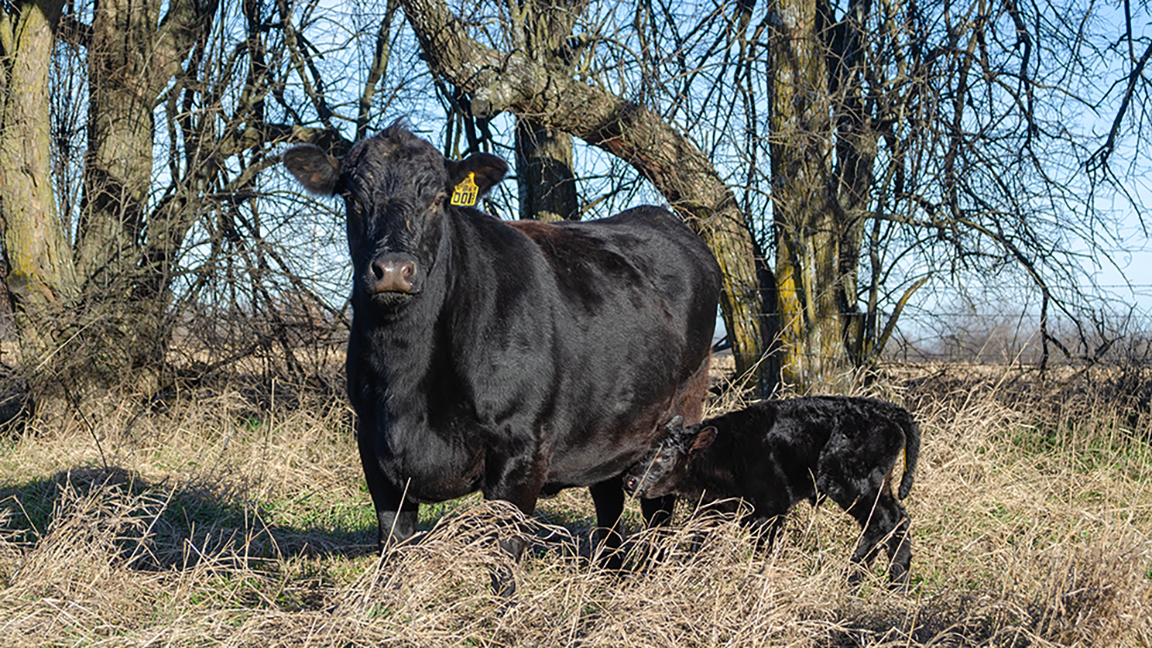
About 20% of the cow herd in Nebraska calves in the fall. A fall-calving herd provides a different time of the year to market calves and needs less labor at calving compared to spring-calving herds.
Fall-calving cows in Nebraska will begin calving in August (late-summer calving) to as late as October. They usually calve in good body condition, but the challenge is keeping them in good body condition through the breeding season.
After calving, high-quality grazed feed resources are limited. Both cool- and warm-season grasses are decreasing in quality and quantity after calving and during lactation.
Grazing crop residues is an option, but lactating cows in the fall will need supplementation to meet protein and energy needs.
Reproductive success affects profitability in the cow-calf enterprise. Investing time and resources to ensure reproductive success is important.
The challenge is how to feed the fall-calving cows economically and maintain adequate body condition when breeding season occurs between November and January. Calving and calf management are always important, because it will be hot when they are born and cold for most of the time prior to weaning.
Management tips for fall-calving herds:
- Achieve and maintain mature cows in a body condition score (BCS) of at least 5 (1-to-9 scale) through the breeding season.
- Maintain first-calf-females in a BCS of 6 through the breeding season.
- Avoid negative planes of nutrition, meaning when what cows are eating won’t meet their nutrient needs for mainly protein and energy.
- Test forages for quality and nitrates.
- Design feeding programs using forage tests, and determine gaps in nutrients needed by the lactating cow.
- Determine supplementation strategies to cover nutrient gaps in your feeding program.
- Provide salt and mineral.
- Have bulls in breeding condition (BCS of 6) 45 days before the start of the breeding season. The same bulls can be used in both the spring and fall herds. Evaluate health and condition after pulling bulls from the spring-calving herd after that breeding season. Pay close attention to the condition and health of the young bulls.
- Bulls should always pass a breeding soundness exam (sometimes referred to as a BSE) before turning out.
- Natural service and estrous synchronization with artificial insemination (AI) or a combination of natural service and AI can work for fall-calving systems.
- Monitor bulls during the breeding season. Low temperature can result in frostbite of the scrotum, causing reduction in semen quality.
- Bull cost can be reduced by spreading them over two breeding systems per year.
- Weather conditions will be hot in August and early September. Provide shade and drinking water for calves, and monitor calving pastures frequently.
- You may need to provide bedding for the herd during extremely cold weather events.
- Provide protection for the herd during low-windchill episodes.
- Fall-born calves weigh less than spring-born calves when weaned at the same age.
- Creep-feeding the calves will increase calf weight at weaning, but it will not take lactation stress off the cow. Take a look at the economics of creep-feeding.
- Have a weaning strategy. Will calves be weaned early, or will calves remain on the cows?
- If calves are early-weaned, have a management plan for them.
- Keep heifer calves growing at a rate that they have the potential to be replacements.
For fall-calving cows, the feed resources available for grazing are low in quality and will not meet cows’ nutrient needs during lactation. Supplementation will be needed. Don’t let cows slip in body condition prior to the breeding season. Weather conditions during the breeding season for fall-calving cows are unpredictable, but in Nebraska, will usually be cold and may include snow or other precipitation.
Cover crops (secondary forage crops) fit nicely into fall-calving systems. Cover crops provide a high-quality feed resource to fall-calving herds (lactating cows, bulls and calves) with little to no supplementation needed. Secondary forage crops can be planted in seed-corn fields, after silage harvest, or after wheat harvest.
Fall calving allows for marketing calves at a different time of the year as compared to calves born in spring. Cow, bull and calf management and feeding programs of fall-calving herds is much different than spring-calving herds because of time of the year, weather conditions, and the grazed feed resources available.
Editor’s note: Rick Rasby is an extension specialist for Nebraska Extension. [Lead photo by Shauna Hermel.]
Angus Beef Bulletin EXTRA, Vol. 17, No. 10-A
Topics: Female Foundations , Management , Nutrition , Reproduction
Publication: Angus Beef Bulletin
Related Content


Current Angus Beef Bulletin
Our September issue focuses on the females of the herd and the records that validate them.