




The Buzz on Flies of Importance
The battle against the usual suspects while preparing for New World screwworm.
September 4, 2025
For a large portion of the United States, the previous year has been one for the books. Plentiful rain and green grass — even in areas that usually can’t claim anything green except for the bar ditches — are certainly cause for celebration.
However, with that moisture comes its own unique set of challenges. Those challenges often materialize as nuisances that can cause tail swishing, bunching, overstimulated and stressed cattle. Plus, there is a reemerging insect on the horizon that threatens to take the concern for fly control to another level.
On a recent episode of the Angus at Work podcast, Angus Beef Bulletin Associate Editor Lynsey McAnally visited with Sonja Swiger, an entomologist with Texas A&M AgriLife Extension, to discuss the usual culprits, why flies are an issue, how to control them and what we can expect should New World screwworm cross into the United States.
Frequent flyers
This year the flies seem thick enough to frustrate cattle and carry off the ranchers themselves. While that may not actually be true, battling the usual varieties of flies seen across the country can be quite frustrating. One thing to keep in mind when putting together your plan of attack is knowing which variety of fly you are dealing with, as methods for control vary depending on fly behavior and feeding style.
Knowing the usual flies in your area narrows the field on control options, but that doesn’t mean you won’t have other varieties show up from time to time — they’re just far less numerous. Three varieties you can always count on, according to Swiger, are horn flies, stable flies and house flies. All three can certainly be annoying, but only the horn fly has cost the cattle industry upwards of $2 billion to manage.
“[Horn flies] are a constant biting species. Both males and females are bloodfeeders, and they have to have that blood,” Swiger advises, noting that these flies are often seen on the back and head of harried animals. “[Horn flies] swarm in large groups and often look like a big cloud over the animal.”
Meanwhile, the stable fly is more of an ankle biter. Preferring to bite the legs, stable flies annoy horses, as well as cattle. Generally found in dairy and more confined spaces, stable flies can still get out into pastures. While we usually talk of flies bothering livestock, humans and dogs also suffer the attentions of stable flies. Stable flies inflict a particularly painful bite that can drive cattle into water, but there is good news when it comes to their feeding patterns.
“We generally see [stable flies] in our cooler months. They don’t like it when it gets super hot, but we can have them throughout the entire spring months, and then they can even come back in the fall. They’re a very problematic species,” says Swiger, explaining that the propensity of stable flies to take a full meal once per day makes controlling them very difficult. “Most topicals are generally directed to where we see the horn flies. That’s not going to provide contact with where the stable fly likes to bite. They may not even interact with some of those products.”
The last common nuisance on our list of frequent flyers is the house fly. They are very cosmopolitan, says Swiger. They like to hang out with all types of people and all types of animals. When it comes to their presence in a pasture setting, Swiger says they might be more drawn to tasty ingredients in feedstuffs than the cattle alone.
“Where we generally find them in higher numbers will be around the barn. If you have animals in a barn or near a barn or you’ve got the feed in the barn, that’s definitely going to be something that will attract the house flies,” Swiger confirms. “Barns are usually close to humans. They’re usually going to have houses nearby, and that increases the chances of seeing them.”
When it comes to horn fly issues, cattlemen can rest assured that there are many products on the market designed to help control biting insects. In fact, most of the products on the market are labeled for horn fly usage because of the effect the horn fly has directly on our animals and on our industry. For more information on controlling horn flies, stable flies and house flies, please listen to the full Angus at Work episode here.
The newest threat on the horizon
While New World screwworm (NWS) is a formerly native species to the Americas, through unified efforts NWS was successfully eradicated from the United States decades ago. Eradication is something not easily achieved and even more difficult to maintain. The reason we don’t eradicate things very frequently, Swiger says, is because they always come back.
That is particularly unfortunate as NWS is one of two fly species in the world that prefers to find living animals to place its eggs onto. When an animal has a wound on its body, those can be susceptible to NWS coming to that wound and laying eggs on or near that wound. Then the larvae will hatch and live inside that wound.
“As it sounds, it’s not a good thing. While we do talk more about it with the livestock industry, this fly is not only looking for livestock,” warns Swiger. “It will literally lay its eggs on any warm-blooded animal it comes in contact with. We just see a larger [effect on] the livestock and the wildlife populations from this fly.”
The biggest concern to date? Movement of animals. NWS alone isn’t a world traveler, generally only flying about 12 miles in search of a host. However, if the fly finds a host sooner, it’s not going to waste energy flying farther in hopes of a different target. If cattle are moved on trucks, for instance, the movement of NWS can be greatly expedited.
“What we’re really seeing with the movement — and what was tracked early on when it started moving into Mexico — is that these distances were 100 to 150 miles away, right? [Those] gaps between the next infestations can only be attributed to movement of animals. Most of the time these are animals not moving on their own,” notes Swiger. “These were mostly livestock, wild cattle in particular. They were animals being moved by humans. That’s our biggest concern.”
Looking for the latest information on New World screwworm? Check out the resources below:
- New World screwworm Fact Sheet Announced
- NWS: What’s Next?
- Ag Secretary Brooke Rollins Announces Plan to Combat Spread of New World screwworm
Angus Beef Bulletin EXTRA, Vol. 17, No. 9-A
Topics: Health , Management
Publication: Angus Beef Bulletin
Related Content


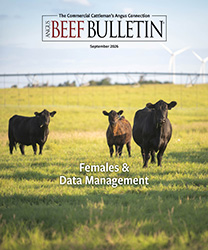
Current Angus Beef Bulletin
Our September issue focuses on the females of the herd and the records that validate them.