



Maximum Advantage
Technology can assist commercial producers selecting replacement heifers.
August 13, 2025
Cattlemen who raise their own replacements use various selection strategies to improve the herd. Most commercial producers evaluate a heifer’s growth, structure and temperament, along with using expected progeny differences (EPDs) to select sires for maternal traits when they plan to keep daughters. The Angus GeneMax® Advantage™ test can be very useful for commercial cattlemen retaining their own heifers as replacements.
Kelli Retallick-Riley, president of Angus Genetics Inc. (AGI), a subsidiary of the American Angus Association, leads efforts in genetic evaluation, research and technology development to enhance the Angus breed’s genetic tools and predictive capabilities. Her role involves overseeing genetic improvement strategies, collaborating with industry partners and ensuring Angus remains a leader in beef cattle genetics.
AGI and Zoetis launched GeneMax Advantage in 2014 as an enhanced genomic test for high-percentage-Angus commercial females to provide commercial cattlemen both maternal and terminal trait predictions to manage replacement selection.
“GeneMax Advantage is the ultimate genomic tool for commercial Angus producers, delivering unmatched confidence in selecting replacement heifers,” Retallick-Riley says. “Powered by the American Angus Association’s massive database, it provides direct comparisons through $Values to your registered Angus sires, ensuring every decision aligns with your herd’s goals.”
With predictions for 19 key traits, including new enhancements for heat tolerance and high-altitude adaptation, this test offers usable data tailored for commercial cattlemen.
Who’s the daddy?
“GeneMax Advantage also includes SireMatch™ technology to identify high-impact sires,” Retallick-Riley says. “Because you are already linked to the Angus database, you can do this with no additional cost or testing.”
Parentage verification alone is worth the investment. Many cow-calf operations utilize multi-sire pastures, so it’s important to know which bulls are doing their job and having the most influence, and how efficient your breeding strategies are.
“In this period of herd rebuilding, it’s important to keep the best genetics to rebuild herds,” Retallick-Riley says. “Employing GeneMax is a way to refine those selection processes to ensure you are seeing the full picture and keeping the best heifers for your goals.”
Experienced advice
Dave Seibert, now retired, still consults with two Angus ranches in selecting heifers.
“Some people feel GeneMax Advantage only helps you cull off the bottom end. It does, but if you use AI (artificial insemination), it can also complement the weak points of a female,” Seibert says.
Many commercial herds, even today, track only a few traits — birth dates, birth weights and maybe a weaning weight, says Seibert, who worked in extension for 42 years. “Over the years, phenotypic data was limited to six traits — calving ease, birth weight, weaning weight, yearling weight, docility and frame score. For many years these were the traits we used for making heifer selections, even in purebred herds.”
When ultrasound came into use, traits like marbling, ribeye and rib fat could be measured.
“Until recently, if you collected those nine traits, you’d done a complete analysis in terms of performance testing,” Seibert says.
GeneMax Advantage provides genomic scores on 19 individual traits, many being difficult-to-measure traits like calving ease maternal, heifer pregnancy, carcass weight and milk.
“Angus registration papers list 23 traits with EPDs, so commercial producers can have almost as much information on their cattle as a purebred breeder,” Seibert says.
After completing the research phase, the Association released EPDs for udder suspension (UDDR), teat size (Teat) and functional longevity (FL). These traits will also be incorporated into GeneMax Advantage.
There is already a great deal of information attainable with a genomic test that is very helpful for commercial producers who don’t have much background data on their cows.
With this genomic tool, heifers can be sorted at a young age, even shortly after birth, Seibert says. This enables producers to make informed decisions to move some of the heifers to the feedlot at weaning.
“If you have limited resources, you don’t need to keep extra cattle; you have more nutrition for the heifers you keep,” he says.
More than rankings
With this genomic test, there are eight multitrait indexes to help sort heifers.
“When this test first came out, this was the selling point, but several other things may be even more important,” Seibert notes, pointing to three indexes specific to GeneMax Advantage and five dollar value indexes ($Values) identical to those on registered Angus.
“With the eight rankings on your heifers, you can go different directions with them,” he explains. “You might look at the $Values and maybe choose maternal weaned calf value ($M) or one of the Advantage indexes (Cow Advantage, Feeder Advantage or Total Advantage).”
Selection for maternal
This genomic test allows selection of maternal traits on commercial cattle.
“When performance testing was beginning, we made heifer selections with adjusted weaning weights and ratios, adjusted yearling weights and ratios, and maybe frame score and average daily gain,” Seibert says. “Most of these are terminal traits and have negative impact on maternal traits like mature cow weight and cow costs.”
Angus cattle were smaller 60 years ago, and the selection trend was to move toward larger frame and higher growth. The unintended consequences included larger cows, higher maintenance costs and, for some, a reduced emphasis on maternal traits.
Maternal traits are absolutely necessary to keep cow-calf producers in business. Fertility and longevity are most important, Seibert says. Now we’ve turned the corner, trying to focus more on the maternal value of a cow.
“GeneMax Advantage offers heifer pregnancy, cow cost, foot scores, [milk], calving ease maternal, mature cow weight, hair shed, etc.,” he says. “These traits will keep you in business longer.”
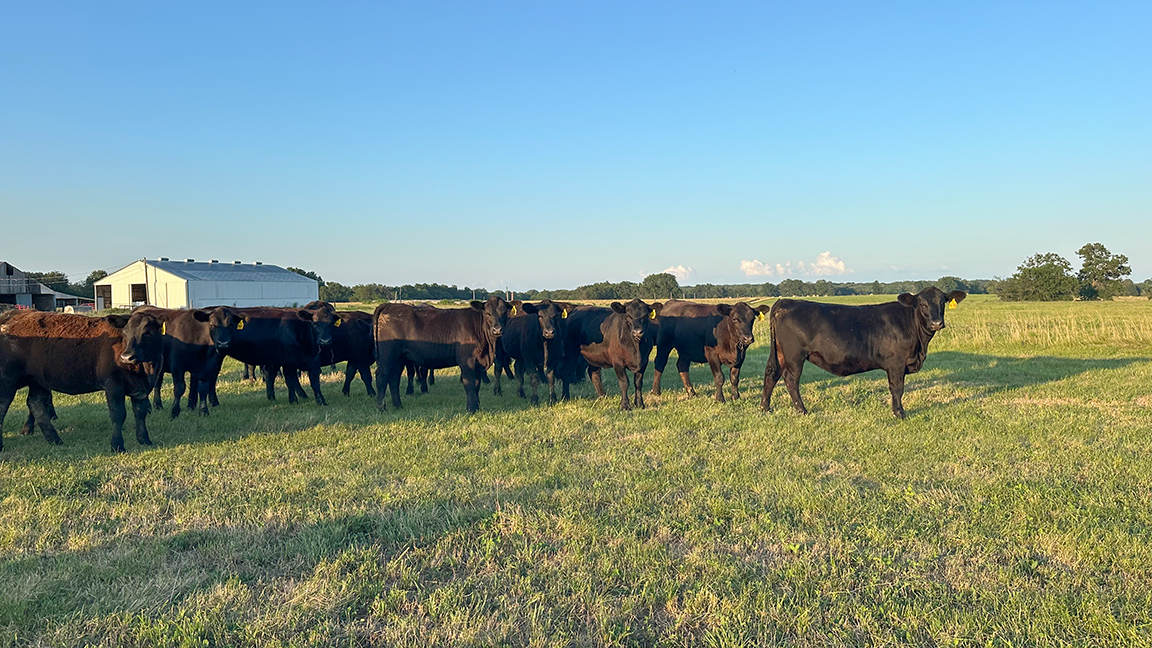
If females are the factory of the cow herd, emphasis needs to be placed on their success. Maternal traits are absolutely necessary to keep cow-calf producers in business. Fertility and longevity are most important, says Dave Seibert.

Planned matings
This genomic analysis also allows “precision mating” using artificial insemination (AI).
“When producers take time to collect DNA samples and pay for the GeneMax Advantage analysis, they should be using AI,” he contends, though the same concept can be used for matching herd bulls to groups of females for pasture-mating. “Sires can be matched to each heifer to complement her strengths or weaknesses. I developed and utilize a spreadsheet in which I rank every heifer for all 19 traits. When I choose the sires, we usually have at least eight that I match with each female to see which one will be most complementary.”
“This is the greatest strength of the GeneMax Advantage analysis to move the herd in a positive direction,” Seibert says. Many people emphasize only one or two traits. They may make progress in those and slide backward in others. With precision AI mating, all traits can be ranked and utilized.
“I separate each heifer’s traits into what I call very high, high, moderately high, some that don’t need to be changed, and some that are very low, low and moderately low,” he says. “I rank the heifers and mate them with bulls that can offset the places where they are weakest.”
The bull is the other half of the equation, and you need a good match to complement each heifer.
Sire identification for each heifer is crucial, so you know her sire and his traits. It must be a registered Angus sire with DNA data.
“You can use multi-sire pasture breeding and still know the sire of each heifer calf,” Seibert says. “This is a tremendous advantage, and you can also go back and see how different sires worked in your herd — not only the AI sires, but also the cleanup bulls, to see which ones are siring better replacement heifers.”
Benchmarking
Another advantage of using GeneMax Advantage is being able to compare your herd with others across the United States, Seibert notes. Many producers don’t know how their herd compares on metrics like heifer pregnancy rate.
“This analysis shows you,” Seibert says. “Even mature cow weight can be compared with other herds. Your index might show that your cow weight is totally out of hand and you need to do some adjustment.”
You can also use benchmarking to evaluate genetic trends.
“Commercial cow-calf producers have always had difficulty evaluating the trends in their herd to see if they are making improvements — with nothing to compare to. Also, from year to year the environment (rainfall, etc.) can mask changes in phenotypic traits like weaning weights. One year your calves might be heavier, or lighter, but with this test you know how they are moving genomically — a way to benchmark changes in the herd,” he says.
Matching your environment
Producers must also identify cows that fit their environment.
“For this I combine three different traits — cow costs, yearling height and mature weight. In terms of how big your cows are, yearling height and mature weight are two of the genomics provided, but I also use cow costs, because it’s closely related to mature weight and milk level,” Seibert says. “Everyone is trying to reduce the cost of maintaining their cows. We have one measure that shows this, and also relates to a couple other things. When selecting Angus AI sires, I try to maintain the milk EPD between 20 to 32 pounds (lb.).”
Cows with EPDs of 35 lb. or higher cost more money to maintain, he says. They won’t be sustainable in many commercial herd environments.
GeneMax Advantage also assists with marketing steer mates.
“The Association has an analysis for marketing steers. Many of those are based off EPDs of the sires, but most herds use similar sires for both heifers and steers,” he says. “With GeneMax Advantage we can evaluate many postweaning traits and $Values for heifer mates (marbling, ribeye, gain, feed efficiency, fat, tenderness, $Beef, $Feedlot, et cetera). We have similar information for the steer mates when we utilize it for heifers. We just need to train the markets and feedlot people to recognize and utilize this information.”
With the high cost of developing heifers, we try to reduce mistakes.
“In the larger herd I work with, I’ve gone back 10 years and followed the number of heifers we selected and bred AI. I showed what percent have been lost over the years and how many stayed in the herd. The second-calf female has a difficult time staying. We put too much investment in these heifers (money, time, reproductive tract scores, semen, vaccines, et cetera), so we’ve got to keep them around longer.”
With GeneMax Advantage there is a wealth of information to help cow-calf producers move their herd in a positive direction.
Editor’s note: Heather Smith Thomas is a freelance writer and a cattlewoman from Salmon, Idaho.
Topics: Management , Female Foundations , Genetics , Selection
Publication: Angus Beef Bulletin
Issue: September 2025
Related Content


Current Angus Beef Bulletin
Our September issue focuses on the females of the herd and the records that validate them.