




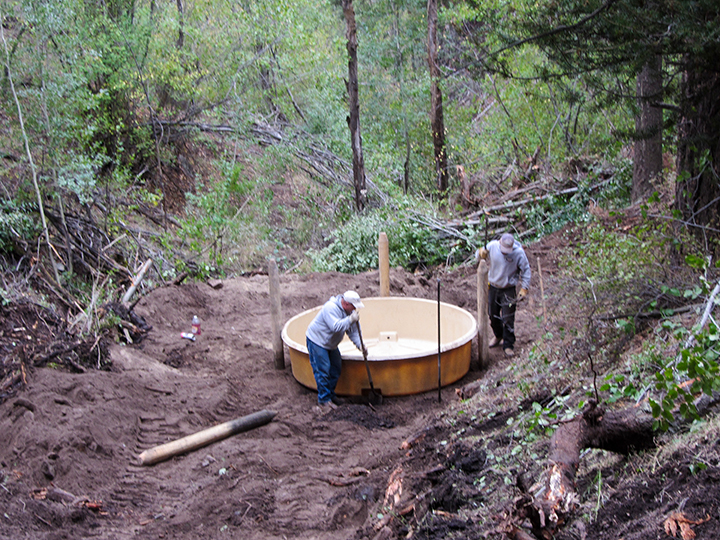
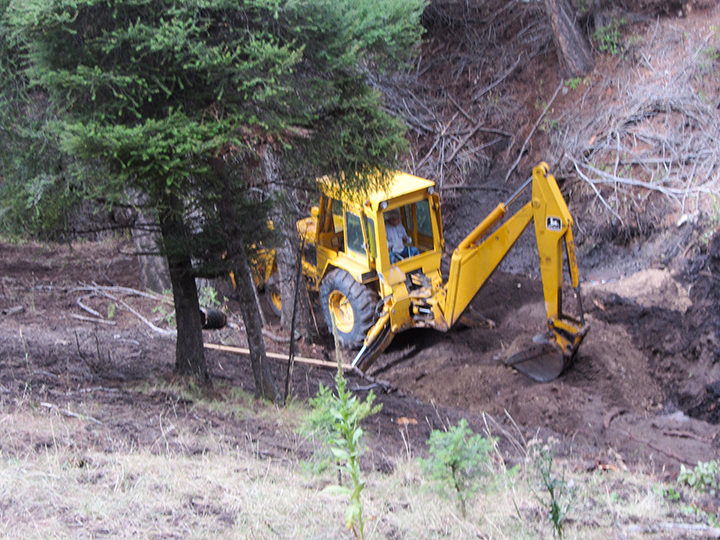
Author Heather Smith Thomas and her family installed a fenceline waterer, capturing water from a spring to serve two mountain pastures during fall/winter grazing. Even if the rest of the surface freezes, where the inflow pipe dumps water in, the surface stays open.
Avoid Winter Water Woes
Ways to winterize water sources.
November 3, 2025
Keeping stockwater ice-free can be frustrating during winter. We sought advice from extension livestock specialists in northern climates to get tips for keeping the water flowing this winter.
Karl Hoppe, North Dakota State University, says the easiest way to keep a water pump or the water in a trough warm enough to prevent freezing is with an electric heating element.
“Some people go frost-free with an insulated tank or trough, without electricity; but, when it’s 30 below zero or colder, they may be chopping ice,” he says, noting many systems fail during extremely cold or prolonged cold weather.
“The last thing I want to do is try to thaw a frozen water line or get ice out of a tank when it’s 40 below zero,” he says. At those temperatures, the water in the standpipe can freeze. A frozen standpipe can take a day or more to thaw using applied heat.
Hoppe says some people use steam or hot air, like exhaust from a pickup or tractor (make sure the area is well-ventilated to avoid carbon monoxide poisoning). Those methods work with time, but the cows still need water.
If you don’t have access to electricity, options for heating a waterer include using natural gas or propane.
“When I was growing up, we used a propane burner with a pilot light and a thermocouple so that, when it got cold, it kicked on,” he says. You can also heat water tanks with a coal furnace or cob box. They have to be stoked, but, as Hoppe says: “That’s easier than breaking ice.”
Wind can blow out the pilot light on a propane burner or natural gas heater, he warns, and it can be difficult to relight in windy conditions. Hoppe suggests putting a blanket around it and yourself to break the wind.
No water, no gain
Some feedyards put in frost-free water tubs or tanks to save electricity, but when the temperature drops to 30 below they freeze up.
“For 10 or 11 months of the year they work fine, but if you have a couple weeks with a serious water issue, cattle do not gain weight if they can’t drink,” Hoppe says.
“Many feedyards use large rubber tire tanks, sometimes covered and set into the ground; but at 40 below, the drinking holes freeze over unless they are covered. A cow may flip the cover open, and then it freezes open,” he says.
“Most water lines to stock tanks are buried. The standpipe/riser needs to be at least a foot or preferably 2 feet wide, with the pipe to the trough coming up through the middle. If the riser is too small, you can’t take advantage of ground heat that’s 6 or 8 feet down (below frost line).”
That warmth comes up the big pipe and keeps the water pipe from freezing, he explains.
“You also need insulation around where the freeze zone would be. If you get frost down to 5 or 6 feet, you need insulation down that far,” Hoppe says. “You either need a large-diameter standpipe or put heat tape or use some type of heating device to keep your pipe from freezing.”
If the electricity goes off for some reason, that won’t work, he points out.
“I put in new waterers 22 years ago and used a 14-inch-wide sewer pipe with bubble wrap insulation around the outside,” he shares. “It has been very dependable.”
When installing a waterer, Hoppe recommends putting insulation between the concrete pad and the standpipe.
“Most people just bolt the waterer to the concrete, but you need some insulation between them,” he says. “Otherwise cold from the concrete goes right into the standpipe.”
Some systems come with standpipes preinsulated to take advantage of ground heat. Big rubber tire tanks have the same concept. They are set into the ground a little themselves, and water coming up to them is from a pipe inside a large riser.
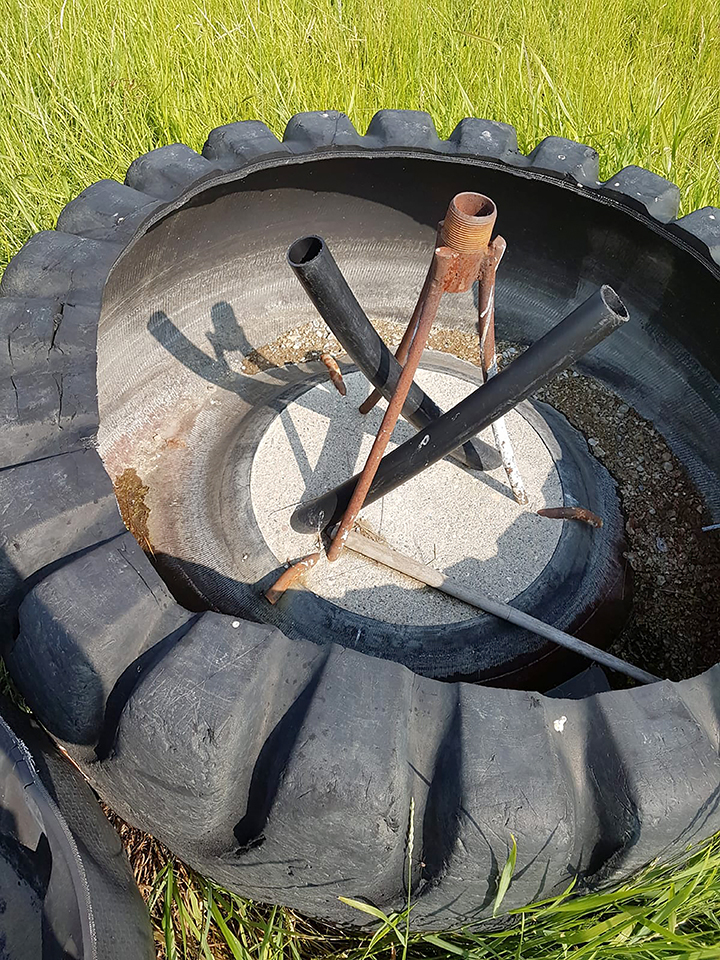

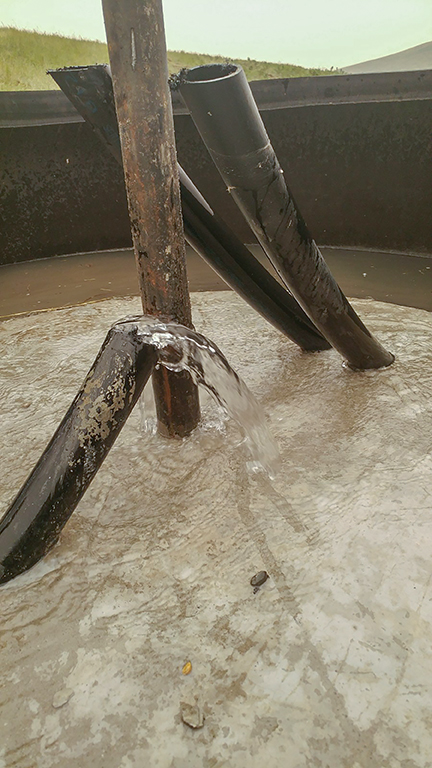


To provide water in winter, Gerald Vandervalk uses a tire trough with water coming up through the bottom and two overflow pipes carrying it away. Even in very cold weather, the constant water movement and volume keeps some surface area open.

“You also need enough water volume — cooling off slower than in a small tank — so the whole thing doesn’t freeze. If water is moving — a fair amount continually coming into the tank — it won’t freeze as quickly as still water. As long as 50° water (ground temperature) is coming in, it will keep enough heat there — if you have enough volume,” he says.
Those waterers still have to be checked every morning.
“Cattle don’t drink much during the night,” he points out. Without as much refill and water movement, they can still freeze over.
Watch the thermometer
Temperature makes a difference.
“Ten below zero is much different than 40 below,” Hoppe says. “In really cold weather, many systems fail.”
When it’s really cold, it helps to have a covered tank, like the coffin-type waterer set into the ground, insulated and covered with dirt to reduce exposure to outside air.
“These tanks have adequate water volume and don’t lose as much water warmth,” says Hoppe.
For any winter water system, proper installation to obtain as much ground heat as possible is most important, he says. “You don’t want cold spots on the waterer.”
Cover the top of the float, advises Hoppe, noting some producers put floats under water. “Then the valve doesn’t freeze unless the whole thing freezes up.”
There are advantages to black tanks that absorb heat during a sunny day.
“If the water gets warmer during the day and you have enough volume, it may not freeze as quickly overnight,” Hoppe notes.
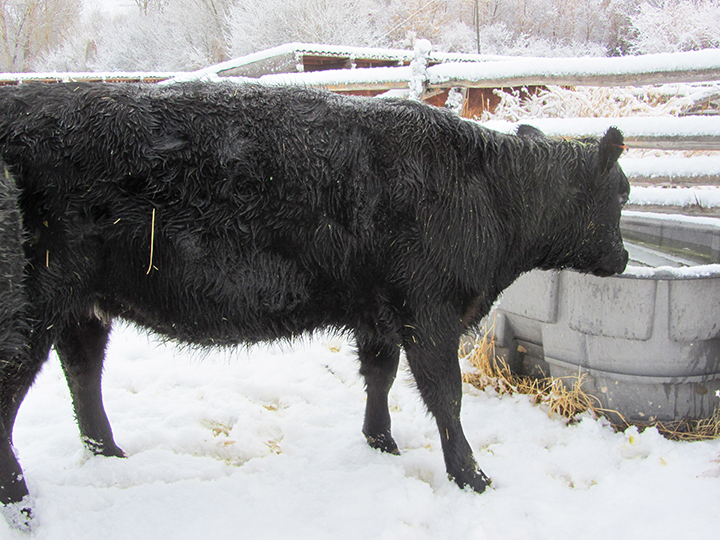
A tank heater keeps this waterer clear of ice for heifers to drink. [Photo By Heather Smith Thomas.]
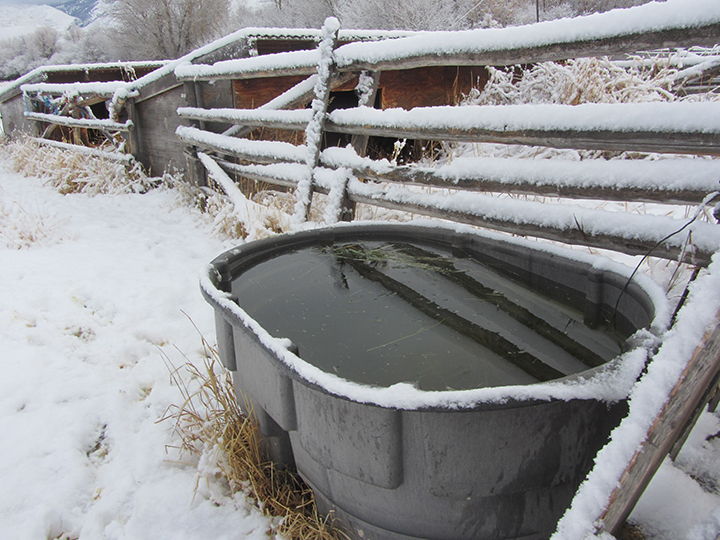
Wind makes a difference. In a windy location water freezes more quickly (at the same temperature) than water in a protected area.
“A few years back I recommended a certain type of waterer to a friend, but he had problems with it,” Hoppe explains. When he visited the farm, Hoppe realized his friend had placed the waterer in a big flat area where wind was freezing it. He needed a bigger heater.
A windbreak or shelter around the water trough might also help.
“With a little shed around it, cows simply put their head in to drink,” he says. “The roof and shed provide some wind and cold protection.”
Hoppe says he used to have waterers with little balls that rose to the top to protect water in the drinking holes.
“Those worked, but when animals pushed them down to drink, there would be a thin film of water on the ball when it seated back up to cover the hole,” he explains. “That would freeze to the top of the tank. Every morning I had to break it loose.”
Pond warnings
If cattle drink from a pond or dugout, fence it off and pipe water underground from it to a trough or nose pump, rather than risk cattle walking on ice and falling through, Hoppe warns. If you allow cattle access to a pond, use an electric fence — solar-powered if necessary — to keep cattle off the main pond. Drinking holes can be chopped at the edge, where there’s less risk of fall-through to drown.
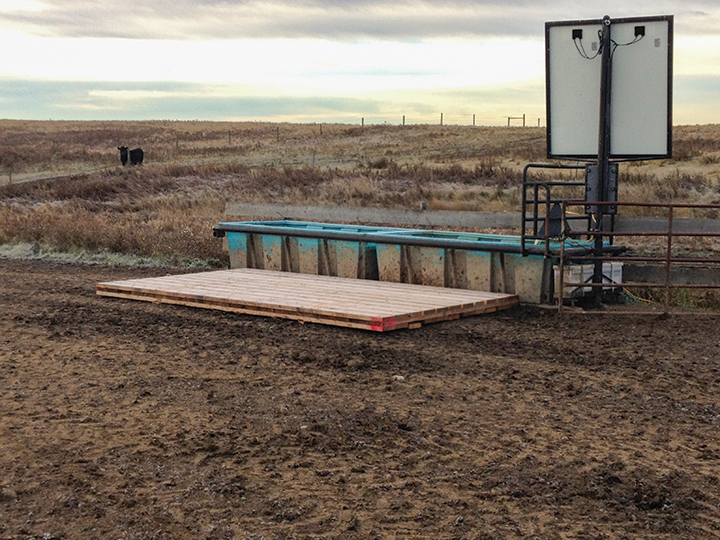
Where there is no electricity, a solar system can be installed to provide heat to waterers.

“Another option is to use a little pump with a gas motor, or that runs off solar power, and use it every morning to run water into a tank for the day,” he says. “This is one more morning chore, but [it] might prevent big problems like a water system freezing up. If the tank gets emptied by the cows before evening, you could pump a little more into it.”
Troubleshooting
Warren Rusche, assistant professor and extension feedlot specialist for South Dakota State University, says even though it is important to be proactive and try to keep water sources functional for winter, sometimes you don’t know your equipment doesn’t work until it gets tested.
“My experience has mostly been with electric waterers and water-heating devices, and generally they work until they don’t,” he says. “The thermostat or heating element suddenly quits.”
Rusche offers some tips to check them.
Visual inspection can tell you if the wiring doesn’t look right, he says, and you can test some of the plug-in ring-style heaters.
“We pull those out of the water during summer,” Rusche says. “Before winter you can test them by sticking them in a freezer for a little while, then take them out and plug them in. If they warm up, they are probably OK; and if they don’t, they’ve failed.”
For a pipeline system that won’t be used in winter, it might be necessary to drain the lines or troughs so they don’t freeze and break in cold weather, creating leaks and problems for next year.
If there is no electricity in a remote pasture, some solar systems work well for pumping water.
“Solar is simply a different form of power, and some of the troubleshooting would be the same,” Rusche says. “Then it’s a question of whether they have enough capacity during shorter winter days and maybe overcast sky.”
Some ground heat sources don’t require power.
“The main thing is to plan ahead and install them properly,” says Rusche. With heat-free systems, valves and plumbing won’t freeze as long as the tub is filled with water. Some also hold more warmth due to black color and substantial wall thickness. The waterer takes advantage of a wide column of ground heat by placing the tub inside the ground heat chamber, rather than above it. The entire tub is constantly and directly warmed (or cooled in summer) by surrounding underground temperatures.
These partially buried systems keep water open, uncovered and readily available to livestock. Some unheated systems require cattle to open a door or lid to access water; and others are open water, and the animals don’t have to manipulate anything to drink. Whatever system you use, have a properly insulated tank or trough, with relatively little exposure to cold air.
“If we plan properly in the beginning, it will work much better. Some people use devices to keep water moving in the tank or trough, since moving water doesn’t freeze as quickly,” Rusche says.
Warmer climates
While ranchers in cold climates expect severe weather, a freak storm or cold spell could be more problematic where winters are normally moderate.
“Here in South Dakota, most of our water lines are buried deep enough they probably wouldn’t freeze, but in other places it might be different,” Rusche says. “It can be frustrating to have a frozen water line, trough frozen solid or a pump house that freezes up.”
Preparation during good weather can prevent headaches later, Rusche says, recalling a pump house incident in his own family’s operation.
“In hindsight, we should have completely rebuilt or at least reframed and insulated that structure during summer,” he says. “It was poorly built, and we kept patching it. Rebuilding would have been an inconvenience — disconnecting the power and water first — but it needed to be done.”

Take a look at existing facilities before winter sets in, Rusche advises. “The biggest preparation for winter water might be to take a hard look at things we’ve been limping along with, and take time to replace them. If something is going to break, it always seems to break when it’s really cold, or on a weekend when you can’t get the part to fix it.”
Creating reliable water sources before winter might allow ranchers to graze range resources longer and cut winter feed costs, he says. Some of the solutions may be long-term investments, but a winter water source could allow use of a lot more forage.
“Even for summer water, the ranches that have adopted some kind of system that doesn’t rely on stock dams or dugouts that silt in or have poor water quality gain other options. All too often ranchers have grass but no water!” says Rusche.
Editor’s note: Heather Smith Thomas is a freelance writer and cattlewoman from Salmon, Idaho.
Related Content



Current Angus Beef Bulletin
Our November issue focuses on the females of the herd and the records that validate them.