




ANGUS ADVISOR
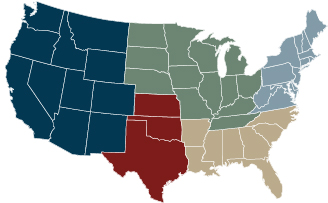
Angus Advisor: Southern Great Plains
Our team of Angus advisors offer regional tips for herd management.
April 14, 2026
Spring-calving herds
Producers throughout the Southern Great Plains have reported improved timed artificial insemination (AI) pregnancy rates in beef cows using the new 7 & 7 Synch protocol. This protocol was developed and tested by University of Missouri scientists. Compared to the long-standing five- and seven-day Co-Synch systems for timed AI, the new protocol requires one additional trip through the chute (four total). Details for the 7 & 7 Synch protocol are available at https://extension.missouri.edu/publications/g2023. Other established estrous synchronization protocols for beef heifers and beef cows can be found at https://beefrepro.org/arsbc/.
Consult your veterinarian about timing and product selection related to vaccination of cows prior to implementing an AI program.
If cattle must be moved to a different location after breeding, they should be transported within four days if possible. In the Southern Great Plains (SGP) region, heat stress is possible during mid to late-spring, especially during times of high humidity. Therefore, care must be taken to avoid compounding transportation stress with heat stress. In situations where animals will not be in transit for more than an hour, transportation during early daylight hours is advisable. Longer trips may require predawn or nighttime transportation.
Fewer females show signs of estrus during heat stress. For this reason, AI programs in the SGP region planned for mid to late-spring may benefit from using a timed AI protocol rather than estrous detection.
Substantial evidence suggests radical changes in diet and activity around the time of AI can reduce conception rates. A consistent, slightly positive plane of nutrition combined with minimal change in activity during the AI and post-AI period facilitates AI conception rate.
Similarly, it is advisable to adapt breeding bulls to pasture conditions prior to turnout with cows. Don’t forget to schedule breeding soundness exams with your veterinarian.
Fall-calving herds
Take the time to individually weigh and record hip height and body condition score (BCS) on your cows, and send data to the American Angus Association. This can be accomplished within 45 days of weaning if it isn’t convenient on weaning day. Some sires have the capability of producing progeny that excel at postweaning performance, carcass quality as well as daughters with moderate mature size. You can advance our ability to find these sires by submitting your cow weights and scores.
Determine your preferred timing for weaning, and inventory veterinary and feed/supplement supplies for the weaning program.
A coccidiostat is an important consideration in situations where calves will be concentrated in small pasures or drylots during the weaning period, especially on properties that have a history of coccidiosis.
General recommendations
Lush spring forage is generally concentrated in nutrients, including minerals, vitamins and vitamin precursors. Even so, spring grasses in the SGP are deficient in sodium. This leads to a healthy appetite for sources of salt during the spring and early-summer months. Salt and mineral intake usually declines substantially by midsummer, so be sure to keep out your salt/mineral supplement this spring so they have adequate tissue stores by the time their intake declines.
Along with sodium, forage phosphorus, copper and zinc are frequently marginal or deficient in the SGP region. This intensifies as grazing season progresses.
Obviously, forage mineral concentration can vary widely from pasture to pasture and ranch to ranch. Just recognize it isn’t difficult or expensive today to conduct a forage mineral survey on one or more of your pastures. Quite a few commercial vendors, veterinarians and extension specialists are capable and willing to assist you with this effort. From there, you can develop a logical and cost-effective mineral supplementation program for your operation.
by David Lalman
Oklahoma State University
david.lalman@okstate.edu

Topics: Animal Handling , Business , EPDs , Equipment / Facilities , Feedstuffs , Foot score , Genetics , Health , Management , Nutrition , Pasture and Forage , Record Keeping , Sire Evaluation , Reproduction
Publication: Angus Journal
Related Publication Articles


Current Angus Journal
Keep up on the latest stories of the people and programs in the breed.

Latest Podcast Episode
Don’t miss conversations with breeders and industry experts.