




ANGUS ADVISOR
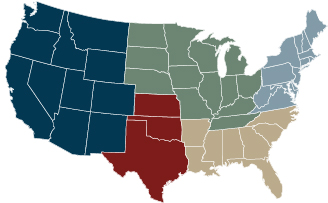
Angus Advisor Southern Great Plains
A regional glance.
July 28, 2025
Spring-calving herds
- Breeding bulls should be removed from the cow herd after a 45- to 65-day breeding season.
- Monitor consumption of free-choice mineral products. Intake frequently declines during mid- to late summer. If consumption falls significantly below recommended level, palatable products such as cottonseed meal, dried molasses, and dried distillers’ grains can be blended with the mineral.
- Remove fly tags once effectiveness declines to minimize buildup of resistance.
Fall-calving herds
- Weaned calves should be monitored frequently for development of lameness, respiratory disease, pinkeye and other health issues.
- Throughout the Southern Great Plains, forage protein concentration falls below the requirements for growing cattle during mid- to late summer. For this reason, 1 pound (lb.) of a high-protein supplement (such as Oklahoma Gold) can increase late-summer weight gain of weaned calves by about 0.6 lb. per day. Inclusion of a feed additive such as Bovatec® or Rumensin® is an important feature in this program. Both additives have been shown to reduce age at puberty and increase the percentage of heifers cycling by the beginning of the first breeding season.
- The protein supplement can be interval-fed. For example, if targeting an average consumption of 1 lb. per day and feed will be delivered three times per week, 2.33 lb. per head would be delivered at each feeding. When delivering a small-package supplement, interval feeding reduces variation in supplement consumption because more total supplement is fed per trip and timid animals have time to consume some of the feed.
- Select replacement heifers and determine which cows will be culled from the herd. Historically, cull-cow prices seasonally decline from July through November. Who knows what will happen this year?
General comments and recommendations
- Monitor water sources frequently to ensure adequate supply and water quality. Mature beef cows’ water consumption can vary from 8 to nearly 22 gallons per day. See AFS-3299 Estimating Water Requirements for Mature Beef Cows for more information.
- If moisture is abundant in Bermuda grass pastures and a split nitrogen (N) application strategy is being used, it may be time to apply an additional 40 to 60 lb. nitrogen per acre.
- Harvest sudan and sudan hybrids for hay in the boot stage (normally 4-5 feet in height). Before harvest, test the forage for nitrate concentration. More information can be found here: PSS-2903 Nitrate Toxicity in Livestock.
- Continue fly and tick control program. Sprays, rubs and feed-through products will need to be employed or continued if fly tags were removed.
Be prepared to test harvested forage, whether purchased or raised. A list of forage-testing laboratories certified through the National Forage Testing Association is available at www.foragetesting.org - Several herbicide treatment options are available to minimize spread of the invasive legume sericea lespedeza. A herbicide application prior to seed production (just prior to and during the flowering stage) during late-summer can be very effective.
- Similarly, blackberry bushes can be effectively controlled during late summer with a herbicide treatment immediately following fruit production/drop.
- Late-season prescribed burns suppress brush and keep sericea lespedeza from going to seed.
by David Lalman
Oklahoma State University
david.lalman@okstate.edu

Topics: Animal Handling , Business , EPDs , Equipment / Facilities , Feedstuffs , Foot score , Genetics , Health , Management , Nutrition , Pasture and Forage , Record Keeping , Sire Evaluation , Reproduction
Publication: Angus Journal
Related Publication Articles


Current Angus Journal
Keep up on the latest stories of the people and programs in the breed.

Latest Podcast Episode
Don’t miss conversations with breeders and industry experts.