


From Blue Crabs to Baling
Wye Angus intern has a summer of firsts.
April 8, 2026
If you want to teach, first you must do.
That’s the philosophy that Molly Lusk, North Carolina State University agriculture education student, took when she looked for hands-on farm or ranch experience to fill her summer.
“If I'm going to teach others about agriculture, I need to have that firsthand experience of ‘I've been there and I've done that,’” says Lusk, who grew up in a small town outside of Asheville, N.C., and got interested in agriculture through involvement in livestock judging.
While attending the Agriculture Future of America conference, she heard about the Talon Internship through the Angus Foundation and decided to apply.
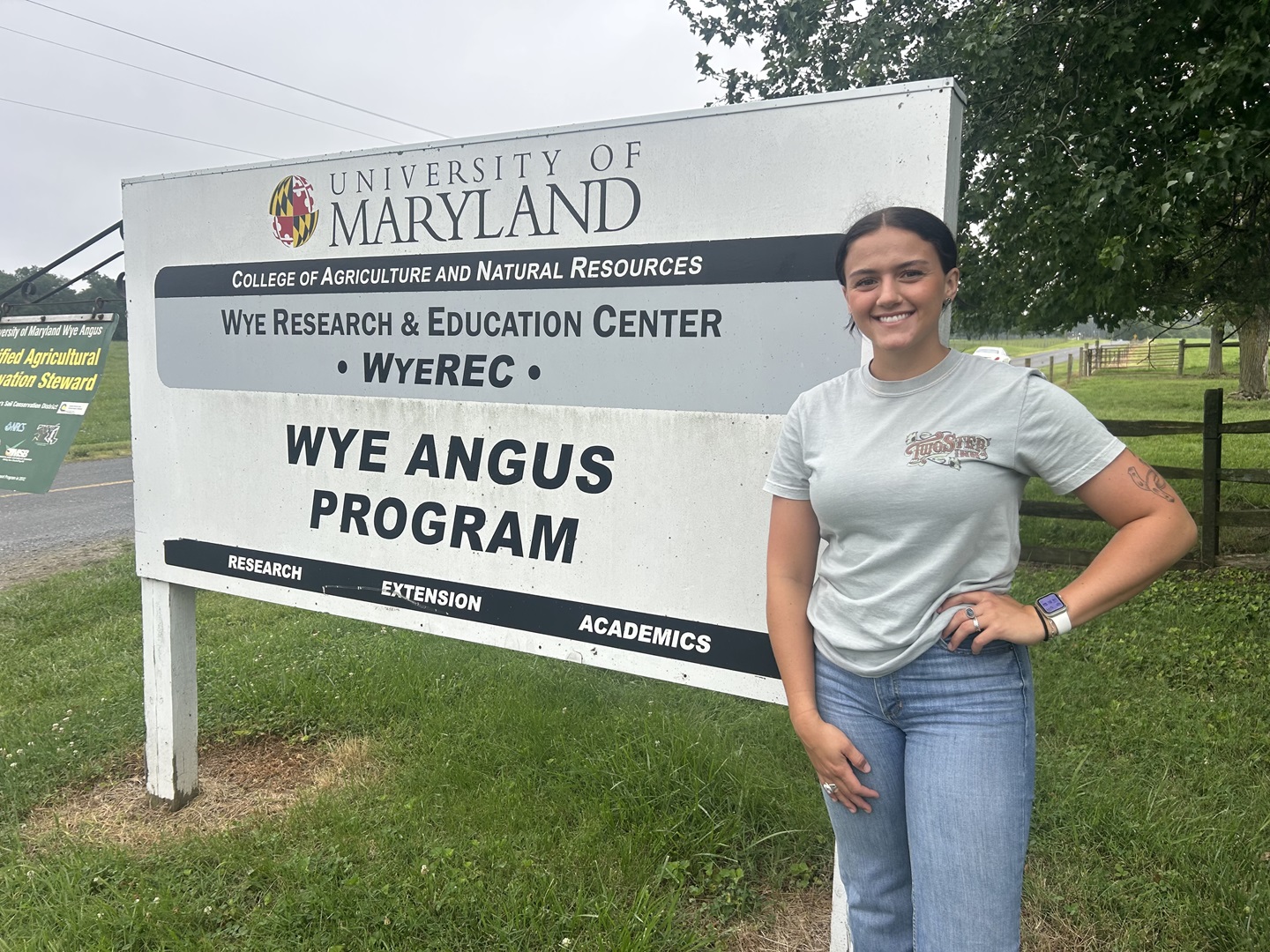

“I felt like I'm going to go do my student teaching and that's an experience that I know I'm going to have, but there might not be another opportunity to go work so hands-on and so closely with the actual livestock,” Lusk said.
She was matched with Wye Angus, a University of Maryland teaching farm with a purebred Angus herd, for summer of learning. Lusk and her hosts, Megan Stibbe and Heath McPherson, program managers at Wye, joined The Angus Conversation to talk about the experience.
“Molly was just eager to learn and willing to do anything,” Stibbe said. “It's fun to get out there and learn by doing, so [we said], “Let's just get her on the tractor, see what she can do.'"
EPISODE NAME: From Blue Crabs to Baling: Wye Angus Intern Has a Summer of Firsts
When ag education student Molly Lusk went looking for a hands-on experience to make her a more well-rounded ag teacher in the future, the Talon Internship Program through the Angus Foundation piqued her interest. The North Carolina native immersed herself in the Wye Angus crew, doing everything from heat detection and moving cattle to baling hay and gathering carcass data. The University of Maryland herd provided a unique backdrop for nontraditional education, while Molly brought new energy and a sense of curiosity to the work. Hear how the internship process works and what everyone took away from it.
HOSTS: Miranda Reiman and Mark McCully
GUEST: Molly Lusk, an agriculture education major at North Carolina State University, first got interested in agriculture growing up in a small town just outside of Asheville, N.C. In eighth grade she joined a livestock judging team, which evolved into her chosen major and decision to get hands-on farm experience to supplement her classroom learning.
Heath McPherson began his role as a program manager at Wye Angus in December. A former National Junior Angus Association board member, Heath says he’s a “self-proclaimed data nerd” and looks into seeing what they can build at the University of Maryland farm.
Megan Stibbe, Wye Angus program manager, has been with the University of Maryland since 2022 and the Angus farm since 2024. Megan grew up on a dairy farm, holds an ag business degree from what’s now Delaware Valley University and worked nearly two decades at an ag newspaper before her current role.
Related Reading:
2026 Angus Foundation Scholarships available
Miranda Reiman (00:02):
Welcome to the Angus Conversation. I'm your host, Miranda Reiman with my co-host, Mark McCully. And Mark, I'm coming to you sort of live from the Nebraska FFA Convention this week as I've got lots of kids running all over the place, competing in a few different events.
Mark McCully (00:19):
That's exciting stuff. Yeah.
Miranda Reiman (00:20):
Yeah, it is. And it's a good chance to see all the cool stuff that young people are doing in agriculture. And it reminds me a little bit of the Angus breed. We're pretty supportive of Angus youth going out with learning opportunities, whether that's support we give them financially or with some experiences that we expose them to. So we're kind of in that season. I have a senior this year, so I am really dialed into the word scholarships.
Mark McCully (00:46):
Scholarship. Yes. Yes.
Miranda Reiman (00:48):
With seven kids to get through college, that's a big word in our house right now. So thinking through the Angus Foundation and the scholarships that are offered through them, that's also, it's prime time that we talk about them.
Mark McCully (01:00):
They are coming up. Yeah, we've got some deadlines approaching. The deadlines vary a little bit, but I know a lot of them are May 1. We've got out on, I always would direct somebody out if they're interested out to our website and go to the Angus Foundation section of Angus.org. And there's the National Junior Angus Association scholarships, which are a bunch. We've got the Commercial Cattlemen Scholarship, which is maybe a little bit of an unknown scholarship that's out there. It's something that I know as we continue to be able to support those kids that maybe aren't as active, don't have the opportunity to be as active in the junior association, maybe in the show ring and some of those things, but are planning to come back into the cattle business. So being able to support some of those kids with some scholarships. We have some vo-tech scholarships, and there's actually a page that has just some other external scholarships and things that are out there maybe by individual states.
(01:56):
And so it's a nice all in one place that young folks that are pursuing their academic careers in vo-tech school and community college, four-year institutions, even some graduate opportunities, all made possible by the incredible generosity that we have in the Angus family through the support of the Foundation over the years.
Miranda Reiman (02:18):
Absolutely. So if you have kids yourself, go tell them to check it out, grandkids, customers or customers' kids, make sure
Mark McCully (02:25):
Customers, yeah. On the commercial scholarship, that's when I know we've really promoted that for our folks selling bulls, get that out to help us get the word out, because a lot of times we may be not connecting with that audience quite as much.
Miranda Reiman (02:39):
Absolutely. And then beyond just the scholarship funds that we supply, there's some other cool opportunities to get experience by doing. Of course, we say that oftentimes with our National Junior Angus programs that they can get involved with. But another opportunity that we maybe haven't shined a light on here on this podcast at all is the Talon Internship Program. And we got the chance to visit with some folks who have experience with that today.
Mark McCully (03:06):
Yeah, both host and student. And a handful of weeks ago, I had the opportunity to be a part of a symposium at the Midwest Animal Science meetings. It was talking about developing young people for the future careers in agriculture and specifically beef cattle production. And it was really fun to go talk about the Talon internship program. That was kind of one of the things I showcased that, talked a lot about what other breed associations are doing as well. But I really think the Talon internship is very unique. And it started back in 2009 with a incredibly generous gift by Cam Cooper and established what we know today as a program that really has a vision for finding young people in particular that really want to get some hands-on experience on farms and ranches. And again, we got some guests today that got to help us live through what, the summer that they experienced.
Miranda Reiman (04:03):
We get to go to a different part of the world that I don't believe that we have visited virtually on the podcast before. So listen in as we head to Maryland. Today on the podcast, we have some special guests who got to know each other really well last summer as participants in the Talon internship program, both a host operation and a young mind that was learning from them. So we have Heath McPherson, who's program manager at Wye Angus, along with Megan Stibbe, who's a program specialist there, along with the intern that they hosted at Wye with Molly Lusk. So thanks for joining us today on the podcast.
Heath McPherson (04:42):
Thanks for having us.
Molly Lusk (04:43):
Thank you.
Miranda Reiman (04:44):
So I guess maybe we'll start on the hosting side of it just to get a little bit of your guys' backstory. I don't know if I should start. I guess Megan, I'm going to start with you because this whole thing probably started with you. Give me first a little bit of who is Megan and what do you do there on the farm, and then we'll kind of go from there.
Megan Stibbe (05:03):
OK. So I started with the University of Maryland in 2022. I actually started out as a program assistant over at the Houghton Lab, one of our other offices here on what I would call our campus of Wye research here in Queenstown. And I accepted this position in September of 2024, so I'm still relatively new here. My background is I grew up on a Guernsey and Jersey dairy farm here in Queen Anne's County where Wye Angus is located. And I was very involved in 4-H and FFA. And then I went to college and got my agribusiness degree from Delaware Valley College. It's now Delaware Valley University in Doylestown, Pennsylvania. And I worked for a ag newspaper for almost 20 years before I came here. So I love agriculture.
Miranda Reiman (05:58):
You were kind of instrumental in helping to apply for the Talon intern to be hosted at Wye.
Megan Stibbe (06:04):
I helped with our previous program manager, Jeff Bricker. He's really the one that took control and started the application process, but unfortunately he passed away in April last year. So Henry, our herdsman, and I really took the lead on getting Molly here to us. And it was a little chaotic, I think, trying to get all the paperwork done. But yeah, once we got her here, I was like, "You're not allowed to leave."
Miranda Reiman (06:28):
Perfect. Love that. And then sitting next to you there in the office is Heath McPherson. And Heath, you actually joined after the internship program, but are here to kind of be the newest member of the Wye team.
Heath McPherson (06:41):
Yes. Yep. December 29th was my start day.
Miranda Reiman (06:45):
Yeah. And you have Angus in your blood, I understand.
Heath McPherson (06:49):
Absolutely.
Miranda Reiman (06:50):
So a former National Junior Angus Association board member and I guess fill me in on the rest of your background.
Mark McCully (06:57):
Also a native of North Carolina.
Heath McPherson (06:59):
Yeah. Yep. Also a native of North Carolina. I would've bought my first registered Angus cow-calf pair in '97. We had a commercial background prior to that and built a registered herd out of what we started with there. My dad and I, we got into the Angus business at the same time and here we are.
Miranda Reiman (07:22):
Excellent. And what are your responsibilities there in your new role?
Heath McPherson (07:25):
Basically just general oversight, driving the program as far as the breeding program, day-to-day of the health program.
Miranda Reiman (07:34):
Very good. All the things-
Mark McCully (07:35):
I think Heath, I read in a release maybe when you were hired, a self-proclaimed pedigree nerd. Was that maybe the description that you gave yourself or was given to you? I don't know what ...
Heath McPherson (07:47):
It's self-proclaimed. Yeah, but yes.
Megan Stibbe (07:50):
He's not lying.
Miranda Reiman (07:52):
I tend to find in my travels that anyone who is a true pedigree nerd is actually proud of it. That's a badge you'll wear.
Mark McCully (07:58):
Absolutely. Yeah.
Miranda Reiman (07:59):
Very good.
Mark McCully (08:00):
Has that been from when you were young, young, or is this something you've picked up along the way? My brother and I used to sit around when we were little kids and quiz each other on pedigrees. So I'm just curious how early it started for you.
Heath McPherson (08:14):
Yeah, pretty much from '97 on.
Miranda Reiman (08:18):
Pretty good. And Molly is joining us from her college location there, North Carolina State University. Ag education major. So tell us, give us your elevator speech, Molly.
Molly Lusk (08:29):
So I am from a small town outside of Asheville, North Carolina. So I grew up in the mountains, Western North Carolina. I don't have a direct relation growing up in agriculture, but I got really interested in eighth grade. I joined the livestock judging team and it honestly kind of just took off from there. Decided to come to NC State and pursue agriculture education so I could kind of give back to those like me who'd want to get involved, but don't come from a family farm.
Miranda Reiman (08:56):
Very good.
Mark McCully (08:57):
How did you come across the Talon internship? How did you learn about it? Was it somebody you knew or did you just find it online?
Molly Lusk (09:04):
So I was able to go to the Agriculture Future of America Conference, which is in Kansas City every November. So I've been going since my freshman year. My sophomore year, I went up to the Angus booth and just kind of started talking to the representative there and they told me about the internship and that I should apply and I just kind of decided to go for it after that.
Miranda Reiman (09:25):
I love to hear that those kind of connections are alive and well. I've got AFA in my background and was pretty instrumental in my career too, so that's really neat.
Mark McCully (09:35):
And I know for maybe not everyone is familiar with the Talon internship. It's such an amazing program to me. It really all stems from the generosity and the vision of Cam Cooper, and many know that name. Years ago, Cam really had a vision to find young people interested in learning about really all parts of running a ranch and running a farm. And she made an incredibly generous donation to the Angus Foundation to establish this internship program. And I think it's just such a unique opportunity to position ... Internships are not necessarily a new thing, but to really have this organized and structured system that supports both the employer, these are paid internships, and we've just been so blessed to have her generosity support this opportunity. And so today we've got internships in place really across the country, I would say kind of coast to coast, border to border kind of thing.
(10:38):
And being able to match, Molly, your desires to learn more about what goes on and get some really, real-world experience and to team that up with a farm. And especially I think something very unique in that Wye, you guys are kind of built for research and built for teaching and things. So I think what an amazing opportunity to come together.
Miranda Reiman (10:59):
I was just thinking that, that it was pretty cool that you're an ag education major and then you get to go see a teaching herd and probably got to experience maybe some things that you wouldn't have gotten to if you were out in the Sandhills of Nebraska, say, in my part of the world.
Speaker 1 (11:14):
Yeah, there was some cool opportunities. We got to go to the extension part of what Wye Angus is involved in, got to see that a few times. So that was cool for me, kind of related to my background.
Miranda Reiman (11:25):
Yeah. Maybe before we really jump into the internship part, you guys could maybe tell us a little bit about that herd there at Wye and what makes you different than typical Angus farm or maybe even a typical Angus farm at a university. So give us some background on that.
Heath McPherson (11:42):
Sure thing. So the herds more or less started with a purchase of 10 registered Angus heifers in 1938. They were all half sisters. And later there was another purchase of eight that came from Bennett Point as well, but those were brought in from Oklahoma. So those were the original 18. We have 11 existing cow families today stemming from those 18 females throughout the mid '50s. We got into Scottish importation, got into importing bulls out of the British isles. Prior to that, they had ran straight Scottish bred, basically straight Scottish bred sires that had been brought into the United States and then actively imported from there. Mid '60s, we closed the herd to outside genetics. And from there, we've been a closed herd. In 1978, the herd was dispersed and in that dispersal, that created the funds for the University of Maryland Foundation, which was part of the gift to the University of Maryland to have the University of Maryland manage the herd from their own.
(13:03):
And we would've acquired the genetics from there as well.
Mark McCully (13:06):
I know many would know the Wye program and know the ... Again, there's such unique genetics and you really preserve those genetics being a closed herd over time. If my history, if I remember correctly, if you think about the cattle during the type change back through the late '60s and early '70s, I'm pretty sure that it was really kind of the Wye genetics and some of those Scottish imported genetics were pretty fundamental in increasing frame size and increasing growth potential and really performance driven. We maybe tend to think of Wye cattle today is a little more on the moderate side of things and a little lower input, but through the late '60s, early '70s, I think you were really type changers and those genetics were so important of kind of moving us away from the belt buckle cattle to maybe more of the cattle we know today.
Heath McPherson (13:57):
Absolutely. The original herd manager here, Jim Lingle, came from a Guernsey background as well, a dairy background, and he really did believe in selecting some cattle with some more scale, some more size to them. He thought that would be more commercially viable at a time when that probably wasn't a popular idea. So 30 years of breeding to become a overnight success and the type change.
Mark McCully (14:25):
Yeah. And you still run a bull test there, is that correct?
Heath McPherson (14:28):
That's right. Yep.
Miranda Reiman (14:30):
And you guys are getting ready for a bull or a production sale?
Heath McPherson (14:34):
Yes. Yep. April 4th.
Miranda Reiman (14:36):
I believe this may air right after that, but I probably should recognize the fact that I pulled you guys together after hours, like week and a half ...
Mark McCully (14:45):
days before a sale.
Miranda Reiman (14:47):
Days before your production sale. That's right. Gold stars all the way around.
Heath McPherson (14:51):
Megan gives me a hard time that I never leave anyway.
Megan Stibbe (14:54):
Yeah.
Miranda Reiman (14:56):
Very good. Well, that probably also helps illustrate a little bit where you fell into the production calendar there, Molly, and how that internship ... I mean, you would've come in beginning of June, late May. I guess walk us through your
Molly Lusk (15:09):
Internship a little bit. It was probably mid-May, I want to say is when I started. And at the time, I remember my first day, we were really looking to see what was in heat, what was being bred. We would go out every morning and check the groups and just see what was going on. And then there were some young calves just based off the breeding season and everything, but most of the summer was the beginning was just checking, see what was in heat. And then we were also, there were some steers that they were kind of growing at the same time too.
Miranda Reiman (15:44):
Very good. And Megan, I guess at the start of that internship, what did you guys do to prepare to say, "Hey, this list of tasks that we're going to have for Molly, or let's get her here and see what she's comfortable with. " How did you prepare to host?
Megan Stibbe (15:59):
I think at the beginning, well, with me being new, Molly and Megan, the other gal that we had hired, they were my first interns. So I feel like they really set the bar high, but I also am very impartial to them. I just adored them so much. They were such hard workers and it was so hot last summer. But yeah, I think the girls would come in at 6:00 with the guys and they would just get their day started. I think they probably had a little meeting every morning, I think maybe around the kitchen table or-
Molly Lusk (16:28):
We had some coffee meetings in the morning. Yeah, we would just sit and chat over a cup of coffee.
Megan Stibbe (16:33):
Yeah, and kind of talk about what the day is going to look like and kind of divvy out tasks that way. And the guys that work here, they're just so wonderful too. I mean, they just kind of know what needs to be done. I feel like there's probably not a lot of instruction that needs to be given because I know that everybody here has been here for years, so it's just that time of the year, this is what we need to do kind of thing.
Mark McCully (16:56):
Do you have some research projects going on given it is a university owned? Are there some research projects going on through the summer?
Heath McPherson (17:05):
We are doing a research project with Dr. Shao where we are taking blood on neonates. That's immunology study there.
Miranda Reiman (17:16):
And with that, we're going to take a quick timeout for this word from Angus Media.
Speaker 1 (17:21):
Are you ready to level up your herd's genetics? With the Angus Bull Book Spring 2026 Angus Sire Directory, you can find your next great sire. The spring issue went live in March, but you're able to view the book online all breeding season. Live EPDs will help you pair the right bull with your breeding objectives. Search for the Angus Bull Book Spring 2026 Angus Sire Directory on the sale book search page on Angus.org.
Mark McCully (17:48):
I know in the past you've done some maybe some grass finished forest-based finishing type thing. So I was curious if-
Miranda Reiman (17:58):
Molly's got some added tasks.
Mark McCully (17:59):
Yeah. Some unique perspective of seeing some on- farm research type of things going on. That's not every internship gets to see that kind of thing.
Heath McPherson (18:07):
Yeah, maybe Molly can speak more to that experience of what she was involved in.
Molly Lusk (18:12):
Yeah. So I know there was a group of steers that were being finished on grain, and then there were some also on pasture. And then once they had been slaughtered, we went and we got to look at the carcasses and see the difference in ribeye size, what the fat looked like, how much fat was there on the carcass. So that I would say was the research that was being done then with the steers. Yeah.
Miranda Reiman (18:38):
So did they make you collect carcass data like get up at four in the morning and go stand in the cooler?
Molly Lusk (18:44):
Well, I did actually do that, yes. I guess it was in Baltimore. So we got up, it was literally 4:00 AM and we rode over there really early and stood in the freezing cold and looked at everything, but it was really cool.
Miranda Reiman (18:57):
Yeah. That's not hazing. It's just part of the job, I guess.
Molly Lusk (19:02):
I had the option to go and I chose to go.
Mark McCully (19:05):
Good for you.
Miranda Reiman (19:07):
Very good.
Heath McPherson (19:07):
And did you go with Racheal Slattery, the beef extension specialist?
Molly Lusk (19:12):
Yes.
Megan Stibbe (19:13):
Yeah, it was great. Racheal really took her time and went through each of the animals that we had hanging and kind of showed the difference in quality and what she was looking at to grade them. So I think our interns really enjoyed that and got to hopefully learn a little bit from that part.
Heath McPherson (19:31):
Did you guys look at carcasses at Rosetta's as well, or just the Wye carcasses?
Megan Stibbe (19:36):
We did look at some of the Rosetta just to compare.
Molly Lusk (19:40):
Yeah, we did a little comparison just between the two.
Miranda Reiman (19:43):
Very fun. So talk maybe about some of your favorite tasks that you got to complete as an intern. What were the things that you thought, "Man, I'm sure glad I said yes to this experience."
Mark McCully (19:54):
Besides the 4:00 AM to go to the packing plant.
Miranda Reiman (19:56):
Right,
Molly Lusk (19:57):
Right. Yeah.
(19:59):
I feel like overall, just getting to go out every day and look at the cows and just kind of ... I mean, we were seeing if groups needed to be moved based on how much forage was there. I really enjoyed that because you're looking at them every day. I learned how to evaluate certain things, whether it was like, oh, one's limping or something like that, something could be wrong or knowing when to move them. So I liked that task a lot. We did that every day. So other than that, I really liked ... They kind of threw me in, but they taught me the process of how we make hay and all of that. So by the first week I was raking, I was tedding hay and I got to roll my first bale there at Wye. So that was really special experience for me.
Mark McCully (20:47):
Were you a tractor driver before you showed up?
Molly Lusk (20:50):
A little bit. I interned on a dairy farm the previous summer, so I had done a little bit, but I will say I spent many hours in a tractor, which was fine with me because I had some AC, but I spent many hours at a tractor last summer.
Megan Stibbe (21:03):
And Molly's made our wall of fame with her bale. Yeah, we took a picture of her and she's on the refrigerator.
Miranda Reiman (21:11):
I am kind of chuckling a little bit inside that you see that as a favorite thing that you did because most people that grew up on farms, the hayfield is not the favorite part of their experience. Yeah,
Molly Lusk (21:24):
I could see that. Yeah. I'm sure
Miranda Reiman (21:26):
That's helping us look at it with new appreciation for the task, Molly. Yeah.
Mark McCully (21:31):
But with air conditioned cabs, sometimes there's worse places.
Molly Lusk (21:34):
It wasn't too bad.
Miranda Reiman (21:35):
Yeah, that is absolutely true. And depending if you're not having to make small square bales or something silly like that. So yeah, very good. Talk a little bit about the experience. When you first started, were you paired up and kind of job shadowing someone, and then did you get to move to independent tasks on your own as the summer went on or did they just throw you to it right from the start?
Molly Lusk (22:01):
A little bit of both. I feel like my first few days I rode a lot with Henry, and that was when he was telling me about when you're looking at the group, you want to look for this, see if you need to move them, or this is what you want to look for, you know this cow's in heat, we want to write that down and monitor that so you can get a breeding date and everything. So for that kind of thing, I was with him for probably the first two weeks. And then I was with the other guys learning how to do things on the tractor or we bushhogged a lot, so that was kind of one of my main tasks. But the first week I was paired up with any of the guys really who had time to go out with me. And then after that, they were like, "Are you comfortable?" And I was like, "Yeah, I guess." And they said, "All right, you got it."
(22:51):
They just kind of said, "You go do it. If you have any questions, come find me."
Megan Stibbe (22:57):
I was going to say, in the past with interns, I've heard the guy say sometimes you can tell their comfort level and you can assign tasks based on that, but Molly was just eager to learn and willing to do anything. So we were like, "It's fun to get out there and learn by doing, so let's just let her on the tractor, see what she can do. " And she impressed everybody.
Miranda Reiman (23:21):
The list just kept getting longer as the summer went on.
Molly Lusk (23:24):
Yes.
Mark McCully (23:27):
So Megan, do you guys normally have interns? So having an intern, was this a kind of a new experience or have you typically had interns there at the farm?
Megan Stibbe (23:37):
No, I think they've had interns usually every summer, they've hired before from University of Maryland. We've hired outside of university. It just depends on what the applicant pool looked like, where they were able to source interns from. I think the free housing that we have is really enticing because it would be hard to find a place to live for just a few months. Yeah, we've been very, very fortunate to be able to have interns during the summer. And then we have a winter internship too, which we have two girls this year working ... They'll be finished in, I think, early May. But yeah, we've been very fortunate to be able to have interns and kind of give them a very in- depth lesson on what goes on here and maybe give them some extra skills that they didn't have before they came here.
Miranda Reiman (24:27):
And talk about what having an intern does, I guess for you guys at the farm, for your dynamic, having some young blood, new people on the team, that kind of thing.
Megan Stibbe (24:37):
Well, I'm the only girl here, so I love having other females in the office.
Miranda Reiman (24:43):
That will definitely change it. Yes, for sure.
Megan Stibbe (24:46):
But it's nice because day-to-day, the work can get really tedious. And I think that allows ... When we have interns, it allows the guys to look at some of the bigger picture stuff that needs to be done. It really gave Henry some time last year to focus on bigger projects that he was trying to work on and figure out what he needed to buy and what needed to happen in order to get a field ready or just special projects that he wanted to look at and plan for.
Heath McPherson (25:19):
And I think that the teaching aspects as well gets you inside your own head of why do we do this? I mean, so it's great from a perspective standpoint as well.
Mark McCully (25:32):
That's where I was going to go, Heath. I think when you contrast summer help versus an internship, there's just a different mindset. Summer help is I need to get on the weed eater and run the weed eater all summer versus an intern is, again, that element of teaching while you go, which probably does at times if there's good questions from the intern, why do we do this? Sometimes, well, maybe that's the way we've always done it, or it does. It probably creates some good discussion. Yeah.
Heath McPherson (26:03):
The teaching aspect of it is important to us here just from the standpoint of we want it to be something that gives them experience, that gives them a culture of associating Wye with a positive experience because you guys know as well as I do that marketing doesn't start with just advertising. I mean, it's a perception. So I mean, we're hoping to train up interns to go out and be disciples to the rest of the world of telling them the good word of Wye.
Miranda Reiman (26:38):
Well, and I always think that when we have young people around, it's just sort of this infusion of new energy. It gets you back to being curious about things and being excited about things. I just joked about the making hay there, Molly, but being excited about things that maybe you thought were just kind of mundane tasks and things like that. So we always love it when we have a summer internship on our team in the office and we just ... It's fun to have people with ... And they also bring new ideas.
Mark McCully (27:05):
Absolutely.
Miranda Reiman (27:06):
That's always kind of fun too. So what were some of the biggest challenges over the course of the summer? It sounds like heat was one of them. Megan, you mentioned that.
Megan Stibbe (27:14):
Yeah. I mean, on the Eastern Shore of Maryland, it can be very hot and very humid, and we're right by the Wye River. So that just adds a whole level of, we call it being close around here. It's just, the heat is oppressive. I guess I should say the humidity is oppressive. We had some rainy days. I felt like it was kind of like, "What are we going to do? " So we would clean or organize or try to do something like that. We wanted the girls to have their full hours for the week, so we kind of would just try to find some tasks. Yeah, there was a little bit of that. We had some rain this summer. Well, that's a good thing, right? I mean, that's not a bad thing.
Miranda Reiman (28:01):
Molly, given that you don't come with the Angus background, did you ever have any of the, I guess, classic imposter syndrome kind of, "I don't know if I can do this? " Or did you come into the internship like, "Hey, I'm equipped to handle this."
Molly Lusk (28:14):
I think there were definitely a few moments where I was like, this is a lot, especially talking to Henry about the pedigree and the history and all of the genetics. I'm like, This is a totally new world to me. But I do think I had a decent skillset coming in as far as physically being able to do things. Because I worked on the dairy farm, I was able to run machinery or things that needed to be done. I can definitely have the ability to go out and do it. But the background and the interest that people have and the value in genetics was totally just so new to me.
Miranda Reiman (28:52):
Right.
Megan Stibbe (28:52):
I know the guys were impressed with your ability to work a headchute.
Molly Lusk (28:56):
Oh yeah. That's
Miranda Reiman (28:58):
An important skill to have.
Molly Lusk (29:00):
Yes.
Miranda Reiman (29:01):
Why did you decide to apply for such a production heavy internship with ag education? You could go marketing, communications. I mean, you could go a lot of ways. Why did you think it was important to get some production experience?
Molly Lusk (29:16):
Well, I've always said I one day would love to start a small herd where I'm from, it's like an average 30, 45 head. So one day I want to be able to do that, but I also felt like if I'm going to teach others about agriculture, I need to have that first world, firsthand experience of, I've been there and I've done that and I've seen it done. And so I feel like if you've been there and lived it, you can help other people understand it better. So I think it was important for me, I felt like I'm going to go do my student teaching and that's an experience that I know I'm going to have, but there might not be another opportunity to go work so hands-on and so closely with the actual livestock.
Mark McCully (29:58):
Did the experience make you, did it, I guess, further commit you to that career path that you had chosen or did it make you go, "Oh, maybe I want to go do this running cows thing?" What was the impact on your career path?
Molly Lusk (30:14):
I feel like that's just a battle I go through every day. I'm like, "What am I going to do?" I don't know. I would love to run cows for sure. That sounds amazing, but I think I also want to be in a role where I can help other people. So I don't know if being in the classroom is doing that or who knows where I'm going to end up, but something with livestock, hopefully.
Miranda Reiman (30:35):
So if you are in a classroom in 10 years from now, is there a moment or a day or a story that you'll be retelling from this summer still in a decade in your classroom? She just laughed for perspective. She just smiled when I asked that question.
Molly Lusk (30:51):
I'll start with a funny one, I guess. I don't eat a lot of seafood. I feel like Megan's going to know exactly what I'm talking about right now. I'm a crab legs only. That's, maybe some shrimp. And one day they were like, let's buy a bunch of, what is it, steamed blue crabs?
Megan Stibbe (31:09):
Yeah.
Molly Lusk (31:09):
Is what we had. Yeah. So that was just completely foreign to me. And they were all so excited. I mean, so excited about lunch that day. And I came in and I just was like, oh my goodness, this is a whole new world. I don't eat this. So I did my best to like it, but I can say I was not a fan. But that's just a funny story that I always think about. And then another one I would say is what felt like the hottest week of the summer, we built the longest fence. It felt like it was just miles and miles. I mean, we stapled, it was five strands of high tensile, and we did it all by hand. And that was just definitely ...
Megan Stibbe (31:54):
Was that the week that our air conditioning went out in the office?
Molly Lusk (31:56):
Yes. It was the same...
Megan Stibbe (31:58):
We went and got ice cream that day for lunch.
Molly Lusk (31:59):
Yeah, we did.
Miranda Reiman (32:02):
That right there would be in the category of challenges from the summer.
Molly Lusk (32:07):
Yes.
Mark McCully (32:08):
And the blue crab would be the new experiences, right?
Molly Lusk (32:12):
Absolutely.
Mark McCully (32:12):
Expanded horizons. Is blue crab the ones where you got to take the hammer and you ...
Miranda Reiman (32:17):
Yeah, it's a lot of work for lunch
Mark McCully (32:19):
...for a little bit of meat.
Miranda Reiman (32:20):
That is a lot of work for lunch. Give me a hamburger.
Megan Stibbe (32:24):
Well, it's such just a Maryland staple. If you see crab cakes on the menu, it usually says Maryland style or Eastern Shore style if they really want to get down into the nitty gritty. So Molly not being from here, we were like, let's get some crabs so she can experience some authentic. And she's like, " I might have a crab cake, but I don't think I'm ever going to eat crabs again."
Molly Lusk (32:48):
No, crab dip, crab cakes. I mean, I'm all for it, but that's about it.
Megan Stibbe (32:53):
That was funny. Because you were like, uh-uh, not having it.
Miranda Reiman (32:58):
That's really good. I like that chance though to experience even, I mean, you didn't go that far from home, but kind of a different region, a different culture. And was there anything else you learned about agriculture in that region or that state where they do things different than maybe what you'd seen around home?
Molly Lusk (33:17):
I will say it's much flatter, obviously, which I live in Raleigh area now, so it's flatter here, but I didn't realize just the soybean fields and how there's just a lot of that. And driving down the road here, I don't really see that. So that was different. And then we went to the Maryland Commodity Classic. So learned a lot about just the state's agriculture there and how diverse is. I didn't realize that there was that much in the state.
Megan Stibbe (33:49):
I remember one of the sessions that we sat in on was a soils class taught by Nicole Fiorellino and you were like, she's teaching a lot of the stuff I just learned or she's talking about a lot of the stuff I just learned in my soils classes last semester. So that was kind of funny.
Molly Lusk (34:05):
Yeah.
Miranda Reiman (34:06):
That's always fun to see the classroom learning out in the wild too. This is actually important stuff that I've just taken a semester to learn. Yeah.
Mark McCully (34:14):
Well, Maryland is a fascinating state. I mean, there is a lot of agriculture in the state of Maryland. And I think probably for many of our listeners that are in more of the Midwest or West, they probably are chuckling when you say how flat it is versus maybe some of the country they're on, right? But probably tend to think of Maryland. They tend to maybe think of Baltimore or maybe they tend to think of large metro areas, but there is a lot of agriculture, very rich history of agriculture in the state of Maryland.
Megan Stibbe (34:42):
Yeah. One of the things they say about Maryland is it's like America's miniature. I mean, we have Garrett out in Garrett in Allegheny County. We have mountains and then we have the Eastern shore, we have Ocean City, so we have ... at the water and a lot in between.
Miranda Reiman (34:59):
That's really cool. And with that, we're going to take a quick timeout for this word from Angus Media.
Speaker 2 (35:05):
A solid herd starts with the cows. Commercial cattlemen need to know that your foundation is built on maternal traits. Tell them in the Female Foundations special section published with the September Angus Beef Bulletin, which will reach more than 137,000 readers. Get an advertisement, an article about your herd and a social post all in one. Reserve your spot by June 1st. Call your regional manager or call us in the office at 816-383-5200 to learn more.
Miranda Reiman (35:40):
So as you guys think about your experience and maybe others listening to this podcast that have seen the Talon internship program and thought, I don't know, is that for me? Maybe we'll start from the hosting standpoint. Do you have any tips, tricks, advice, anything to tell people who might want to apply to host and intern?
Megan Stibbe (35:59):
Go for it. We really didn't have any expectations because it was unknown for us, but we were thrilled with the intern that you supplied us with Molly because you guys kind of picked which interns go where and we couldn't have been happier. I felt like Molly was so suited for us. We got along really well. Hopefully she learned a lot. We had some fun while she was here. We do try to tailor the internship around what they are interested in. So Molly was interested in ag education and we did try to do some things that she hopefully found interesting. She got to attend. We went to a state fair. We went to Delaware State Fair last summer, so we got to watch a beef show over there and we went to the Commodity Classic. So yeah, I mean, we want to make sure that they're enjoying themselves while they're here.
(36:51):
It's not just to quote unquote work with their internship, but that they're hopefully gaining contacts or networks outside of just us.
Mark McCully (37:03):
And you say you have housing on the farm. Is that part of the-
Megan Stibbe (37:07):
We do. We are very, very fortunate to have housing here.
Mark McCully (37:10):
I know sometimes that can be a little bit of a stumbling block on internships of if there's not a housing element or a wing of the house or a bunkhouse or something in relatively close. It sounds like you guys are really fortunate in that regard.
Megan Stibbe (37:25):
Yes, we are. We are very fortunate.
Miranda Reiman (37:28):
So Molly, from your standpoint, if you were going to talk to other college students who are maybe considering it, what do you got for them?
Molly Lusk (37:37):
Yeah, I would say going into it, also I just had no expectations because there's, I want to say, three rounds of interviews that take place before you ever find out where you're possibly going. So you have no idea. I will say I didn't know Maryland was even an option. I thought it would be somewhere Nebraska or something, just something like that. So then when I found out, it was like, okay, that's not what I was expecting, but that's really cool. I'm going to learn about somewhere I've never been. I have no idea anything about the state. So that was really cool. And then I would also say just really dive into it and do everything. If they ask you if you want to do something, just why not try it? They're there to teach you and help you. And I will also say that there has been way more connections made even here back at home from Wye Angus that I had no idea about.
(38:32):
I was talking to some people this morning back home and they raised Wye cattle and I had no idea. So you never know what connections you're going to make, so just take every opportunity.
Heath McPherson (38:42):
Yeah, you're pretty close to two pretty big hitters there, there at Mars Hill and Claremont.
Molly Lusk (38:48):
Yep. I had no idea. Yeah.
Miranda Reiman (38:51):
So I'm sort of feeling like that if you get to have your cow herd someday, has this solidified your choice to run Angus cattle?
Molly Lusk (38:59):
Yeah. Yes.
Miranda Reiman (39:01):
I have to say yes, but I'm kind of guessing-
Heath McPherson (39:03):
Wye cattle?
Miranda Reiman (39:04):
That's right. Very specifically. Yeah.
Molly Lusk (39:08):
Yeah.
Megan Stibbe (39:10):
I was going to say, Molly, how good are those Wye burgers?
Molly Lusk (39:12):
They were so good. We had those for lunch quite a few days and they were really good.
Mark McCully (39:18):
Better than the blue crab?
Molly Lusk (39:18):
Way better. Yeah. I can't ...
Mark McCully (39:23):
No, that's awesome.
Miranda Reiman (39:24):
So upon returning back to school then, Molly, has your opportunity this summer shaped the way you approach anything back at campus, your classes that you've been taking or anything like that?
Molly Lusk (39:39):
I think there's just been a lot of what I learned there has translated even more into what I'm learning here. So when I was at Wye, there was a lot of rotational grazing was very big, like I was talking about earlier. So then when I came back here and I take a pasture management class, it's like, "Oh, I've done that. I've seen that." So that relates a lot. But also just, I was there by myself and so I feel like it was a challenge, but it kind of changed me and changed the way I approach things. So now I feel like I go at everything assignments and just classes in general with a more open mind and more like, this could lead somewhere that I wasn't expecting.
Miranda Reiman (40:20):
Absolutely. I understand that you guys there at Wye had inquired kind of almost immediately about how do we get another intern for the next year? So is this something that you want to continue to pursue as the opportunity is available?
Heath McPherson (40:37):
Absolutely.
Megan Stibbe (40:37):
Yeah, certainly.
Miranda Reiman (40:39):
Yeah. So I guess that kind of speaks for itself again to other Angus ranches that are maybe if you're listening to this and wondering if it's worth the paperwork and the kind of unknowns of who you might get and some of those kind of things you guys are given it a vote of confidence.
Megan Stibbe (40:54):
Molly was wonderful. Like I said before, she had such a strong work ethic and she was willing to try anything. There wasn't anything where she was like, "Oh, I don't want to do that." I mean, she might not have had a smile on her face or beaming smile, but she was definitely willing to take it on. I mean, she was not shy for any hard work.
Miranda Reiman (41:14):
Very good.
Mark McCully (41:15):
That's awesome. Very good. Well, I think both of you guys as a host and Molly, you as an intern embody what Cam would be very proud of as she would look at what I think was her vision for making connections and giving, providing a great experience. And you mentioned that interview process. I mean, I do think as the program has grown, we're always looking for host ranches and farms, and of course we're getting more as the word has gotten out on this program, we have gotten more and more applicants. So Molly, yes, there was a bit of a rigor that you had to go through, but part of that was also to make sure that there was a good match. It wasn't so much of ... It was making sure that the intern's interest and the host could provide that good match. And we have some hosts that would say, horseback is, we're going to spend 80% of the summer on horseback.
(42:13):
Okay, well, there's an obvious match. Let's make sure we probably don't send somebody that doesn't like horses, but just interests and kind of where they want to go. And so that's a lot of what that back and forth and that interview process is about and probably why there's some paperwork on the front end with the host ranches and farms, just trying to make sure we can make that match and that fit as good as possible. And sounds like this was a good one, good fit.
Miranda Reiman (42:39):
No, if you've ever been a listener of this podcast, you know that before we wrap up, I do a random question of the week. But before I get to that, is there anything that I haven't asked you guys about that you wanted to make sure that we tell the world about this internship experience? I
Megan Stibbe (42:54):
Think one of the things I would just like to mention is that we do offer internships, not just summer. We have a winter internship that starts early January that would run through the beginning of May. And that is really a big one for us too, because it covers the calving season and then the beginning of breeding season. So it's really very, very hands-on as well with being there to assist with calving and just everything in between.
Mark McCully (43:24):
And your sale, right? They would probably get us closer to your sale and the bull test and all those things. Yeah. Yeah.
Miranda Reiman (43:30):
Absolutely. Great point. Anybody else have anything to add?
Heath McPherson (43:35):
Well, I mean, we certainly want to continue to grow and develop our internship program and we certainly want to tailor the experience to the specific intern. We've talked about the things that we could do that maybe add some value to it. We've talked about doing a North American breeders tour. Our winter interns will get to see Vytelle come in and do an IVF flush of several cows here. We've had interest in one guy that wants to go into nutrition. So we talked about pairing him up with a nutritionist and some of those things. I know if Henry was on here, he gets excited about things and he would talk about how he would like to give further responsibility to interns to kind of do their own little project and how that fits in, how that can grow that individual and let them develop something of their own.
(44:34):
He was talking about letting them kind of develop a rotational grazing plan first without kind of prompting them and then walking through the process and kind of getting it to where it needs to be and then letting them implement the program. So we're certainly looking at anything that we can do to add value to the internship process.
Megan Stibbe (44:55):
And one thing that's pretty cool is Henry started out as an intern when he was at University of Maryland. So I mean, it turned into a full-time job for him. So he's kind of the epitome of ... We've been very fortunate to have wonderful interns and hire some of them back.
Miranda Reiman (45:14):
We love that. We do the same thing here at Angus and we're always pretty excited when we get to keep one of our really, really good interns.
Megan Stibbe (45:22):
I know. I'm always sad to see them go. You spend hours and hours a day with these interns and then they just leave one day and you're like, "Oh, I'm so lonely here."
Miranda Reiman (45:31):
I know. Although I do sort of feel like a little mother hen sometimes as I see them doing cool stuff all across the industry and somebody becomes a kind of household name in the industry and then you can say, "That was my intern." That was really cool.
Megan Stibbe (45:48):
I have to talk about Molly because she lived in the intern house by herself. Our other intern last summer was a local girl. So Molly started a business.
Molly Lusk (45:58):
I did. I silversmith now. That was kind of one of the things I started back last June, so it's kind of coming up on a year, but just taught myself how to do it one day. And yeah, it's kind of just from there.
Mark McCully (46:10):
Wow.
Megan Stibbe (46:10):
She makes beautiful jewelry.
Molly Lusk (46:11):
Thank you.
Miranda Reiman (46:13):
That is the definition of a go- getter. You're out working somewhere in the hot heat and cold coolers and you're going to start a business.
Molly Lusk (46:22):
Yeah.
Miranda Reiman (46:23):
You guys really hit the jackpot with her.
Mark McCully (46:26):
Good for you. Good for you.
Molly Lusk (46:28):
Thank you.
Miranda Reiman (46:28):
You. Well, to get to our random question of the week, I guess in the spirit of kind of new horizons and discovering new things, I want to know if you could take a road trip to somewhere new, where would you be going? Whoever wants to answer first, somewhere you haven't seen.
Mark McCully (46:46):
Can I go?
Miranda Reiman (46:47):
Sure. Yeah, you start.
Mark McCully (46:48):
I've never been to Maine, and I've always wanted to take a road trip up to Maine in the New England state, so it's on my bucket list.
Miranda Reiman (46:56):
I hate to say this, Mark, but that's a little bit also my answer. I wanted to go on our honeymoon. We wanted to go somewhere that we had never been and I wanted to go to the Northeast. And so I had picked Nantucket and then I looked at the price tag and that was way too much for, we got married in college. So instead we went to Mackinac Island in Michigan and to Niagara Falls, but we have not kept going up in your part of the world. So that's on my list. All right, somebody else got to go now.
Molly Lusk (47:24):
Me and my roommate actually are going on a long road trip when we graduate and we're going to hit every national park. So I guess I would say that's on the national bucket list. That's what I want to see is just every national park in the United States.
Miranda Reiman (47:34):
That is going to be a trip. I have been to-
Molly Lusk (47:38):
A long trip.
Miranda Reiman (47:40):
...maybe a third of them. At one point I thought, man, I'm going to have to do more than one vacation a year to get to all of them before I die. So that's impressive. I like that, Molly. Yeah.
Megan Stibbe (47:52):
We can check off Assateague.
Molly Lusk (47:55):
Yeah, that is true.
Megan Stibbe (47:58):
I think I would just love to see more of the Midwest. I feel like it's a flyover state for me. So I usually am going to the West Coast, further, but I would just love to see some of-
Miranda Reiman (48:12):
Nebraska.
Megan Stibbe (48:13):
Yeah. I mean, like the Corn Belt.
Mark McCully (48:15):
Missouri.
Miranda Reiman (48:17):
Love it.
Mark McCully (48:18):
Well, you're welcome both of our ... We will be tour guides for our parts of the world.
Miranda Reiman (48:23):
Absolutely.
Heath McPherson (48:25):
You bet. I would say Route 66, hitting up Arizona. I'm a photographer outside of being program manager here at Wye, so I enjoy that sort of thing.
Miranda Reiman (48:39):
Well, Molly will be right along that route, I guess, if she goes to all the state parks, because as you head in Grand Canyon and down in that area, you'll hit that up. So very good. Well, thank you guys so much for taking the time to jump on the podcast with us today and to share your experience and Wyes, to you guys for opening the door and Molly for saying yes to the experience. Yeah.
Mark McCully (49:04):
Thanks for joining guys.
Molly Lusk (49:06):
Yeah. Thank you.
Megan Stibbe (49:07):
Thanks for having us.
Miranda Reiman (49:09):
To keep tabs and upcoming opportunities, visit angus.org or subscribe to the AJ Daily by visiting Angusjournal.net. Things that you can either take note of yourself or share with those young people in your life. This has been the Angus Conversation, an Angus Journal podcast.
Related Publications


Current Angus Journal
Keep up on the latest stories of the people and programs in the breed.
Latest Podcast Episode
Don’t miss conversations with breeders and industry experts.