

BEHIND THE BRAND
Defining the Margins of Quality
Ranchers decisions help support customer demand.
July 22, 2026
Decisions made by Angus ranchers to target the Certified Angus Beef® (CAB) brand have fueled a carcass quality revolution, one that continues to support strong consumer demand. Since 2006, CAB has grown from 6% of all U.S. fed-cattle harvested to nearly 22.5% today.
In 2025, of the 15.35 million head of Angus-influenced cattle processed through licensed packing plants, 5.77 million met the brand’s 10 science-based specifications. This equates to a 37.6% acceptance rate — an all-time high,and 23.6 percentage points above the 25-year low of 14% in 2006.
Driven by genetic selection and improved management, carcass quality has advanced significantly — most notably through continued progress in marbling. Yet, with nearly two-thirds of Angus-type carcasses falling short of brand standards, understanding why is critical to balance the economic incentives of added weight against CAB product size and consistency requirements.
Where cattle miss the mark
Each year, CAB conducts a multipacker, seasonally weighted supply study evaluating nearly 2 million Angus-influenced carcasses. Results from the most recent analysis show the average CAB carcass achieves a Moderate²² marbling score, a 14.6-square inch (in.) ribeye, 0.65 in. of backfat, and a 923-pound (lb.) hot carcass weight (HCW). By comparison, non-qualifying carcasses are predictably lower in quality (Small⁷⁰ marbling) but larger in size — averaging 949 lb. with a 15.2-square-in. ribeye and 0.63 in. of backfat.
Given years of selection pressure and the genetic trend for increased marbling, one may assume further emphasis on marbling is not necessary. Yet, insufficient marbling remains the largest limiting factor, as 81.8% of carcasses fall short of CAB certification for not having enough marbling.
However, more than 24% of those carcasses were within 30 degrees of Modest marbling — showcasing an opportunity to move many carcasses from commodity Choice to CAB and capture additional carcass value.
Unlike marbling, which carries no upper threshold within CAB specifications, other traits must remain within limits. Among non-qualifying carcasses, 14.5% exceeded the 1,100-lb. weight threshold, 9.5% surpassed the 17.0-square-in. ribeye limit, and 9.8% failed for backfat beyond an inch — reinforcing that beyond certain points, more becomes disqualifying.
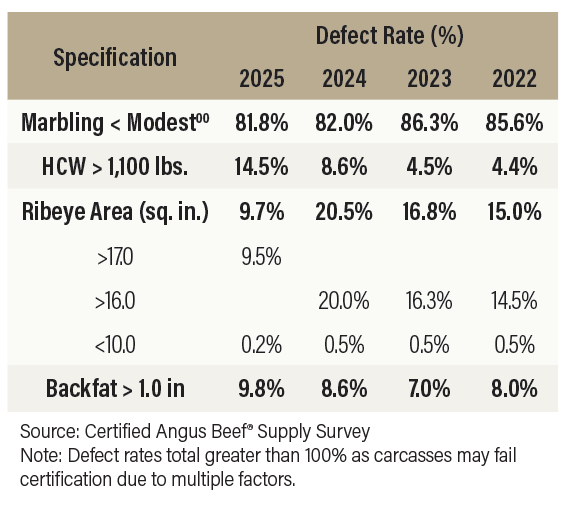
Table 1: Reasons Angus-influenced carcasses fail to certify

Informing brand decisions
These insights are critical to the brand. They allow for a deliberate balance to be established between protecting product consistency and the brand’s premium position, while also remaining producer-relevant amid evolving production and market realities. For instance, after remaining unchanged for 18 years, in 2025 it was decided to increase the ribeye area specification from 16.0 to 17.0 square in. as the rate for carcasses surpassing our upper limit reached 20.5% in 2024. Similarly, two adjustments to increase the HCW specification have been made since 2007.
These adjustments were based on insights examining why carcasses fall short and economic drivers surrounding those reasons.
The brand’s annual supply survey has clearly characterized CAB and non-qualifying carcasses and fueled the discipline to maintain and, on few rare but necessary occasions, adjust the brand’s stringent standards. As the industry continues to produce higher quality and heavier carcasses, these insights will only grow in importance — reinforcing CAB as the target and clarifying the margins for brand acceptance. Next month, we will discuss resources available to assist Angus producers in Targeting the Brand™.

John Stika, Certified Angus Beef

Topics: Member Center Featured News , Consumer
Publication: Angus Journal
Related Publication Articles


Current Angus Journal
Keep up on the latest stories of the people and programs in the breed.

Latest Podcast Episode
Don’t miss conversations with breeders and industry experts.