




DATA DIVE
Comparing Animals Across Breeds — The Right Way
When evaluating multiple breeds for a sire, simple calculations can bring clarity to sire selection.
March 19, 2026
Have you ever flipped through a sale book and wondered how to compare bulls from different breeds? The truth is you cannot make an apples-to-apples comparison using within-breed expected progeny difference (EPDs) at face value.
Each breed calculates EPDs within their own genetic evaluation, on its own base. So, the numbers that may look identical are not. An Angus +60 weaning weight (WW) EPD isn’t the same as a Simmental +60 or Hereford +60.
Applying across-breed EPD adjustments, calculated by the U.S. Meat Animal Research Center (USMARC), allows for a fair comparison.
Genetic selection
For decades, EPDs have fueled genetic progress. They are the most accurate genetic selection tools available because they combine the pedigree, phenotypes, progeny data and genomic information into one number for selection.
The American Angus Association EPDs on registered Angus cattle are supported by decades of data collection by members through the Angus Herd Improvement Records (AHIR®) program. The EPDs are backed by millions of data points and updated weekly.
Even so, EPDs are only comparable within the same breed. So how can a commercial cattleman know how a Hereford bull stacks up to an Angus bull? Or whether an Angus sire offers more growth than a Simmental bull?
Level the playing field
Since 1993, across-breed EPD adjustments from USMARC have allowed for a direct comparison of EPDs between breeds.
These adjustments are supported by more than 50 years of research through the Germplasm Evaluation (GPE) Program. The GPE program studies genetic differences among the most widely used beef breeds in the United States.
Each year, USMARC publishes updated adjustment factors for traits common across breeds, including growth and carcass measures. These factors allow producers to convert any breed’s EPDs onto an Angus base using simple math.
Applying the adjustment factor is simple
Across-breed EPD = within-breed EPD + adjustment factor
The full list of adjustments for each breed and traits can be found at www.angus.org/tools-resources/national-cattle-evaluation/across-breed-epd.
Applying the adjustment factors
When the adjustments are utilized, animals from differing breeds that may appear at first to be similar for genetic potential will show genetic differences. What might appear at first to be a lower birth weight bull from another breed, after the adjustment is applied, may be more comparable to a moderate birth weight Angus bull that has additional traits that also fit your breeding objectives.
Going back to the three bulls with the +60 WW EPDs, they have been included in Table 1, along with birth (BW) and yearling weight (YW) EPDs.
The three bulls appeared to have identical EPDs when looking at their respective within-breed EPDs.
Once the adjustments were applied, however, they were determined to have differed genetic merit for each of the traits. The Angus bull had the lowest BW EPD, and most growth for WW and YW.
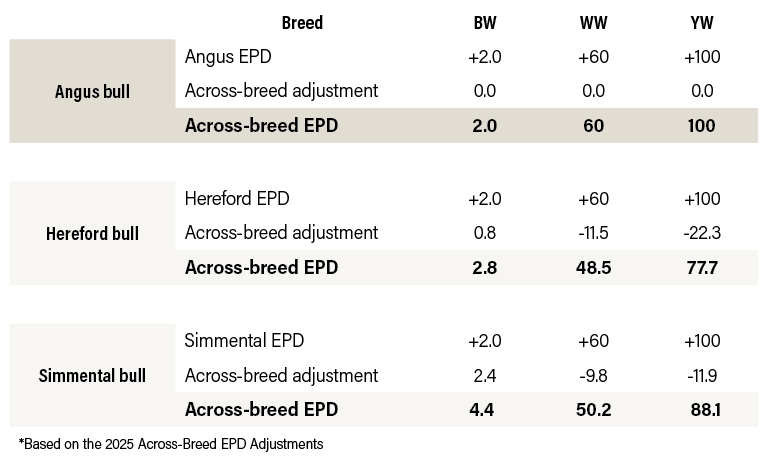
Table 1: Example of using across-breed adjustment factors to compare bulls from different breeds.

A tool for informed decisions
Across-breed EPD adjustments give producers a clearer way to compare sires from different breeds and make decisions with confidence. When animals are placed on the same base, it becomes easier to see which bull truly fits the goals of your operation. Often, even if an Angus sire doesn’t show the lightest birth weight or biggest numbers on the page, the adjusted values allow for a clearer picture of what each animal has to offer.
These tools help ensure your customers can select the bull that will work best for their environment, their cows and their long-term herd direction. Across-breed EPD adjustments give producers a clearer way to compare sires from different breeds and make decisions with confidence.

Esther Tarpoff, Director of Performance Programs

Topics: Member Center Featured News , Association News , EPDs , Genetics , Reproduction , Selection , Sire Evaluation
Publication: Angus Journal
Related Publication Articles


Current Angus Journal
Keep up on the latest stories of the people and programs in the breed.

Latest Podcast Episode
Don’t miss conversations with breeders and industry experts.