





MARKET ADVISOR
Market Advisor: November Update
Meat demand and competing livestock and meat prices.
November 20, 2025
“A rising tide lifts all boats” is a phrase attributed to speeches about the economy given by former U.S. President John F. Kennedy. It is a figure of speech associated with the idea that an improved economy will benefit all participants.
It also has been associated with prices of competing commodities. Economic theory suggests a high price for a commodity could increase demand, and therefore prices, for competing commodities due to the substitution effect. In other words, consumers could substitute lower priced substitutes for the higher priced commodity.
However, there are other determinants of demand such as tastes and preferences and incomes of consumers that affect prices. Supplies of individual competing commodities also affect prices.
That being said, let’s look at how competing livestock and meat prices have been doing compared to the record high cattle and beef prices.
Retail demand for beef, lamb, pork, chicken and turkey has been strong in 2025 and positively impacted by a number of factors including GLP-1, high protein and Keto diets.
Prices for cattle, hogs, lambs, turkeys and chickens (until recently) have been higher than last year.
Cattle and beef prices have been increasing cyclically since 2020 due to a declining beef cow herd reducing supply and strong demand. Prices reached record high levels in 2023 and have continued that pace through 2025.
USDA projects fed cattle prices to average a record $226 per hundredweight (cwt.) in 2025, with an increase to $246/cwt. in 2026. Calf and feeder cattle prices are at record levels buoyed by strong fed cattle prices, smaller supplies and moderating feed prices. Retail all fresh beef prices have risen to a record $9 per pound (lb.).
Hog prices have been fueled by strong domestic pork demand and shorter supplies. National base hog carcass prices are currently at $90/cwt. compared to $83 at this time last year.
USDA is forecasting pork production to decline 1% this year. The USDA Hogs and Pigs quarterly report issued Sept. 25 confirmed shorter supplies. Market hogs at 68.5 million head were down 1.3%.
Seasonal hog price weakness is expected for the rest of the year, but the lower supplies will likely support prices near last year’s levels.
Lamb prices are significantly above last year’s depressed prices. Fed lamb prices in the Northern Plains at $229/cwt. are $70/cwt. above the $159/cwt. seasonally low prices in 2024. Domestic lamb supplies are about equal to last year, lamb imports are running below last year, and cold storage stocks of lamb and mutton are down as well. That is supportive to lamb prices.
Chicken prices were above last year until mid-summer, but have declined from $1.37/lb. to $1.07/lb. The chicken industry has responded quickly to high prices and low feed costs with increased production. Increased chick placements, improved egg fertility rates, and additional slaughter have caused a 2% increase in 2025 production. That has pressured chicken prices and is causing new product introductions in the fast food sector to stimulate demand.
Whole hen turkey prices this year have steadily increased from about $0.90/lb.to $1.68/lb. Continuing Avian Influenza cases have caused about a 6% decline in 2025 turkey production, and frozen hen turkey inventories to be down about 2% from last year. That has supported prices which usually peak right before Thanksgiving
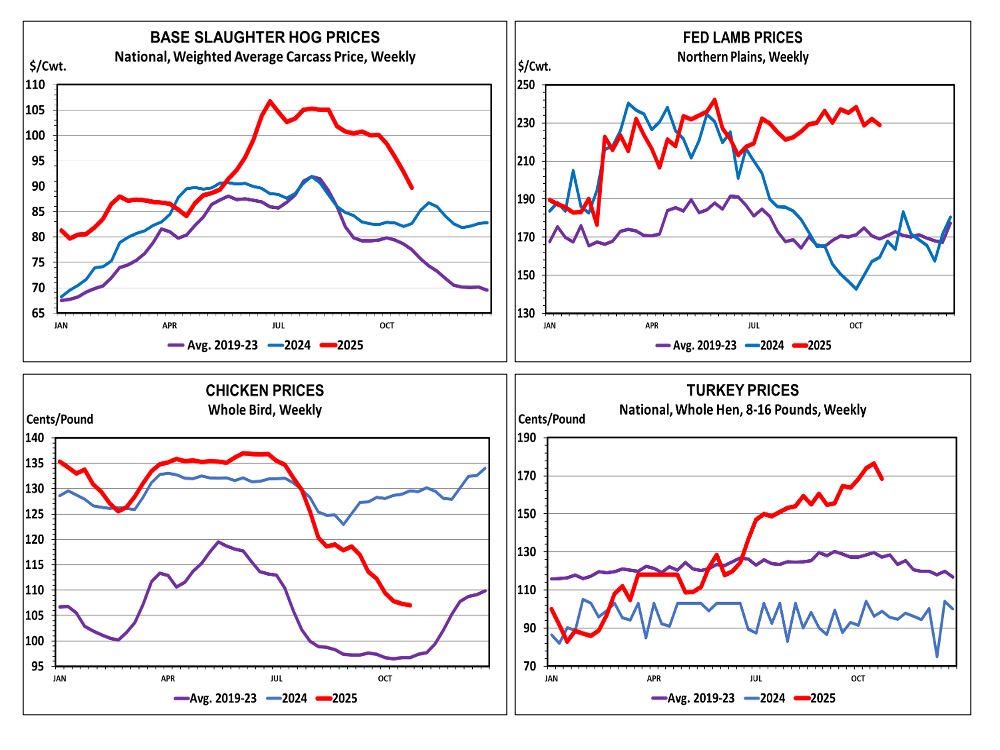

Strong domestic consumer demand has supported livestock prices this year. Economic theory suggests that higher prices stimulate more production where possible. Of course, weather, reproductive biology, and other factors come into play as many supply and demand factors are dynamic.
USDA predicts 2026 beef production to decline with increased heifer retention and reduced beef cow slaughter. USDA also expects lamb production to decline slightly with increases in pork, chicken, and turkey.
Total 2026 red meat and poultry supplies are expected to increase slightly, so maintaining strong meat demand will be important.
Topics: Association News , Business , Industry Insights , Industry News , Marketing , Member Center Featured News
Publication: Angus Journal
Related Publication Articles


Current Angus Journal
Keep up on the latest stories of the people and programs in the breed.

Latest Podcast Episode
Don’t miss conversations with breeders and industry experts.
