



The Show Must Go On, Or Not
When a natural disaster hits before sale day, it’s a tough decision whether to cancel, postpone or go ahead.
September 9, 2025
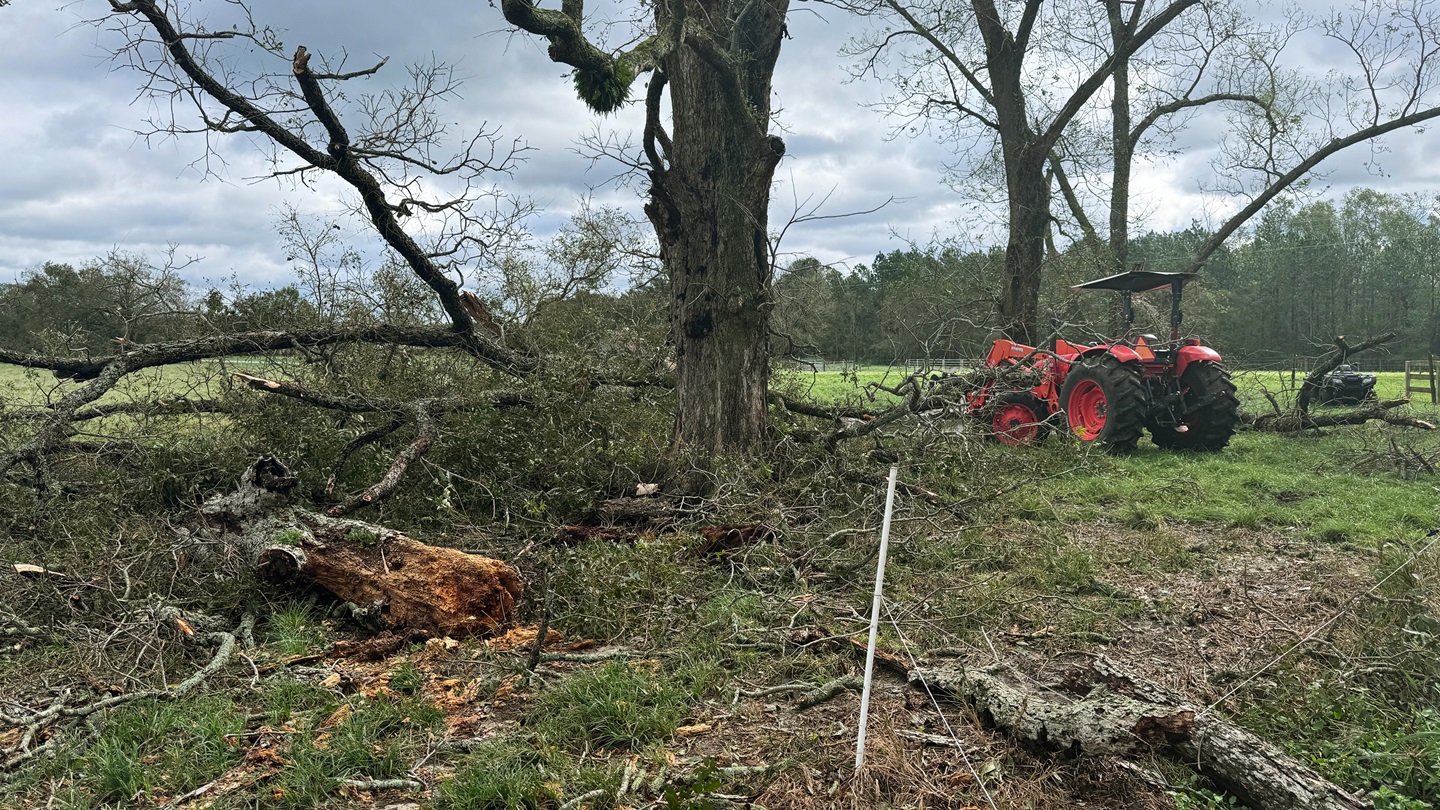

Never mind the South Georgia location. How’s this for a sale going Western?
In 2022, general manager Jason Johns and his now-wife Sandi had only been at Circle G Ranch for two months, and in his words, were still trying to figure things out. There was a hurricane brewing, but Johns wasn’t worried.
“We’re too far inland. We’ll be fine,” he said.
The morning of the Nov. 14 sale, all the bulls were penned for the noon start. Around 8:30 or 9 a.m., Johns was visiting with a potential buyer. A neighbor was burning trash, but the fire got into dry pine straw and the hurricane-spawned winds whipped it into Circle G’s stacks of round bales.
“We were already gonna be running really short, really tight on hay,” he remembers. “We all took off to fight the fire.”
With smoke blanketing the Adel, Ga., Angus operation, Johns and his crew went back to the sale barn to cook hamburgers for their customers and start pushing bulls toward the ring. Right about noon, the storm hit full on. Johns struggled to get the huge folding door of the sale barn pulled down while the pen riders pushed antsy bulls toward the sales ring, getting soaked and dodging lightning at the same time.
While two bulls were in the ring, you guessed it: the power went out.
“The auctioneer never missed a beat,” Sandi says.
Thankfully, the light flickered back on and they sold 59 lots, averaging $4,733.
“You can get through anything if you have a good crew,” Sandi adds.
The owner, Jim Gresham, told Jason that with the first one under their belts, it could only go up from there.
Famous not-so-last words.
Then there was the 2024 visit from Helene. The hurricane blasted through South Georgia in the wee hours of Friday, Sept. 27, causing unbelievable damage.
Circle G’s female and embryo sale was scheduled the following Wednesday at 6 p.m. Electricity and internet were nothing but a wish for 12 endless days.
Jason says, “I had to go into town to call the sales manager to tell him I wasn’t going to be much help.”
Fortunately, the sale was online, and the videos were done prehurricane.
“We went to Longhorn’s in Moultrie so we could watch our own sale,” Jason says.
Besides the struggle to get a hot meal and access to the internet, the females averaged $8,500.
There was still the Nov. 14 bull sale to think about. In posthurricane days, that’s an overwhelmingly short amount of time. For starters, Jason and Sandi had to cut their way by chainsaw through the downed trees in their driveway and the road to get to ranch headquarters. Ditto for their crew and neighbors.
“The first thing we did was check on people,” Sandi says.
Next, they checked on cattle. Only one bull was killed when a treetop fell on him. Considering the damage, they said it was a blessing it was just one.
Their next concern was getting water to cattle. Being good stewards, most of the Circle G cattle are fenced away from ponds. Johns’ crew had to pump water out of a pond with a gas-powered pump and haul water to troughs, an all-day chore.
Then they had to figure out how to feed the bulls, especially the sale bulls. They feed a total mixed ration of corn silage mixed with a commodity feed. They had to clear the mile-long road from the silage bags to the bull pens and of course, there were miles of fences to rebuild.
Still, Jason says, “It was not an option to cancel the bull sale. You’ve got to have the money from the sale to keep going. Our employees depend on the income.”
There’s just so much work the family puts into the bulls, Sandi says.
“After we had so much devastation, it was gratifying to have the sale,” she explains.
With burn piles of trees still smoldering, the final tally on the 74 lots of hurricane-hardened bulls was $8,609.
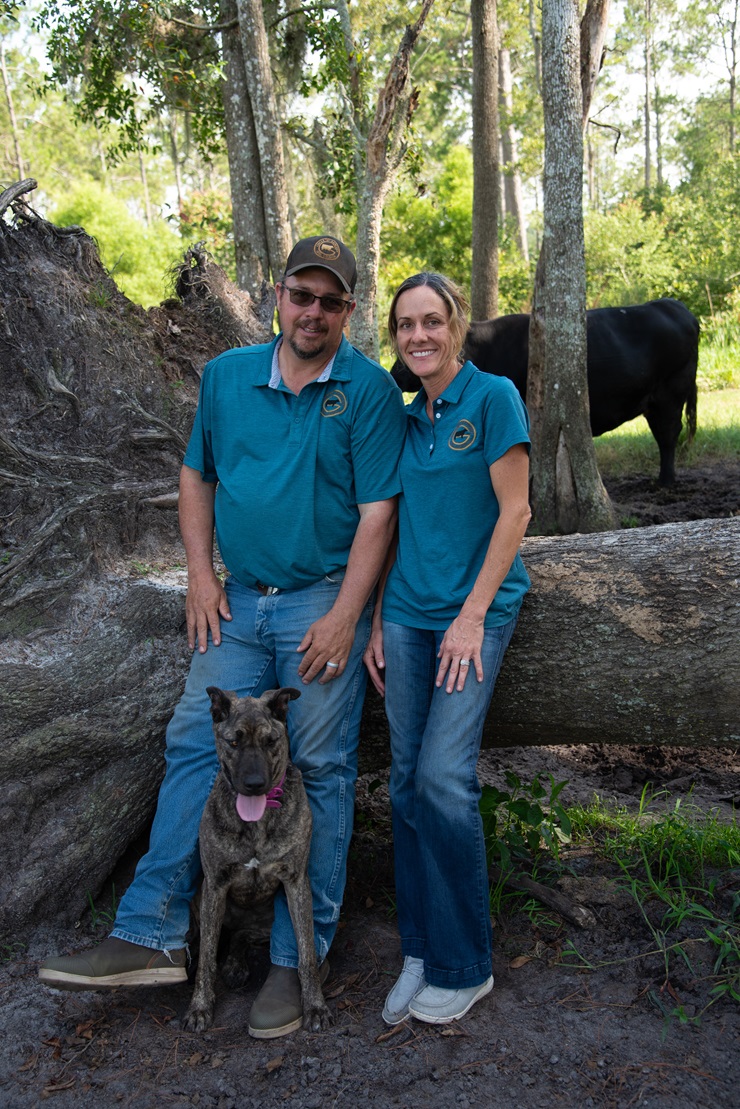
Jason Johns, manager at Circle G Ranch, with wife, Sandi, says canceling their bull sale wasn’t an option, even after Hurricane Helene hit the Angus operation.

Getting through it, together
In nearby Nashville, Ga., Chandler Akins; wife, Jess; and baby, Margo, rode out the night in their home, two miles from their Bar A headquarters. Two of their employees also spent the night with them because the Akinses didn’t want them by themselves at their homes.
“It turned out to be a blessing because they couldn’t have gotten here,” Chandler says.
He has a photo of the TV screen showing winds of 107 mph that night, more than most rain-logged pines, oaks and pecan trees could stand — not to mention a big chunk of the barn they use in their bull sale.
Chandler had more on his mind than his family, their cattle and infrastructure, though. In addition to their own bulls, he already had consignors’ bulls in the pasture.
He and a group of other purebred breeders started The Source sale in 2015. The first Saturday in December, it gives the Akinses a place to market their bulls as well as those from friends who have similar genetic foundations, tracing back to the famous Partisover Ranch herd built by longtime mentor Randy Daniel. Through the years, a few other friends have joined the sale to add breed and genetic diversity.
Thankfully, none of the young bulls were hurt, and the consignors were one of the biggest blessings.
“We had consignors with maybe five bulls come down for three days in a row to help us try to put the pieces back together,” Akins says.
First, though, he had to come to terms with the shock of seeing their operation turned upside down.
Like the folks at Circle G, he had to figure out how to feed, water and keep the cattle in their pastures, all of which had fences down.
“We hauled water for a few days in nurse tanks before we were able to get enough generators to run the wells,” Chandler says.
There was also the challenge of feeding. He develops the bulls on ryegrass baleage and a commodity feed, mixed and fed out of a tub mixer.
“We don’t have a commodity barn yet, and couldn’t find a generator powerful enough to get the feed out of the grain bin and into the mixer,” he explains.
Enter Godfrey’s Feed in Desoto, Ga. They hauled feed down on the Sunday after the hurricane to the Akinses and other area cattlemen. Akins put his share in tote bags and says, “Godfrey’s went above and beyond the call of duty.”
One of the first calls Chandler made the morning after the hurricane was to his sister, Callie, when he told her they had to find another place to have the sale.
It was never a question of actually having the sale, though, despite the fact they were trying to pick peanuts, calve and dig out from under the mountains of trees.
“We needed to market the product we’d invested in for 18 months, and our customers needed bulls. I had to come to peace with the fact everything was not going to be perfect, but our customers are like family and friends. The hurricane devastated a lot of them, too, and we were all just trying to work it out together.”
Roll with it, learn from it
It isn’t just southern hurricanes that disrupt sales. This past spring in Nebraska, a late March ice storm leveled power poles across the state and knocked out the power at Lylester Ranch, Martell, for a week.
The timing was a bit of a challenge. The lights and internet didn’t come back on until the day before their annual bull and female sale. Besides hampering sale preparation, they were calving at the Angus operation, and the surveillance cameras didn’t work without the internet, meaning one of the crew had to be on-site at the calving pens all night.
There was also the extra labor to keep generators running to keep the heating elements going in water troughs, as well as to power the refrigerators storing vaccines and freezers filled with beef.
“There were no generators or parts anywhere locally,” manager Brandon Snider reports. “You just roll with the punches and do what you’ve got to do to take care of the animals.”
Snider says there wasn’t a question about having the sale; he kept expecting the power to come back on before it did. Despite the storm-related bumps, though, he says it went well.
However, if there is a next time for an untimely natural disaster, the ranch will be better prepared.
In July, he said, “We’ve got an electric contractor here hooking up a permanent, much larger backup generator. It can run for a longer time without having to be filled with fuel.”
Like Akins, he says the attitude of other area purebred breeders and ranchers was one of getting through it together.
“The cattle business is full of people who are used to dealing with the reality of life. When stuff like this happens, most of us pull together and and just deal with it. At a couple of sales I went to around the same time, it almost seemed like there were more people at the sale than the previous year.
Cattle people tend to help each other out. If they feel like somebody’s in a bad place, they’ll surround you.”
Priorities
In his job as an American Angus Association regional manager, Will Harsh has helped breeders get through presale disasters ranging from pandemics to hurricanes to blizzards. Here’s his advice:
First, decide whether to cancel, postpone or have the sale as scheduled.
“Find out if people can actually get to the sale. We all hate to postpone a sale because we worry if it is gonna be as successful as it would have been on its original day.” He says, though, “Nine times out of 10, when folks have had to postpone it, they’ve gotten along just as well if not better.”
He suggests to reach out to customers. “Whether there’s a bad storm coming or not, you need to be in touch with them,” he says. “Ask how their bulls are doing, how their family is and how their calves sold. If bad weather hits, you’ve already got that relationship. You can ask them, do you think this is gonna be bad enough to hinder you and your family? If you’re struggling to get cattle fed and you’re calving, are you gonna be able to make it?Catering to your customers is absolutely the key.”
If you decide to go ahead with the sale, what can you do to try to make it easier or better for your customers or yourself?
“Internet bidding has taken the world by storm ever since the coronavirus pandemic. It’s one of those necessary things when it comes to marketing genetics,” Harsh says. “Use the internet to your advantage. A lot of those sales in 2020 and 2021 were strictly online. We made it as easy as we possibly could for customers to still purchase the bulls they wanted.”
Harsh says in his part of the country, AM radio and local radio stations are a go-to source of news.
“It’s important to get in touch with your local stations, your breed association and all the people who are working at your sale,” he advises. “Tell them you need to put out the word. Notify the public whether you’re still moving forward with it, moving it back an hour or moving it to another day. For the people who are planning on bidding online, let them know you’re still moving forward and any of the consultants or field reps can look at cattle for you. We can be on the phone and bid for you if you don’t feel comfortable bidding on the internet.”
Think digital.
“The digital and print services team at the American Angus Association can add banners to your sale book and the Association’s website, send out e-blasts and put posts on social media stating your sale has been postponed or is being hosted as scheduled. We try to offer as many different options as we can to make sure your customers know if there’s a change to your sale.”
Topics: Business , Equipment / Facilities , Events , Human Health , Management , Marketing
Publication: Angus Journal
Related Publications


Current Angus Journal
Keep up on the latest stories of the people and programs in the breed.

Latest Podcast Episode
Don’t miss conversations with breeders and industry experts.