




BY THE NUMBERS
Putting Teat and UDDR EPDs to Work
With the rollout of Teat and UDDR EPDs earlier this year, producers have been exploring how to use them effectively.
August 11, 2025
Teat size (Teat) and udder suspension (UDDR) are scored on a 1-to-9 scale. A score of 1 for teat size indicates a large, bulbous teat, while a 9 reflects a small, uniform teat. For udder suspension, 1 represents a very pendulous, broken-down udder, and 9 indicates a tightly suspended, shallow udder.
There is no single ideal score for teat size or udder suspension. This is different from traits like Foot Angle (Angle) or Claw Set (Claw), where a score of 5 has been targeted as more ideal. Instead, producers should determine what works best for their herd and communicate that clearly to commercial customers.
Interpreting trait averages and relationships
Teat and UDDR are both moderately heritable traits, with heritability estimates of 0.32 and 0.28, respectively. In the Angus population, the average score for each trait hovers around 6.5.
While genetics significantly influence these traits, the environment and age of the cow also play a role. To ensure expected progeny differences (EPDs) are not changing solely because cows get older, cow age is accounted for in the genetic evaluation model.
The genetic correlation between Teat and UDDR is 0.76, which shows a strong relationship — but not a 1 or perfect direct correlation. Selecting for smaller teats usually results in tighter udder suspension, but the traits should still be evaluated and, more importantly, scored separately.
A negative genetic correlation of -0.24 also exists between Maternal Milk (Milk) and UDDR. As udders become more tightly suspended (higher UDDR EPD), maternal milk may decrease slightly (lower Milk EPD). This highlights the importance of avoiding single-trait selection and balancing udder suspension with maternal milk in breeding decisions.
Figure 1 shows the current spread of both the teat size and udder suspension scores utilized within your genetic evaluation of the traits. The Angus breed has very acceptable udder conformation according to collected data, though some outliers remain.
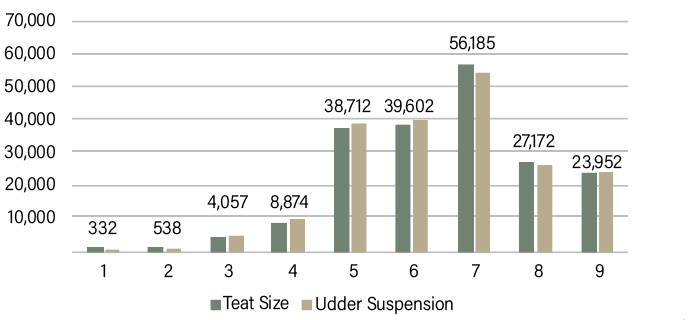
FIG. 1: Distribution of Teat Size and Udder Suspension Scores in Genetic Evaluation

For these reasons, selecting for an optimum EPD for Teat and UDDR may be more practical than targeting the top 1%. Just as many producers avoid selecting the largest cows (top 1% for mature weight EPD), some may also choose to avoid the extremes with these new traits. Extremely tight udders and very small teats, while they may rank highly, are not always ideal, especially if teats are too small and udder too shallow for a calf to nurse effectively.
On the other hand, managing your herd to avoid udder scores at 4 and below can help reduce the risk of udder breakdown early in a cow’s life. Lower scores can be associated with increased intervention to get calves to nurse and a greater likelihood of culling for udder-related issues.
Striking a balance and avoiding extremes can lead to more functional, longer-lasting females. Teat and UDDR EPDs can help you manage away from problem udders, rather than simply chasing the highest-ranking animals. Avoiding sires ranked below or above certain thresholds, based on your own herd’s needs, is most desirable.
When reviewing percent ranks for these traits, it helps to think about how far they move off the average (50th percentile) rather than just looking for the bars furthest to the right. Figure 2 shows an example of how to visualize that chart.
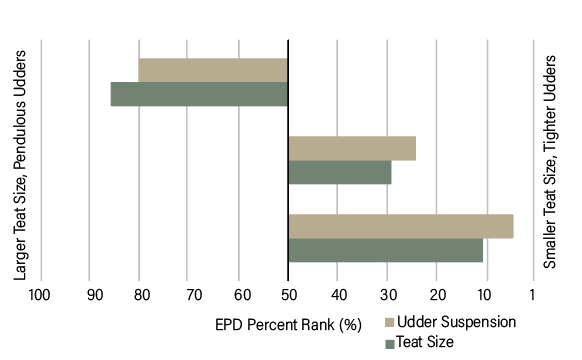
FIG. 2: Teat Size and Udder Suspension EPDs - % Ranks

Early adopters: setting the curve
Producers who began collecting udder scores early may notice not all their animals rank above the breed average. While this can be disappointing, as an early adopter you are helping to set the average.
What matters most is whether the EPDs are accurately ranking animals within your own herd.
Early adopters are often in the best position to identify the acceptable and unacceptable performers in their programs. This doesn’t mean every animal will rank above average, but it does mean you have better tools for making informed decisions.
As with any new EPD, the range of values will expand as more data is submitted. Even now, there’s nearly a two-score spread between the lowest and highest-predicted EPDs for these.
Importance of data collection
Association members have submitted nearly 200,000 scores on approximately 117,000 females for teat size and udder suspension each. These scores, combined with pedigree and genotypes (AngusGSSM or HD50K™), contribute to the weekly prediction of more than 2.4 million EPDs.
The average EPD accuracy across all animals is 0.27 for Teat and 0.26 for UDDR. Accuracy varies depending on the amount of data available for each animal. Females with actual scores but no genotype have slightly higher accuracy than the overall. Females with both a recorded score and a genotype show, on average, a 10% increase in accuracy than those with just a genotype, and a 14% increase compared to the overall average.
Collecting both allows producers to make more confident selection decisions because the accuracy of selection is greater, accelerating genetic change. Table 1 outlines the differences in average, minimum and maximum EPD accuracy values by trait and animal group.
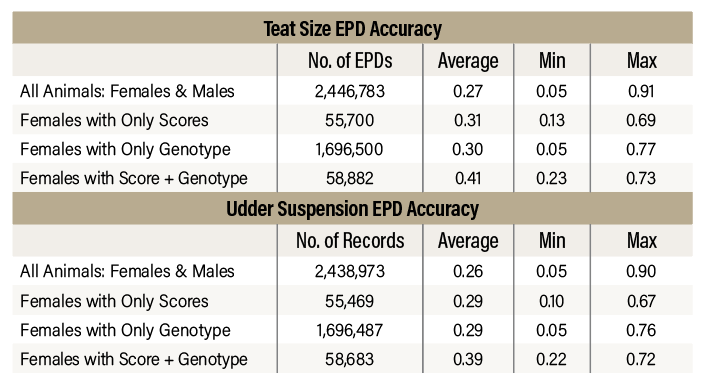
Table 1: Differences in average, minimum, and maximum EPD accuracy values by trait and animal group

Putting it into practice
Let’s use the breed average as a reference point. Suppose your cow herd averages a 6.5 udder suspension score with a UDDR EPD of +0.54. If you use a bull with a +1.04 UDDR EPD (top 1%), the next generation of females would be expected to average around a 7.0 udder suspension score. On the other hand, using a bull with a +0.04 UDDR EPD (bottom 95%) would likely lower the herd average to about 6.0.
Because Teat and UDDR are linear traits, producers can use corrective mating to gradually improve udder structure. For example, if a bull’s daughters have really small teats, breeding them with a bull that has a lower Teat score can help make the teats more desirable.
As with any trait, single-trait selection is not recommended. Teat and UDDR EPDs should be used alongside other important traits such as other maternal, management, growth and carcass traits as well as any other factors relevant to your environment and management goals.
To learn more about the scoring system, refer to the “Data Dive” article in the Angus Journal from September 2023.

Kelli Retallick-Riley, President

Topics: Genetics , Member Center Featured News , Reproduction , Selection
Publication: Angus Journal
Related Publication Articles


Current Angus Journal
Keep up on the latest stories of the people and programs in the breed.

Latest Podcast Episode
Don’t miss conversations with breeders and industry experts.