




‘The Cows Will Show You’
Klint and Lori Swanson on building Shipwheel Cattle Company.
October 7, 2026
From time to time during the hardest seasons on his family’s northern Montana ranch, Klint Swanson reminded himself that he came from resilient stock.
“I kept thinking that this is nothing compared to what our forefathers have sacrificed or what they’ve gone through for us to get here,” he said. “So we’ve got to keep going.”
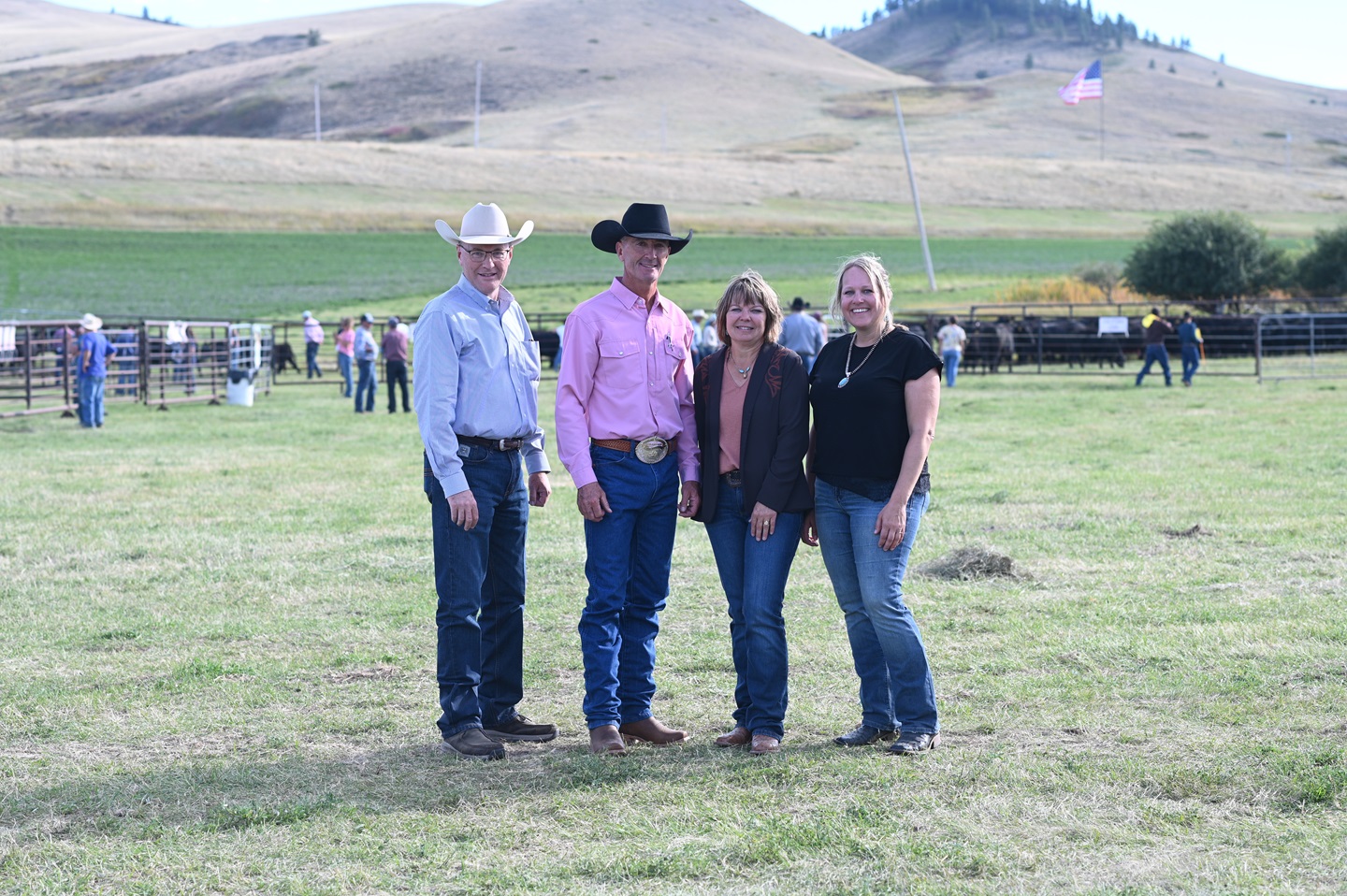
From left are Mark McCully, American Angus Association CEO; Klint and Lori Swanson, Shipwheel Cattle Company; and Miranda Reiman, Angus Media director of digital content and strategy.

He and his wife, Lori, joined The Angus Conversation and shared their journey — the good and the challenging — in building Shipwheel Cattle Company near Chinook, Mont. Surviving drought and the lean years leads them today. They give a lot of credit to the herd that stems from Klint’s first two heifers he got as a 9-year-old.
"The black Angus cow, she pays all the bills for us. We rely on her for everything,” he said.
Ranching near the Canadian border, they live in an area where the cattle have to be tough, so they build them accordingly, with a focus on hardiness, solid feet and longevity.
"If you let her do it, she’ll do it,” Klint said. “She’ll go calve on her own. She’ll raise that calf. She’ll breed back and she’ll make the most of the winter here on her own.”
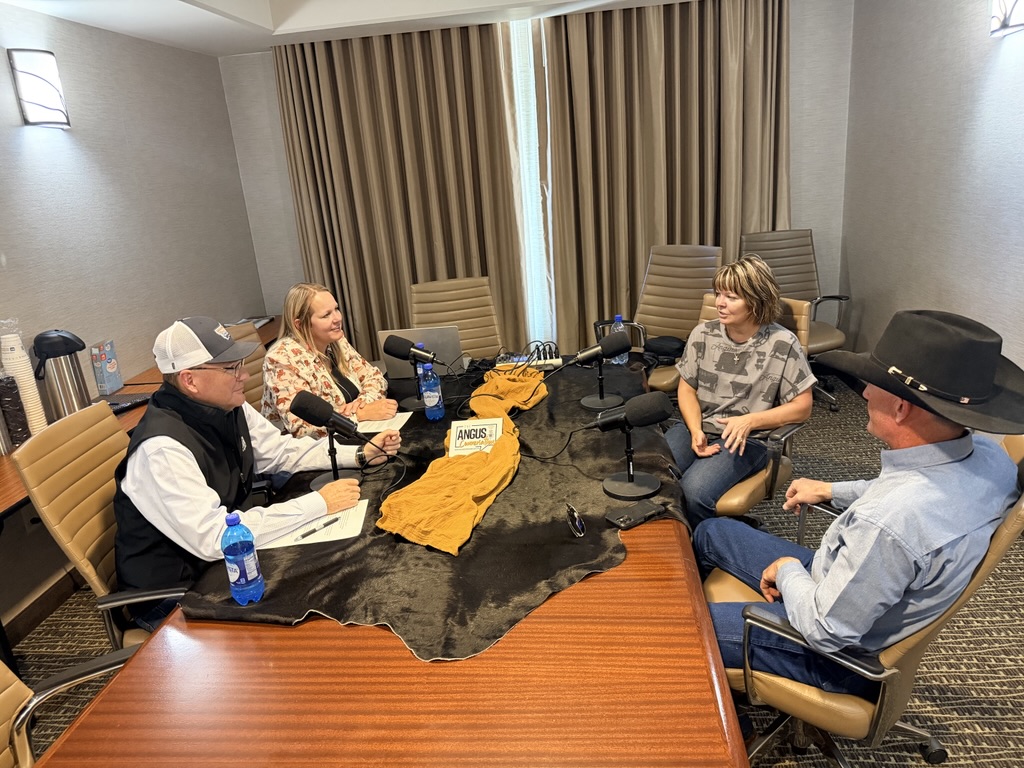

They have adapted over the years to better fit feed resources and customer preference. They calve in late spring and early summer, selling 18-month-old bulls at their annual production sale in December.
It’s not all roses, but they’re in a spot today where they can look back and say it was worth it. Their grown children, Austin and Bree, now help out on the ranch in addition to running their own businesses.
“We’ve always told them there’s no better way to make a living,” Lori said, noting the kids were the main “hired help” and were a big part of what they’ve been able to accomplish.
“Lori and I bought that ranch, but so did they,” Klint agreed. “They didn’t sign on the line, but they basically did and they’ve earned it, too.”
EPISODE NAME: ‘The Cows Will Show You’: Klint and Lori Swanson on Building Shipwheel Cattle Company
Montana’s Hi-Line country is known for its expansive landscape and sparse populations. Nestled along the Canadian border, it’s great cow country when the weather behaves. But when it doesn’t? The cattle have to be tough, and the people tougher. Klint and Lori Swanson grew up in the area and have made Chinook, Mont., their home since they married and started Shipwheel Cattle Company. They balance functional cattle — good feet and longevity — with performance. In this episode the Swansons talk about starting a sale, selling aged bulls, raising a family on the ranch and surviving the lean years.
HOSTS: Miranda Reiman and Mark McCully
GUESTS:
Klint and Lori Swanson’s roots run deep in the Montana cattle business. Klint’s grandpa brought Angus cattle to northern Montana in 1945, and his parents founded Apex Angus in the 1960s. When Klint was 9 years old, he was gifted two Angus heifers, and they’re the foundation of the herd the family runs today. The cattle are spread between two locations, Snake Creek Ranch at Lloyd, Mont., and Lori’s homeplace, Clear Creek Ranch, near Chinook. Their two grown children, Austin and Bree, are involved in the family operation, along with running their own businesses. Shipwheel Cattle Company hosts an annual bull sale in December on the ranch.
SPONSOR:
Deer Valley Farm: Make the next generation of your herd even better. Mark your calendar for the Deer Valley Farms Focused on the Future annual production sale, Saturday, Nov. 14, in Fayetteville, Tenn., featuring elite Angus Genetics from one of the industry's most respected programs. Visit Deer Valley Farm online for sale information.
Angus Media: You breed cattle that stand out. We'll make sure they do. There are a lot of options for livestock marketing, but Angus Media is the only one backed by the Angus audience. We have more than 74 million impressions across print and digital platforms to customize the target audience to get the right eyes on your offering. Contact your regional manager or visit AngusMedia.org to get started.
Miranda Reiman (00:02):
Welcome to the Angus Conversation. I'm your host, Miranda Reiman, with my co-host, CEO of the American Angus Association, Mark McCully. Mark, we're in Montana this week.
Mark McCully (00:12):
We are. It's beautiful here in Montana. Absolutely gorgeous.
Miranda Reiman (00:15):
It really is. And I won't spoil the reason we're here because we get into that in the podcast, but I guess one of the cool parts about taking the podcast to the road is that we get to see people in person. And I know I say this so many times, listeners are probably sick of me saying it, but the reason I do this job is because I love the breeders that I work for and I love a chance to get out among the cattle producers that we work for. And we've had quite a few chances to do that.
Mark McCully (00:41):
Yeah. I think the fall always gives us opportunities and we are on tours, right? We're doing some tours here and I know congratulations to so many of the states that have pulled together very successful tours. It's always fun to just see the Angus family come together, whether that's a state family, whether that's a regional family or our bigger Angus family that will come together in November in Louisville at the Angus Convention. So plans are well underway for all of the speakers, the educational tracks, the times for fellowship. We've got some new things planned, some great opportunities where we're going to really, being able to get feedback from membership on some strategic questions, pulling some state leadership meetings together. So it's just going to be a great couple days in Louisville.
Miranda Reiman (01:31):
And if you haven't marked your calendars or haven't checked it out, dates are a little bit later. It's November 13th through the 16th. So make sure you've got that on your calendar. You go to angusconvention.com to get yourself registered, but we'd love to see as many of you as possible.
Mark McCully (01:46):
Yeah. And I say going back to Louisville because for many that know the history of the Angus Convention and the Convention of Delegates would have been down at Louisville in conjunction with the North American. And of course, some things have changed over the years, different format for convention. North American's even a little different today, but we're looking forward to going back and be in conjunction. The Angus shows will be going on over at the fairgrounds there. And so it'll be a great time for folks to come together and do the business of the organization and the association, but also again, get over to the North American and take in the show.
Miranda Reiman (02:21):
And so we are looking forward to seeing Angus breeders there. We're looking forward to the week that we have ahead. And I think you guys are going to enjoy this podcast that we got to do in person with Klint and Lori Swanson. So enjoy. Well, today on the podcast we have Klint and Lori Swanson of Shipwheel Cattle Company at Chinook Montana. Do I say Chinook, or you have locations?
Lori Swanson (02:44):
Nope, that's good.
Klint Swanson (02:45):
That's fine.
Miranda Reiman (02:46):
Two places. Very good. We are here at the Montana Angus Tour. Mark and I both have traveled to the big sky country and are excited to take in the Montana Angus tour, but you guys have had a big part in planning the Angus tour.
Mark McCully (02:59):
You're hosting and organizing.
Miranda Reiman (03:02):
How's that going?
Lori Swanson (03:03):
That's a lot. That's a lot. We've had that discussion this week that maybe it's too much, but we're doing good.
Miranda Reiman (03:09):
So we've caught you actually at the beginning of the week. You guys will be closing out the stop, but have a couple of days here planned full of lots of great cattle up on the Hi-Line?
Lori Swanson (03:19):
Yes, up on the Hi-Line, you are saying that correct. Lots of great food.
Miranda Reiman (03:24):
Very good.
Mark McCully (03:25):
Well, we want to get into the tour a little bit, but maybe before we do that, how about maybe just a little bit of the story of your operation? Maybe a little bit from the beginning, kind of how you got to where you are today.
Klint Swanson (03:37):
How much time you got?
Mark McCully (03:39):
We keep this rolling for a long time if you want.
Klint Swanson (03:43):
America's celebrating 250 years this year and I guess we kind of are quietly ourselves. Between Lori's family and my family, we've been about 250 years combined ranching in Montana. That's incredible. So that's pretty cool.
(03:58):
Yeah, a lot of history. Her family homesteaded 30 miles south of where our tour stop's going to be.
(04:07):
And then my family homesteaded on the Rocky Mountain front between Choteau and Browning, about 150 miles west of here in 1896. My granddad was one of the first to bring... He got tired of the, problem with the Herefords. He brought black Angus cows in 1945 and that's where it started. My folks started in the '60s with purebreds and then started having production sales then. 1984, they gave me my first heifer. A couple years after that, I guess we started selling bulls. So with Apex Angus, that's my family. So about 40 years for us selling bulls. '98 we married. 2000, we moved to Chinook. We had an opportunity to lease Lori's folks' place. Not a lot of room for me up there. It's God's plan and it was a tough decision at the time, but it was meant to be. Everything's worked out very well for us.
(05:13):
2009 we formed Shipwheel Cattle. Well, up to 2009, we continued to sell bulls with Apex. 2009 we had enough bulls to offer of our own. We started Shipwheel Cattle Company.
Mark McCully (05:29):
Where did the name Shipwheel come from?
Klint Swanson (05:32):
That's our brand. It was given to me by my grandma. We weren't sure what to call it, but that's what we came up with. I mean, that's what the brand's called, but as far as our ranch name. And then our first sale was a little private treaty, silent auction in a chutehouse.
Lori Swanson (05:54):
With a dry erase board.
Klint Swanson (05:55):
Yeah. It was about half the size of this. It wasn't even as big as this room. Sold 23 bulls that day. Now we've worked up to over 200 a year.
Miranda Reiman (06:08):
And then kids joined the picture in there.
Klint Swanson (06:12):
Well, Austin was born '02.
Lori Swanson (06:16):
2003.
Klint Swanson (06:18):
Bree was '04. And they're very involved with our ranching today. So they're both back home and it's very gratifying to have them with us working and involved. But 2010 we purchased the ranch where our stop's going to be, added on to our current place, folks' place, more than tripled our acres. But 25 years of debt for us, it's been tough, but the black Angus cow is, she pays all the bills for us, all of our debt. We rely on her for everything and we're finally kind of can see the end now. It's 15 years in and market is where it needs to be. It's not too high.
Miranda Reiman (07:13):
Yeah. Want to say that one more time? Yes.
Klint Swanson (07:17):
Our kids can see that they don't... We had a lot of lean years and they questioned whether they want to do this, but now we're kind of getting ahead and with the good market, they can get excited about it.
Miranda Reiman (07:32):
I guess hearing that timeline a little bit, I'm thinking you guys moved to new location, grew your herd and started your family all within a fairly tight window of those had to be some kind of chaotic years in there.
Klint Swanson (07:46):
It was. Yeah. We questioned whether we should do it, but say it was God's hands and it was meant to be and it's been tough. But got to teach these kids, not everything's easy. All these kids, they want everything easy now. Well, it's not going to be. You got to earn it. You got to work for it. And like I say, but the cows, people doubted that we could do it and let my cows and this will show you and they've done it for us.
Miranda Reiman (08:19):
Of course, I met you guys first when you guys were part of the Certified Angus Beef Brand the Barn campaign and you guys are barn number 22.
Lori Swanson (08:29):
Yes.
Miranda Reiman (08:29):
22, have that painted. Talk about why you were interested in even featuring the brand on the side of your barn.
Lori Swanson (08:38):
We were actually contacted, I believe Paul talked or called us and said, "We would like to do this for you guys." And we were very, very... It was
Klint Swanson (08:47):
Kirke.
Lori Swanson (08:48):
Was it Kirke Angus? Okay, Kirke too. Very humbled and honored to be able to put that on our barn. So we said, "Absolutely." And it was a little crazy that week, I remember, and I think I might've even said to you or one of the other gals that was on the branding, I said, "I kind of just poo-pooed it because we had fair week with our kids and our kids had animals in every barn at the fair. And then we're going to be there the day after the fair." And I'm like, "Really? Okay. But don't worry, we'll take care of everything. Okay." And no, it was such an amazing opportunity for us and to have that and be able to go to the national convention and visit with you there as well when we were there in North Carolina. But no, we are extremely honored to have that on our barn and be the number in Montana that we are.
Klint Swanson (09:42):
We just did a, it's not even done yet, but a major sale barn remodel. So it's looking really good now.
Lori Swanson (09:51):
Yeah. It's all lighted. The barn door is now all lighted. Thankfully, where our barn's location was, it was on the north side so it doesn't get all the weather in the sun, so it looks just as good today as it did when it was -
Klint Swanson (10:05):
We did the tin color to kind of match the logo.
Lori Swanson (10:05):
Yeah, we changed the barn to match the logo.
Miranda Reiman (10:09):
Wow. That's dedication. I like that.
Lori Swanson (10:12):
So it's beautiful.
Miranda Reiman (10:13):
And as we were talking earlier, of course, there's the features in the barn book that we wrote about those first initial families to have the logos. And your kids were little then.
Lori Swanson (10:23):
They were very little. And that even turned into a really cool story too. You had hired Eric Mull as the photographer to come out and photograph our family and our barn. And our daughter was just young and impressionable and was really interested in photography. And he just -
Miranda Reiman (10:43):
Kind of mentored her.
Lori Swanson (10:43):
He did. And he still does today, except for now he says that she's mentoring him after going to school and learning and staying on top of all of the new camera equipment and everything like that. But turned into a wonderful relationship. In fact, he was hoping to be here this week, but unable to make it work in his schedule. He's hoping to come in October, but he has made four more trips out to Montana since that barn branding and photography session and has come out. He came and did Bree's senior pictures, a portion of them, and it's turned into a wonderful relationship. So excited.
Miranda Reiman (11:16):
And that's incredible for people that don't know because he lives on the beach now.
Lori Swanson (11:20):
He does live in Florida. Florida. Yep. Sandestin.
Miranda Reiman (11:24):
Very good.
Lori Swanson (11:25):
Yep. Yeah, it was great.
Mark McCully (11:26):
Before we maybe jump deeper into Shipwell Cattle and talk about the cattle, I want to really call out the tour that we're on and the work and dedication that you guys have put into being a stop, but then Lori also you're working and the team I'm sure here is coordinating. Maybe just talk a little about the Montana Angus Tour. I think many would know it's, to my knowledge, the biggest state tour and it's been going on for quite some time. You got a lot of people coming, not even all from the United States.
Lori Swanson (11:57):
Correct. Yeah, we are super excited to host this year. We have twice as many people coming this year as we did eight years ago when it was at... Montana has seven districts, and so every seven years you forget just long enough how much work it was and you ramp up to do it again. But we kind of call it, at least here, we call it the seven-year ranch cleanup because that's when you get all new corrals, you paint the barns, you do all the new things and things that need to get done just really hurry up and get done.
Miranda Reiman (12:30):
We've got a deadline.
Lori Swanson (12:31):
We got people coming for dinner. So no, we thoroughly enjoy hosting. This is the 53rd annual Montana Angus tour. We have a couple on this tour that were on the very first one, Dave and Yvonne Hinman. They're also hosting and we have the honor to give them a memorial tomorrow.
(12:58):
We are giving them a Trailblazer Award. Klint and I are. They have been tremendous mentors to us, putting on the tour. We live up here in Northern Montana so far that the past few years it's been a little slimmer than say South Montana. People venture to go to South Montana easier for the location, the fishing, the hunting, the everything. But we have so much to offer here up north and this year it really is proving that people are finding us now, having double the crowd. We have 16 states in attendance and 11 countries, which is pretty impressive for our little area. Our hotels are all sold out. Our restaurants that are catering are tapped out. They don't have any more help. They have no more beef. We have it all spoke for, for this week. So it's a wonderful time. We enjoy visiting, the camaraderie.
(13:56):
There are also people that... I have been the secretary of the tour in the north here. This is my fourth time doing it. And there are people on our registration list that were here the first time that I did it. There's always the people that come on the tour every single year. But again, Dave Hinman, when he first moved up to the Malta area from the Bozeman area and him being one of the stewards of getting the Montana tour going, he came and said to us, because we all kind of gathered around all the Angus breeders and said, "Why would people come here? It's the coldest winters and the biggest mosquitoes and all of the things. Why does anybody want to come to Northern Montana?" And Dave has always been that one, "Nope, we got to do this and they'll come. We have to do this and they will come." And he's been the driving force behind us always.
(14:45):
We've doubted ourselves. We're like, "Nah, this is never going to work. It's never going to fly." Dave's always been that person that said, "Nope, it'll happen. We'll make it happen." So we have that outlook on it now too. It'll happen. We'll make it happen.
Klint Swanson (15:01):
Yeah. It's quite a tradition and history and definitely want to keep it going and improve on it, keep making it better and better.
Miranda Reiman (15:08):
Absolutely.
Mark McCully (15:10):
I don't know how many I've been on. I've had the fortune to be on quite a few, and I'll tell you, it's such a well done tour. First, the organization on the front end, and again, you guys always get great participation. Folks, I think tend to... Obviously, it's a pretty beautiful part of the world, but that tradition of really running a first rate tour and then having great stops where folks can come and interact with the tour stops, but then other breeders as well. I can tell you, I'm a big fan of tours. We just got the chance to come in actually from North Dakota's tour. The folks over at North Dakota did a fantastic job also putting on a great tour. I know South Dakota just had a tour. They had a really nice crowd. I guess I'm a believer in this day of virtual, social, digital, everything.
(16:03):
We still like to get together and I think that's something kind of extra special that happens here. So well done and thank you for all the work that goes into it.
Lori Swanson (16:11):
You bet. You bet. Anytime.
Miranda Reiman (16:12):
We're looking forward to the week for sure. And that's a good place to put a pin in it while we hear from today's podcast sponsor.
Speaker 1 (16:21):
If you're looking to make the next generation of your herd even better, mark your calendar for Deer Valley Farms focused on the future annual production sale. Saturday, November 14th in Fayetteville, Tennessee. Featuring elite Angus genetics from one of the industry's most respected programs, this sale offers an outstanding set of bulls and females built for real-world success. Visit Deer Valley Farm online for sale information and make plans to be part of the Focused on the Future sale.
Miranda Reiman (16:54):
So you said who would want to come up here? I was super excited when I found out where the tour was going to end up this year because I've gotten to go on story trips kind of across Montana, but never in this part of Montana. So the drive up this morning I thought was just beautiful. So just know that, but I know that there are some parts of this area that you might not think it's so beautiful in maybe January. Why don't you talk just a little bit about the environment in which you're raising cattle in up here?
Klint Swanson (17:23):
Well, that's one of the reasons why cattle from this area are so sought after. It's extreme environment. Lori and I have seen 70 below wind chill, calving.
Lori Swanson (17:36):
... don't go outside. I'm sick that day.
Klint Swanson (17:37):
Yeah, the one night. She had night check, but she was pregnant. She rolled over and said, "Honey, I'm sick." So I propped up and I went out and checked, but she wasn't sick.
Lori Swanson (17:48):
The wind was blowing 40 or 50 miles an hour and it was blizzarding and there was a four foot drift up against our door and I got there and I thought, I don't need to go outside.
Miranda Reiman (17:59):
So if we wonder where she draws the line. It's not at 65 below, it's 70 below.
Klint Swanson (18:04):
Got to 70 and that's enough. But no, it's quite a variety of topography here. There's short grass north, there's Milk River Valley, foothills to the bear paws and then the bear paws. But like I say, it's very hardy cattle, feeders from... My dad, ... Joe Morgan from Poke Feeders in Kansas came up, sat at our table. Remember when that was? It's probably 30 years ago. And he wanted to buy dad's steers, our steers, Apex, because of the reputation and Northern Montana, and it's been a 30-plus year relationship. He sought out those steers that were grown here.
Miranda Reiman (18:52):
That's cool.
Klint Swanson (18:53):
Yeah. We do things, our program is a little different than most here. We've adapted to trying to work with Mother Nature more.
Lori Swanson (19:05):
We don't go out when it's 70 below.
Klint Swanson (19:07):
She wasn't going out 70 below anymore, so I had to find something. We've transitioned to later calving range. Our cows range calf in April, May, June. And then it's less feed that way. We AI them on grass and we're just working with Mother Nature more. It's just easier here. And therefore we sell older bulls, we grow them slow and we don't do the yearling bulls. A lot of the programs do and that's fine, but our deal has changed somewhat because of the climate here. Sure.
Miranda Reiman (19:45):
And you guys do a fall bull sale, is that right?
Klint Swanson (19:48):
Yep. 18 month old bulls.
Miranda Reiman (19:50):
Okay. Very good.
Klint Swanson (19:51):
Yep.
Miranda Reiman (19:52):
And did that date change based on that or was it always...
Klint Swanson (19:56):
When we were selling yearling bulls, our first sale was here was in April. Yeah. And then with Apex was always the first Tuesday in March yearling bulls. So
(20:08):
I grew up calving early and cold and just got tired of running the cows to the barn and our cows are out and that's the beauty of the black Angus cow. If you let her do it, she'll do it. She'll go calve on her own. She'll raise that calf. She'll breed back and she'll make most of the winter here on her own. Last winter, last few winters was pretty mild, but we could have went all the way through winter with no feed, just protein supplement to those cows. Some tough winters, yeah, we've got to feed them, but we sure don't abuse them. But she'd rather be out grazing than eating hay.
Miranda Reiman (20:48):
And by the looks of it on the drive up, you guys probably aren't going to have a lot of hay this year. It looks like it's been -
Klint Swanson (20:53):
We had pretty good hay here.
Miranda Reiman (20:54):
Did you guys, good
Lori Swanson (20:55):
It was really spotty in Montana, so it just kind of depended on where you were standing. But yet where you came from through, it was pretty dry.
Miranda Reiman (21:01):
Pretty dry.
Klint Swanson (21:02):
Yeah. Very fortunate here.
Mark McCully (21:05):
What's your rainfall here?
Klint Swanson (21:07):
I don't know.
Mark McCully (21:08):
I always say what's normal, but ...
Klint Swanson (21:13):
We've seen three inches the whole year up to someplace. A couple of our leases are record this year up over 20. So I'm guessing 10 to 12 average, but snowfalls vary. We've seen 10 feet of snow down to two feet maybe is the lowest over the winter.
Miranda Reiman (21:34):
Sure.
Klint Swanson (21:35):
But the cold, we get the wind.
Lori Swanson (21:38):
It'll set in for a month.
Miranda Reiman (21:39):
No a lot of trees to stop the wind.
Klint Swanson (21:41):
Well, the cows are mature cows that you'll see the place, but they winter in the bear paws and it's a lot of natural cover and we have some fields we save for winter grazing and they do very well in spring water. Sure. Every coulee's running water and it's just really good cow country.
Miranda Reiman (22:01):
When I was looking up some things about your ranch, the first thing I noticed right away on your website was your facts about your bulls and you had kind of listed out some things and I took note of you had that three-year foot guarantee. Why is that so important to you?
Klint Swanson (22:17):
We've seen a problem within the breed the last 15 years, 10, 15 years, and just having to get rid of a young cow because poor feet, really horrible, really bothers me. And for us, for selling bulls and for the breed and for the commercial producers that see the same thing. So we saw a need to improve on that and we have, and I think people are aware of it, some are, and that we take it very seriously. Our cows have to walk a long ways and if she can't, she can have all the best numbers in the world, but if she can't walk and can't breed, none of that matters.
(23:00):
That's first and foremost to us. So when the bulls come back home here off grass right after the tour, every one of them comes down the alley and every one of them gets rated on their feet by me and Briee, our daughter's... She's starting to do that. She rated them last year. I guided her and then we put the three year... We grow them out slow. They're never fat. They're hardy bulls, breeding bulls. They can travel and we stand behind them. We're the first one in the state of Montana to actually rank their feet in the catalog. If you have problems with feet, they are... When he's five years old, I'll still stand behind him. Some of our cleanup bulls we use, there's the one bunch right now, there's five, six, and seven-year-old bull in with them. And we keep hearing that more and more that your bulls just last and that's what we want.
Mark McCully (23:58):
Well, putting that guarantee out and also hold you, that one. If one's probably even close to marginal, you go the other way, right? Yeah.
Klint Swanson (24:10):
You bet. If he doesn't... Our bulls are sorted, you add it all up when he's in the womb with his mother. When she's rated, it's like seven times they got to make through seven sorts to get to the sale. So by the time, then they've earned it, and feel pretty... We know that we feed them at home. I feed them personally a lot of the time every day. So we know their every move and if they screw up more than once, they don't make the sale.
Miranda Reiman (24:43):
That was something I was going to ask you about is that it also said that only 50% of the calf crop makes the sale. So how do you determine what earns them the right? You just said you'd sort them seven ways, but what are you sorting on?
Klint Swanson (24:55):
Well, like I say, the first sort is their mom. She has to have good feet, good udder, good disposition, just to be a really good all around cow. Then the next is calving time. If there's something wrong with that calf, then he's out. Then it's branding, then it's weaning. We go through them then. It's just constant. When they're at home feeding, you can tell if they're going to screw up.
(25:23):
And then yearling time before they go to grass, if like I say, a disposition comes about or a feet or just phenotype, if I don't like the looks of him. Some bulls change for the better, some change for the worse. But just the things, the characteristics that really matter to commercial cow man, that is our base. That's how our family started commercial and we still run commercial cows. We have more commercial cows than registered still today. And having that base, that understanding of the things that matter the most. We breed our cows for... We want them to last well up into their teens. And we have cow families that they consistently, those daughters, we breed those... They do. They just last. There's difference in people, cattle, horses, whatever, but that's what we want. Cows that last well up in their teens, work their butt off and last a long time doing just like the bulls we sell.
(26:31):
We want them to go and last a long time.
Mark McCully (26:33):
So when you talk about the fundamentals and how important it is in terms of the cow side of things, as you were coming up and your family was sending cattle down to Joe Morgan and you were getting data back, how do you balance some of that data you were getting back and the carcass results and making progress there with this cow herd that you're going to scrutinize so hard? As I travel around, balancing those two things tends to be sometimes the challenge. So your philosophy on going after that.
Klint Swanson (27:01):
Yeah. My dad, he focused quite a bit on the carcass traits. We've kind of moved away. We still pay attention to that, but our focus is like we've talked, the mama cow and a great cow that's going to last a long time. She's got to be easy flushing, got to be good udder. She's got to calve on her own. The cattle out of her are still going to perform. We still want performance in them. There's a balance. We don't breed for extremes. Like the little cattle, we don't like the big cows, but we just want them in between, a lot of the traits. The high carcass cattle, extreme carcass cattle, frankly don't work for us in this climate, unless they have a lot of feed. They have a lot of performance, a lot of grow in them that they just kind of fall out for us.
(27:59):
But we definitely want to, like I say, have the balance of still breeding for some marbling and ribeye, but just not extreme. We're not, flats of Kansas cows, grazing flat pastures and calves going right to feedlot there. But I'm glad there is. CAB has done very well and for our industry, our families, just the reputation that Certified Angus Beef has and it's pretty cool.
Miranda Reiman (28:36):
Talk to us a little bit about your customers. You've mentioned several times. Where are your customers coming from? How are they marketing their calves? What are they looking for?
Klint Swanson (28:46):
It's kind of a wide range there. Some are into the more feedlot, but a lot of them are the way we're growing our bulls, they're coming after that. The older bulls, we're about the only one in this area that sells the older bulls that can cover more cows. And then with the guarantee, they'll say it, you stand behind them and we do. If you have an issue with one of our bulls, we're going to make it right. I wouldn't want to be treated that way. We've bought bulls in the past that, weren't treated that well, and I didn't like that. So everything happens for a reason and taught me how to stand behind them.
Mark McCully (29:29):
Do unto others?
Klint Swanson (29:31):
Yes, sir.
Lori Swanson (29:32):
Exactly.
Mark McCully (29:34):
How about calving ease? In this part of the country, have most of your commercial customers, I guess calved, have they moved calving season a little bit later like you have? Do you still have some calving in the dead of this winter up here? Maybe what's ideal from a calving ease/birth weight kind of standpoint?
Klint Swanson (29:54):
There's been some transition from going later on average, yes, just for lack of help, calving earlier, the feed. And the birth weight, we have some customers that they only want so high and they have done that for a long time and they stay that way. They're worried about too much birth weight. I tend to disagree. We range calve, we don't have a problem. We're known for having more birth weight. But then there again, those genetics, those cows that we can see they have more doability to them. They just have more body. The bulls have more power, more muscle, natural muscle to them. If they're a five EPD, five, six, we're using one. We raised a seven and we sent them to Nebraska. We've never pulled a calf. We haven't pulled a calf out of a cow for, I don't know when. And our heifers, we don't hardly help either.
(30:57):
So like I say, we kind of go against the grain. We don't do the low birth weight thing. We just like our bulls with a lot of extra muscle and meat, red meat in them. And that comes from a little more birth weight.
Miranda Reiman (31:15):
And with that, we're going to take a quick timeout for this word from Angus Media.
Speaker 2 (31:20):
You breed cattle that stand out. We'll make sure they do. There's a lot of options for livestock marketing, but Angus Media is the only one backed by the Angus audience. We have more than 74 million impressions across print and digital platform to customize the target audience to get the right eyes on your offering.
Miranda Reiman (31:39):
Talk a little bit about your guys' evolution. And you talk about your sale started in a room with a whiteboard to what you guys are putting on today. How did you grow that?
Mark McCully (31:51):
Which was more stressful?
Miranda Reiman (31:52):
Yeah, that's right.
Mark McCully (31:53):
The first one or the last one?
Lori Swanson (31:56):
I don't know. I was about ready to get carpal tunnel with the whiteboard. They've kind of evolved technology, like you say, we have to just keep on keeping on with that. We all questioned ourself here a couple weeks ago when we're in the midst of a bull sale barn remodel. Why are we doing this? Because the last couple of years, and weather is always a big factor for us for our bull sale. So obviously we had to go and get online and have everything so that people can still access our sale even if they can't make it physically. And I've heard more than enough that they trust Klint to pick out their bulls for them even if they don't make it. They'll call and say, "Hey, I need this many bulls." And he'll have the ringman buy them for them and their sight unseen guarantee as well.
(32:45):
If they don't like them, they don't have to take them. But our numbers and our lunch line have really gone down because people are just choosing to stay home and buy online with the guarantee that we offer.
Klint Swanson (32:58):
And if we can get a good video of them, they're pretty comfortable with that.
Lori Swanson (33:02):
Yeah.
Mark McCully (33:03):
Will they try to make it early beforehand to come look at the bulls and then buy them online?
Klint Swanson (33:07):
Some do, yeah. I wish more did to get the bulls that really fit what they, like Lori said, I'll pick some bulls out that I think it'll fit, but still there's that, still bothers me that they're going to like the bull.
Miranda Reiman (33:25):
When in that timeline of things did you build a sale barn? Was there a barn there that you converted? What was that situation like?
Lori Swanson (33:32):
It was just an old shed that my dad had built when I was a little girl. It was early '80s, late '70s, early '80s that was just a cold storage shed growing up there. We had had family reunions and graduation parties and wedding receptions and we had our wedding reception in that building actually. So it was a building we were fully using, but just decided that that would be what we wanted. And we were also one of the first ones to embrace the video auction here in Montana and not run bulls through a ring. Bill Pelton came to us and said, "You guys are just starting out. I believe you are to the point where you need to have a live auction sale. When you have too many people bidding on one bull and trying to keep track with your whiteboard, it's time to go to a live auction." So he came and he pitched an idea to us that we thought was never going to happen and we weren't even ready for and we never dreamed it would be what it is today.
(34:29):
But he had the whole entire brainchild laid out and came and said, "I think we need to do this." And Klint and I looked at each other and we're like, "Yeah, right." And the rest is history. We had been asked and told many times throughout that, "How do you not have bulls come into the ring? How are you going to do that? I can't believe you guys just jumped in with both feet." But we were right there and the timing was right too with the way that technology was transitioning that we didn't have to bring them in. And so we just jumped right on board with that.
Miranda Reiman (35:05):
So you've never ran bulls?
Lori Swanson (35:06):
We've never ran bulls through. It went from our private treaty just out in the pen to directly just to three TVs. Well, actually it started out with projection screens was our first two years of doing that. Bill came and videoed for us for many, many years. And also that instilled in our daughter of wanting to do that. And that's where she went to school for marketing and design and things like that so that she's doing everything in-house now for us that way, catalog, photographs, videos, everything. But he was a huge mentor to her as well, getting that ball rolling with that. But yeah, when he came, he even said, "Kyle Shobe is an up and coming auctioneer and I think you all would be a great fit. Let's have a meeting." So we did.
Miranda Reiman (35:54):
Was it like a blind date?
Lori Swanson (35:55):
Kind of was, yeah.
Miranda Reiman (35:57):
But it stuck.
Lori Swanson (35:58):
It stuck, because here we are.
Miranda Reiman (35:58):
He's still selling your sale today.
Lori Swanson (36:01):
Kyle is still selling our sale today. We've never run bulls through. Kyle even questioned it too. You can't not hear doors slamming and smell sawdust and all the things. And our sale barn, I mean, the first two years we had just little propane heaters. We were wondering if we were going to gas everybody in there because it wasn't insulated. No, we didn't. It wasn't insulated. No heat, no running water. We've had porta-potties for however many years still, this year we're going to have indoor bathrooms in December. That's great. But I had come up with the grand plan of putting heaters in the porta potties, so everybody was very appreciative of that in December.
Mark McCully (36:41):
Sure. Well, now it's almost quite commonplace to not put the bulls through, or females, whatever the sale might be. There's a difference of opinions out there, but I know from a labor saving standpoint
Miranda Reiman (36:52):
Safety
Lori Swanson (36:57):
Cattle,
Mark McCully (36:58):
Something we've heard.
Klint Swanson (36:59):
Yeah, it's just way easier on them, stand out of the pen.
Lori Swanson (37:02):
They don't usually make the best first impression sometimes when they, yeah.
Miranda Reiman (37:08):
So when you got done with that first sale, were you like, "Wow, we're ready to do it all again?" Or were you still thinking, "What did we get ourselves into?"
Klint Swanson (37:16):
Yeah, we felt pretty good after that day. Half the bulls had half of them sold, but it was exciting really to... I've been selling bulls with my family since I was old enough to walk, but just to have our own, it's pretty cool. And yeah, we just kept going and going, I guess, and here we are.
Mark McCully (37:44):
So what will be most different at your outfit in 10 years?
Lori Swanson (37:48):
Probably won't be anybody there. It'll be Klint and I sitting in this really nice sale barn indoor bathrooms.
Miranda Reiman (37:58):
But the kids are back on your operation?
Lori Swanson (38:00):
They are part-time. Yep. They both have their own businesses themselves. Austin is what I call a genetically defected, taking it back to the Angus
Miranda Reiman (38:12):
You say that lovingly, right?
Lori Swanson (38:13):
Yes, I say that lovingly, but going back to with genetic defects in the Angus breed, I never had really put that all together until my son... My family as truck drivers, we haul livestock. My father hauled livestock his whole life. And our son, we put him on a horse when he was five years old and we're gathering cows and one of us was ponying him and he's on this big huge horse and we're going down the hill and he makes the sound of a jake brake with his mouth. And Klint's like, "Great. There goes my cowboy. He's just going to drive a truck," because he didn't even crawl. He went from not moving to pushing a dump truck around running behind it. And yeah, he's been jamming gears since he was eight years old in an 18-wheeler.
Miranda Reiman (39:05):
And he purchased his own and had a business before he was even out of high school, is that right? Yeah.
Lori Swanson (39:09):
He started and he has Swanson Trucking, so he's over the road.
Klint Swanson (39:13):
He's in charge of all of our haying.
Miranda Reiman (39:15):
It is kind of nice to have somebody like that around.
Klint Swanson (39:18):
It is very nice. He's been doing that for several years now. Our calving later, then we're breeding later during haying, which is a challenge. I wish I could help him more, but we're so busy breeding cows that he's just got to mostly do it. He gets some friends and they get 'er done.
(39:39):
And then Bree has her...
Lori Swanson (39:41):
Yeah, Bree's back from college and she has screen printing, graphics, design, photography business right in Chinook there too. So now we have to make an appointment with her.
Miranda Reiman (39:53):
Got to get on her schedule.
Lori Swanson (39:55):
Nobody can get a Shipwheel cap to save their life because she's sewing caps for everybody else.
Miranda Reiman (40:00):
But also taking all of your guys' photos. She's doing all of this.
Lori Swanson (40:05):
She does it. She's a vital part.
Miranda Reiman (40:06):
Your catalog is beautiful.
Lori Swanson (40:08):
Yep. She does the catalog and the pictures and the videos, and she's riding right there with us too and helping with calving and everything. She learned adulting really fast in the last year after college. Sports were a big part of her life. They were both of them, but Austin concussioned out, so we made that choice for him early on that enough was enough. So she played college volleyball at Miles Community College in Miles City and then decided that she'd had enough gym time in her life and her knees were probably already shot. So she decided to come home and adult after her two years and has really enjoyed being back on the ranch. I think she's a vital part in all of the day-to-day operations as well. So she has to do her screen printing and embroidery at night.
Miranda Reiman (40:57):
Odd hours.
Klint Swanson (40:59):
As far as 10 years, I'm looking forward to some grandkids. They're going to do their thing, but genetics, I've learned cattle, people, horses, a lot of them skip a generation. I take after my grandpa. He was a cow man. Austin takes after his grandpa, the next generation. So I see that a lot in cattle, not necessarily the first, but the second. Hopefully we can keep carrying this on.
Mark McCully (41:30):
There you go.
Miranda Reiman (41:31):
So knowing what you guys know now at the point you are in your operation, is there anything you would've done different over the last couple of decades?
Lori Swanson (41:39):
Not, do it at all.
Miranda Reiman (41:41):
That was the wrong answer.
(41:43):
We heard him talk about what the markets are like now. Come on.
Lori Swanson (41:46):
Finally. He's promised me, I don't know how many years that he was going to sell down. We've had to run a lot of cows in order to make our land payments. I mean, you just have to, and way more than we can handle.
Klint Swanson (42:00):
We had six, seven really good moisture years after we bought that ranch and had a good friend of mine worked for us for 10 years and things were... But we were up to 1,350 cows, just Lori and I, and Craig. And then the drought hit and then that was six years and it was tough. We were down to asking the bank, "Give me one more year." They stuck with us and then the rains finally came. The market's now up and boy, what a relief because it was tough to get through that. We sold down. Some people sold out. It was so dry. Austin was hauling feed out of North Dakota for -
Lori Swanson (42:48):
Months.
Klint Swanson (42:49):
Everybody around, even us, he ran too hard trying to get hay up here for people. North Dakota had a good year, good years. We questioned it there for a few years there. But you
Miranda Reiman (43:03):
Were already so far in.
Klint Swanson (43:05):
We're going to get through this. I made a lot of sacrifices that I couldn't... We're so busy, things we couldn't do, like a lot of the ranching way of life. You make a lot of sacrifices for work. And there's some things I wish I could have got to, but did the best we could. And Lori, she ran a lot with the kids sports when they're little and I got there when I could.
Lori Swanson (43:33):
Yeah, we had to divide and conquer a lot on everything, but everybody just had to pitch in. It was all hands on deck. And his famous saying is, "We've got to grab another gear and keep going." I came from the truckers and he's the one telling me that. Yeah, we've had to buckle down and just grab another gear and keep going. Now it feels good. The pressure has definitely let off. We've had some really good years moisture-wise, financial wise, all of the things that are coming together and it makes it pay off to where you're happy with your accomplishments and the hard work, I think, because there's a few years there you just don't want to... You're wondering why. There's got to be an easier way. And I do think too with the next generation, our kids, we may have burnt them out just a little bit because they had to work really hard.
(44:23):
They had to work really hard. And they learned that things were tight. It was slim. We didn't have a lot and they -
Klint Swanson (44:30):
But that's what every kid needs to live through.
Lori Swanson (44:33):
And they didn't appreciate it at the time. But now they don't see it as much as we do, and we're really trying to instill that in them right now in their 20s that all those rough years, it's what made you who you are, and it made you dig deep, and it made you be a better person because you now can be humble, know how, what hard work, how it pays off. So for us, it's more relief these last couple of years has been because now we can see the light at the end of the tunnel, like you said. We're able to maybe cut back on some cows and it's been empty promises for -
Miranda Reiman (45:14):
He's smiling over there. Does that mean he's not committed to the cutting back yet?
Mark McCully (45:17):
He's got three picked out.
Lori Swanson (45:20):
Oh, trust me, my list is this big.
Klint Swanson (45:24):
Yeah, we're at the point now where the registered cows, we built enough to go with that. We are going to sell down on commercial cows. So finally got there. I don't want to sell them, but we bought them with that ranch and it was from Max Miller and I told him keep the cows here and they're still there. So 16 years later and they paid the bank.
Mark McCully (45:50):
Well, you guys' story of resilience, determination, grit, whatever you want to call it, I think it's the story of US agriculture in so many ways and so many places. And so it's inspiring to hear. I think even for maybe young people starting out, we're encouraged and excited that there's profitability and some success in our business right now, but we also always have to remember there's hard times coming and staying resilient and determined through those times is what makes this all possible. And again, one of the many, many things I love about this industry is folks like you that didn't throw in the towel when there probably would've been many days where that would've been sure the easier thing to do, but it's not what you wanted to do and look where you are today.
Klint Swanson (46:38):
Yeah. And the drought, we're not going to give these cows away. We're going to get to the other side of this and things are going to get good and here we are. Yeah,
Miranda Reiman (46:47):
It's a long game. And
Lori Swanson (46:49):
That's the rewards. It takes a long time sometimes, but those are definitely the rewards.
Klint Swanson (46:54):
We haul cows everywhere to try to keep them, grass, and ... us hauling feed in and got through it.
Miranda Reiman (47:05):
Do you guys have any advice for how to... I mean, it seems like your kids took that and they said, "Yeah, we're sticking with it" when other kids might have just hightailed it out of here. Do you have any advice for how you've been able to incorporate the kids back on the ranch? I mean, obviously following their own passions seems to be part of that plan.
Lori Swanson (47:25):
It's actually been a little challenging more than I anticipated, but like I said, I think maybe we may burn them out a little bit when they were young working them so hard, but because they learned that there's an easier way to make a living, but we've always told them there's no better way to make a living. This is the best way to make a living. And if you ask them, they'll tell you the same thing. They like to fight mom and dad because they know way more than we do.
Mark McCully (47:52):
All kids do.
Lori Swanson (47:52):
Yeah.
Klint Swanson (47:54):
Yeah. We never bound them to the place, but I've always told them, "If you've got some work ethic, you're honest, and you got some want-to, you guys can go do whatever you want anywhere, but you've got to have those basics. You can do any business, but they've lived it with us and we bought that, Lori and I bought that ranch, but so did they. They didn't sign on the line, but they basically did and they've earned it, too. So it's going to be theirs when we're gone and they've earned it, like I say, and hopefully generations from now it'll still be there and they can add to it if they like. I don't know that they will, but yeah, there's no better way to raise kids than on a ranch.
Miranda Reiman (48:52):
Love that. Well, thank you guys so much for sharing your story. I always have a random question of the week, so is there anything else you guys want to add before we not take this interview any direction you wanted to go? All right. So random question of the week. I want to know when you were going through some of those hard times, was there a saying or advice from grandpa or a Bible verse or a song or what was your keep-going mantra? If you had to draw inspiration, where were you getting it from?
Klint Swanson (49:24):
I tell my family all the time that you'll be all right. My daughter even has it tattooed on her arm when she went to college. She was missing home and she was having a, you know how it is, college and sports and she tattooed it on her arm. It was a reminder, you'll be all right.
(49:41):
And you will.
Lori Swanson (49:42):
It didn't matter if you fell down or a cow took you or whatever, got bucked off. Klint was always, "Oh yeah, you'll be all right."
Miranda Reiman (49:51):
Except if it was 70 below.
Lori Swanson (49:54):
Well, he was kind of robotic and he just got up and went out and I was like, "Oh." Then I felt terribly guilty, but not for very long. I fell asleep.
Miranda Reiman (50:03):
You're like, "He'll be all right."
Mark McCully (50:04):
"He'll be all right."
Lori Swanson (50:06):
We have done that to him once or twice.
Klint Swanson (50:09):
I thought, this kept us going is we haven't had it that hard compared to our families that homesteaded in the late 1800s here. Every generation has gotten softer, but those people went through no power and the winters were tougher back then than they are now. My family, they fed with horse. They put up hay by hand with horses, teams. Lori's dad was born in '12. He lived through some hard times, depression. I just kept thinking of that, that this is nothing compared to what our forefathers have sacrificed, what they've gone through for us to get here. So, we've got to keep going.
Mark McCully (51:05):
Driving up from North Dakota up to here, you drive by a place that you could tell an old homestead there wasn't much left and you sit there and think, "Wow, I know I'm not tough enough today," but how hard that had to have been back in those times and to your point to look back now at so many of the luxuries we have and to appreciate what we have because those were tough times.
Miranda Reiman (51:32):
Or the connection you have now. Living out in remote, it's hard enough when you can't get to Target or you can't get to places, but we're so connected now. I'm like, you were really on your own. You were just out here alone.
Lori Swanson (51:45):
For everything.
Miranda Reiman (51:45):
For everything. Yeah.
Lori Swanson (51:47):
Yeah. We have a covered wagon sitting on our stop that we'll be serving the dessert out of tomorrow that dear friends have gave to us. I'm thinking in my retirement years, I want to be a teamster, so we were looking at getting a team. But I looked at that covered wagon and it's an original as we were setting up yesterday and I though to myself, and I have before, but I am pretty tough, but there is no amount of toughness that would've led me from the East Coast out here on that piece of equipment. There's just no... The grit, like you say, that they must have had to come and what they endured getting here.
Klint Swanson (52:30):
And to want to do this way of life, give everything they had. My family's cemetery was there around the place. A lot of infants, babies died. I can't imagine what they went through and that just kept me going, kept us going.
Mark McCully (52:53):
That's great perspective.
Klint Swanson (52:54):
Yeah. And I consider to be one of the chosen ones to get to do this. A lot of people think they want to do it, but get right down to it.
Lori Swanson (53:05):
We run across that quite a lot, the wanters.
Klint Swanson (53:10):
Anyway,
Mark McCully (53:10):
You've got to have the want to.
Klint Swanson (53:12):
Got to have the want to.
Miranda Reiman (53:14):
Well, what a legacy you guys have been able to continue on. And again, thank you so much for sharing your story, especially in what is the start of a very busy week. So we're looking forward to seeing all the cattle on all kinds of stops, I guess. We're going to see quite a few cattle up here in this region and looking forward to that.
Klint Swanson (53:34):
Well, thank you guys for everything you do for us.
Lori Swanson (53:36):
Yep. We appreciate it.
Mark McCully (53:37):
It's a privilege and thanks for coming on and sharing your story. I know it's one that listeners will be motivated by and inspired by.
Klint Swanson (53:45):
Well, I hope so.
Mark McCully (53:46):
Yeah, I have no doubt. So thank you both.
Klint Swanson (53:49):
Thank you.
Lori Swanson (53:49):
Thank you.
Miranda Reiman (53:52):
It's always so fun to have an episode recorded in person. And listeners, we would like to see you in person too at Angus Convention this fall. Coming up November 13th through the 16th in Louisville, Kentucky. Visit angusconvention.com to get yourself registered. And when you're there, come find us. We'll be out and about, or visit us at the Angus Experience. Share with us what you like most about listening to this show. We truly can't wait to see you. This has been the Angus Conversation, an Angus Journal podcast.
Publication: Angus Journal
Related Publications


Current Angus Journal
Keep up on the latest stories of the people and programs in the breed.

Latest Podcast Episode
Don’t miss conversations with breeders and industry experts.