




Proving What Works
Angus Genetics Inc. partners with the University of Illinois for $Values selection study.
July 21, 2026
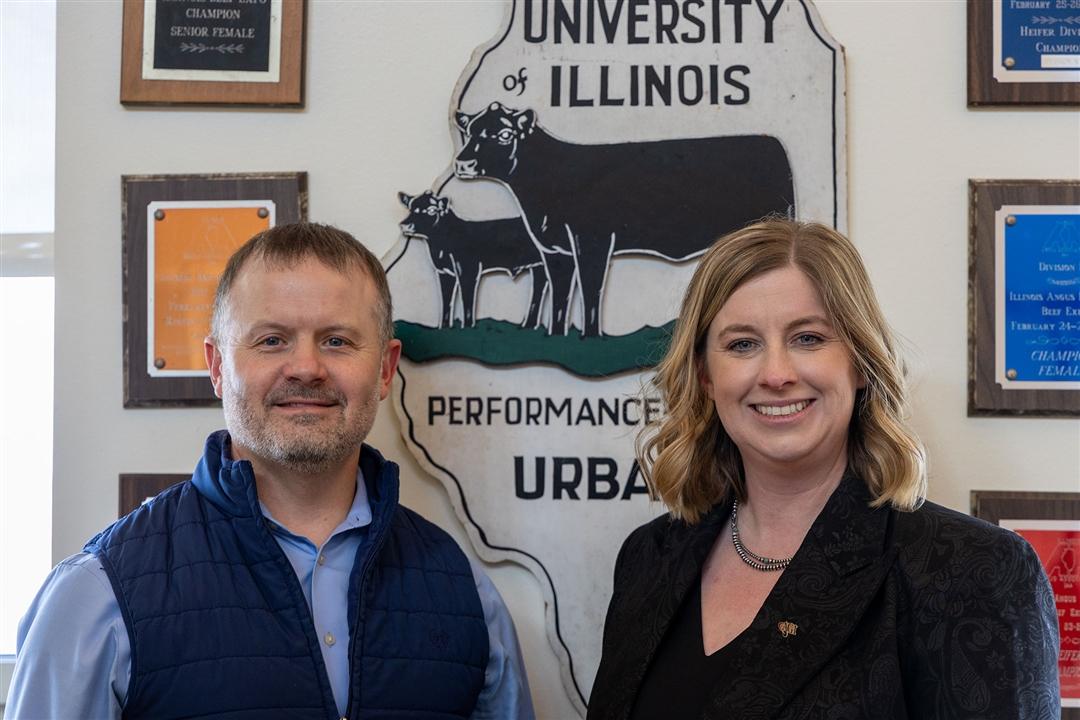
Dan Shike (left), professor and interim animal science department head at the University of Illinois Urbana–Champaign, and Kelli Retallick-Riley, president of AGI, pose as partnership representatives at the beef unit near the UIUC campus in March 2026.

While every operation across the country is unique, all cattlemen face big decisions each year when it comes to herd reproduction. Selecting for the right genetics and choosing ideal matings can be challenging, but genetic selection tools like expected progeny differences (EPDs) and dollar value indexes ($Values) are designed to help producers. The genetic tools are not new concepts, but the time-old question remains: how do producers know they can rely on the numbers?
Angus Genetics Inc. (AGI) has partnered with the University of Illinois Urbana–Champaign (UIUC) to complete a five-year research project to validate several $Values in a commercial-herd setting.
“We get questions from producers from time to time asking, ‘What research has been done to prove that these indexes work?’” says Esther Tarpoff, director of performance programs at the American Angus Association. “That’s exactly what AGI and the University of Illinois are doing in this study, proving how well $Value indexes really work.”
Tarpoff says she has high confidence in the component traits (i.e., EPDs) within the $Values.
“What I’m most excited about is seeing what the research shows about how well-described the economics are within these tools,” she says.
Unpacking the project
Tarpoff explains the project started by breeding 600 Angus-based commercial cows to six different Angus bulls. She adds an important piece of the sire selection comes from using proven, high-accuracy bulls with established performance data to accomplish the project’s goal of validating current indexes.
“This project is not using young, low-accuracy sires because we aren’t looking to ‘prove out’ sires,” Tarpoff says. “We’re using sires that are proven and already have a lot of progeny.”
Once sires were selected for the study, the first cohort of females were bred.
“The first calves were born in the fall of 2025, weaned spring of 2026 and will be harvested in the fall of ’26,” Tarpoff explains. “We have rebred the females for Cohort 2, so we’ll have multiple cohorts of carcass data to go through this index validation project.”
When breeding females for Cohort 2, one bull carried over from 2025 for project consistency, but five new sires were introduced. As for the 2025-born offspring, a primary focus was set on breeding to validate beef value ($B).
“We were very intentional about the sires that we selected, we needed some high $B bulls and some low $B bulls,” Tarpoff says. “You have to have the spread in those in order to be able to see differences. If everybody’s the same, it’s hard to determine the index works.”
Kelli Retallick-Riley, president of AGI, says while the study was first established to evaluate $B, it has been expanded to validate maternal weaned calf value ($M) and combined value ($C), which combines $B and $M. To view which traits are included in each index, visit this link.
“Producers may be wondering why we started with $B,” says Retallick-Riley. “We hoped that this validation project would be successful and continue on past $B; but we wanted to make sure we had a well-designed system first from a research perspective.”
Monitoring results in real time is where faculty at the University of Illinois come into play. Professor and department head of animal science, Dan Shike, explains their facilities make them an ideal host for this type of project.
“We have three farms, but two that are utilized for this project,” Shike says. “One is a large Angus-based commercial herd at our Dixon Springs Agricultural Center, and all of the steer progeny from that herd come up here to campus to our feedlot.”
That feedlot is equipped with the Vytelle feed intake monitoring system, so individual feed intake can be collected throughout the finishing period. Shike adds phenotypes like body weights and dry-matter intake will also be recorded. This project will also collect a full set of carcass data for steer progeny, including hot carcass weight, ribeye area, 12th-rib fat thickness, and yield and quality grades — all traits that drive $B.
Additionally, management traits like foot scores will be collected, and maternal traits like teat and udder scores and others will be collected on heifer progeny as the study progresses.
“As these females are returned back into the herd, we will continue to work on validation around $M,” Tarpoff says. “That is a bigger picture of our research project.”
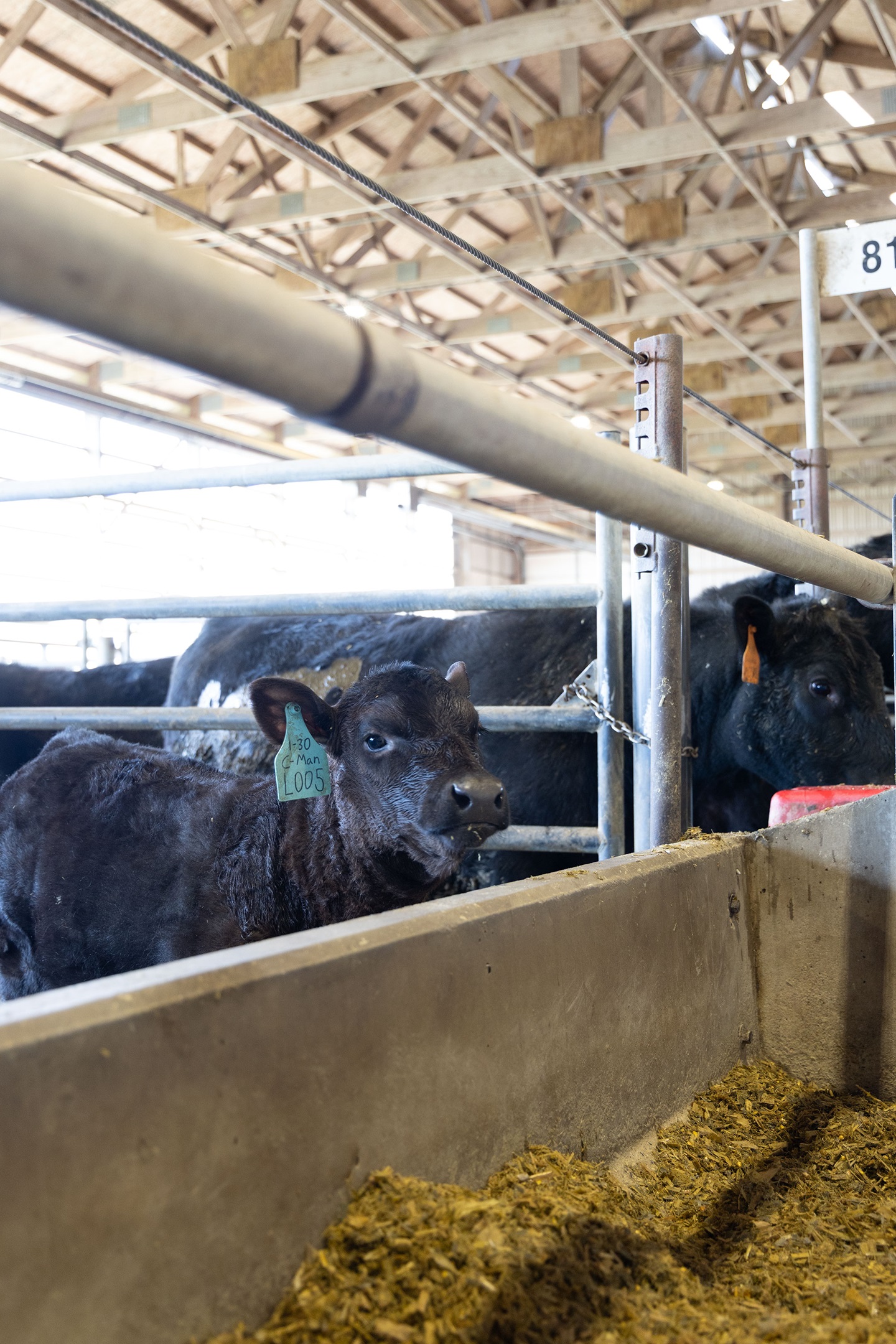

Retallick-Riley says during this multiyear project, results for $B will be available sooner than results for $M or $C.
“Validation of $M requires a longer time horizon,” she says. “Think about all the maternal traits included in it.”
Beyond an available cow herd to perform research and modern technology to accurately depict feed intake results for the study, the multidisciplinary areas of expertise made UIUC a qualified partner, according to Shike.
“We have a couple geneticists that are partnering on this project, another nutritionist besides myself, and two people who are better in the precision livestock management space, using sensors and cameras to collect some phenotypes quicker and more efficiently,” he explains. “At the root of this, we want to validate selection indexes, but it’s also a great opportunity to collect additional phenotypes through the use of computer vision, which could leverage this data in the future.”
$Value to producers
To Smitty Lamb, treasurer for the American Angus Association Board of Directors, this project’s excitement comes in its full-circle practicality.
“I have an animal science degree and one breeding and genetics class — I’m not a geneticist,” he says with a chuckle. “But this type of project I can get excited about because I can relate to and understand results really well.”
Since the study will collect phenotypical data by tracking feed intake, weights of animals and seeing the changes in realtime, Lamb notes it will be easier for “everyday” people like himself to understand. In his eyes, another pro is the genetic merit available for all scopes of production.
“We’re measuring in a commercial setting, which I think is fantastic. We’re using real time, real-world costs; real-time, real-world prices; and real-time, real-world premiums in this study. It’s super beneficial to not only the seedstock producers, but also our commercial customers.”
Producers can expect to hear more information on project results in the future, and carcass data will be received after Cohort 1 progeny are harvested this fall. Retallick-Riley says their commitment to this study is well worth the long-term investment.
“We know these tools impact producers’ livelihoods because they’re making selection decisions, which impacts profitability,” she says. “It’s our responsibility at AGI and to the industry to do our due diligence and affirm they’re doing what we say they’re doing to the expectations of the people using them.”
Editor’s note: Megan Clark is a freelance writer from DeWitt, Iowa.
Topics: AGI Research , Genetics , Association News , EPDs , Record Keeping
Publication: Angus Journal
Related Publications


Current Angus Journal
Keep up on the latest stories of the people and programs in the breed.

Latest Podcast Episode
Don’t miss conversations with breeders and industry experts.