




MARKET ADVISOR
Beef Replacement Heifer Dynamics
A market update.
April 3, 2026
The most asked question recently in the U.S. beef cattle industry is, “When will beef cow herd rebuilding begin.” That question is a result of seven straight years (2019-2025) of beef cow liquidation and record high cattle prices.
A number of obstacles including continuing and expanding drought conditions on a regional basis, production cost inflation, record high beef replacement heifer prices and more beef production due to higher fed cattle carcass weights may be hurdles to herd rebuilding.
One of the pieces to the beef cow herd restocking puzzle is the availability of beef replacement heifers to rebuild the herd.
The USDA-National Agricultural Statistics Service (NASS) released the annual CATTLE inventory report on January 30, 2026. It is available at: https://usda.library.cornell.edu/concern/publications/h702q636h
NASS reported the Jan. 1, 2026, U.S. beef replacement heifer inventory at 4.7 million head, increased 41,700 head (1%) from the 4.67 million head last year indicating some interest in herd rebuilding where forage conditions are favorable. 2025 was the lowest number since 1950, and the slight increase in 2026 was still historically low. So, the availability of heifers for herd rebuilding is another obstacle to significant herd rebuilding.
After the last cyclical low in beef cow numbers on Jan. 1, 2014, with record prices, much improved moisture conditions allowed herd rebuilding to start in earnest. But there were more replacement heifers available then than now. Compared to the 4.7 million heifers available to begin 2026, there were 5.56 million heifers available to begin 2014 and 6.09 million available in 2015.
However, the number of replacement heifers can change throughout the year.
Since 2001, the NASS report has also divided beef replacement heifers into two categories. The first category is beef replacement heifers over 500 pounds (lb.) expected to calve as two-year old heifers in 2026. Those heifers were bred in 2025. The second category is heifers over 500 lb. that may be bred as yearlings in 2026 to calve in 2027.
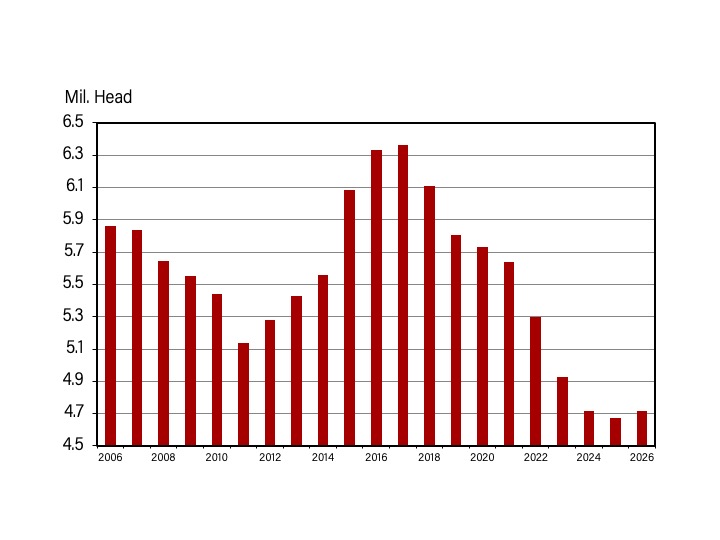
Heifers Held as Beef Cow Replacements
January 1, U.S.

Also reported as “Other heifers” are beef heifers over 500 lb. not reported by producers as replacements.
The number of beef heifers expected to calve in 2026 at 2.96 million head was up 1.4% from 2.92 million in 2025.
All the heifers expected to calve do not enter the cow herd and get reported as cows the next Jan. 1. Some heifers may not be pregnant; others may lose a calf and be sold; and some may raise a calf, but not rebreed or have other issues and be marketed.
The number of beef heifers planned for breeding in 2026 was 1.75 million head, down just 300 head from 2025, and historically low.
The number of heifers reported for breeding is usually only 60-65% of the next year’s heifers expected to calve. For example, Jan 1, 2025, 1.75 million heifers were kept for breeding. On Jan. 1, 2026, there were 2.96 million bred heifers.
The difference comes from the other heifer category. Some cattle producers purchase replacement heifers from the other heifer category to breed instead of keeping their own. Others purchase heifers to develop, breed, and market as a value-added enterprise.
In years when adequate moisture conditions allow restocking plans to begin, the replacement heifer category may need to be adjusted upward if more heifers are bred than earlier planned.
That was the case in the rapid beef cow herd expansion in 2015 and 2016.
The number of other heifers in 2026 was 9.4 million head compared 9.5 million in 2025.
Due to the dynamics of the other heifer category, sometimes NASS revises the previous year’s replacement heifer category. For example, on Jan. 1, 2026, NASS revised 2025 beef replacement heifer numbers up 100,000 head, due to improved pasture conditions is some areas resulting in more heifers being bred.
Keep in mind that NASS numbers are not wrong when they are issued. But they may be revised due to producers changing plans throughout the year.
The number of bred heifers expected to calve in 2026 is up, and there is potential for additional heifers to be bred during 2026 than originally planned if moisture conditions improve.
Northern Plains cattle auction markets are reporting replacement quality, bangs vaccinated, 800-900 lb. heifers from the other heifer category bringing $2,800-3,000 per head, which may indicate optimism.
Topics: Association News , Business , Industry News , Member Center Featured News
Publication: Angus Journal
Related Publication Articles


Current Angus Journal
Keep up on the latest stories of the people and programs in the breed.

Latest Podcast Episode
Don’t miss conversations with breeders and industry experts.