




BY THE NUMBERS
What Does It Take to Become a Legend?
The genetic influence and the long-lasting effect of animals that made Angus what it is today.
April 14, 2026
This month we celebrate the members of the Angus community who helped make Angus The Business Breed we know today. From a genetics perspective, legacies are remembered through the names of the legendary bulls still mentioned in footnotes and from auction blocks year after year.
Undeniably, a lot of work and a little luck is put into creating the exact parent combination that will elevate an animal to the big leagues. Breeders spend years studying pedigrees and potential matings, calculating inbreeding, and looking at expected progeny differences (EPDs) and studying phenotypes waiting for that bull — the one whose genetics will be spread across Angus herds.
Breeders aim to build a legacy and breed animals that reach the peak, but how do you define what the actual peak is?
Some breeders would define it as having the highest Angus dollar value indexes ($Values); others the highest sale price, winning a new banner or registering the most progeny in a year.
The concept of “best” will always be subjective.
Quantitative genetics, however, offer a few more objective answers to what the “peak” of the breed is, how genetic influence is built and what aspects are involved in making it to the top.
More progeny vs. the right progeny
A breeding bull has a simple goal: generate progeny. Because of that, we often associate a bull’s success with the number of calves it fathers in its lifespan. If we dig a bit deeper, would that famous bull be successful if it wasn’t for its sire’s genetics?
In quantitative terms, geneticists deal with this riddle by calculating the marginal genetic contribution, meaning an estimate of how much of a population’s genetics came from a single animal instead of purely relying on the number of descendants. These estimates can be best calculated one generation at a time.
Table 1 presents the latest marginal genetic contribution rankings, calculated using a pedigree with 15 million animals. These values show how measuring the contribution can be different from just looking at descendants.
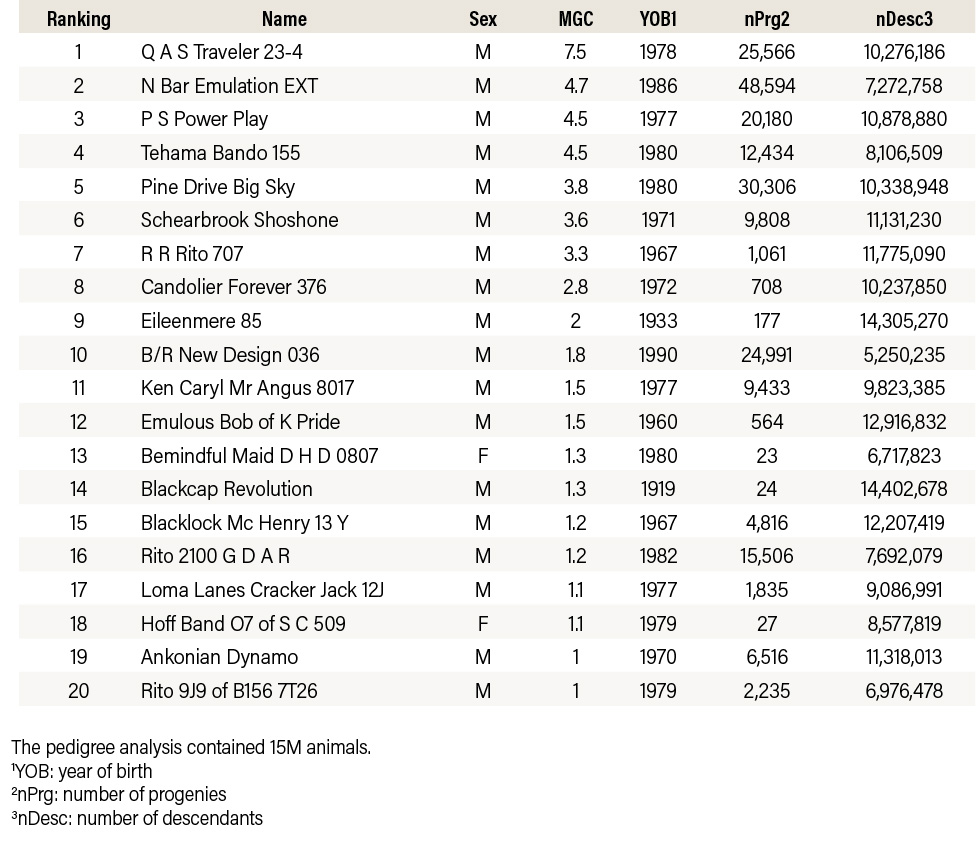
Table 1: Marginal genetic contribution (MGC) of an individual to the genetic variance of the American Angus population through 2024-born calves.

Comparing the first and second ranked sires, we see N Bar Emulation EXT had almost 50,000 progeny in the data, while Q A S Traveler 23-4 has contributed around 25,000 progeny to the American Angus Association’s population evaluated; yet analysis shows Q A S Traveler 23-4 has contributed to a larger percentage of the population’s genetics at around 7.5% through his progeny.
Legacies last for generations
Another interesting point of calculating the marginal genetic contribution is how the contribution of an animal can persist through generations. When the 2024 calf crop was analyzed, a long-lasting effect of older animals in the breed’s population was observed. In fact, the average year of birth of the 10 most influential animals for this group was 1971.
More interestingly, around 19% of the genetics of the 2024 calf crop can still be traced back to Q A S Traveler 23-4 and N Bar Emulation EXT. This shows that even if a straw from a 1970s bull is not being pulled this breeding season, his influence still persists today. A lineage well-built will be seen for generations to come.
It is also noticeable from looking at marginal genetic contribution that once an animal gets to the top as one of the most influential over a population, it is very likely it will remain there. In the past three decades, the list of top 10 animals with more contribution has seen little change, even with adjustments in the industry.
Even though the start of genomic testing decreased the generation interval and made lesser-known bulls with different genetics more visible, it also
highlighted the genetic merit of some of the most used bulls.
Besides that, the influence of the top contributors survives through their progeny’s success. Each generation of highly used bulls continues connecting the new population to their ancestors, perpetuating their genetics.
The top is open to change
The list of the most influential animals is fairly constant, but not permanent. Although Angus has a very large population, popular bulls do trace back at some point to the same ancestors.
These bulls’ sires have proven their value over generations and were part of the monumental progress of the breed. These ancestors most likely have presence in the majority of herds; and because of that, it is very hard to find distinguishable genetics.
Even if a different genetic line is found, the change from a proven bull and a known lineage to an unexplored path is not largely expected. However, preferences on genetics and consumer perception are known to change with time and with that, trait priorities can change.
The dairy industry is a close example of that. Once driven by milk production, the selection index adopted in 1971 went from putting 52% of emphasis on milk to -1% in 2014. Not only were other traits of importance added, but the high selection intensity on production had also driven fertility down; a change had to be implemented in their indexes.
Having different genetic lines in a population helps maintain a healthy genetic diversity within a breed. Diversity functions as a genetic “safe box” in case traits need to be recovered.
With that, the future might hold opportunities for new names to make their way to the top of the Angus breed for their genetic influence.
Your next legendary animal might be a cow
While maternal genetics are important in selection systems, artificial insemination and the effect a paternal line can have on a herd make it easier to focus on the bulls. However, an excellent cow can carry a breeder’s name just as far.
In Table 1, Bemindful Maid D H D 0807 is ranked as the 13th most influential animal in all 15 million animals analyzed, explaining by herself 1.3% of all genetic variance of the breed. She had only 23 progeny, but has more than 6.7 million descendants. By calving important bulls, she had her genetics spread out through the breed. Curiously, if we consider only the calves born in 2024, her contribution to the diversity increased to 2.3%.
This is not an isolated case or a fluke. Out of the 25 top contributors to the genetics of 2024 animals, five were females. In the era of genomic testing, young bulls, and popular sires, putting in the hard work on a dam’s genetic line is one approach to producing a generationally influential animal in the Angus breed.

Larissa Novo, AGI® Research Associate

Topics: Genetics , Member Center Featured News , Association News , EPDs
Publication: Angus Journal
Related Publication Articles


Current Angus Journal
Keep up on the latest stories of the people and programs in the breed.

Latest Podcast Episode
Don’t miss conversations with breeders and industry experts.