






Raising Kids, Raising Cattle
Data-driven breeders and community leaders Tom and Carolyn Perrier honored as 2025 inductees into the Angus Heritage Foundation.
February 9, 2026
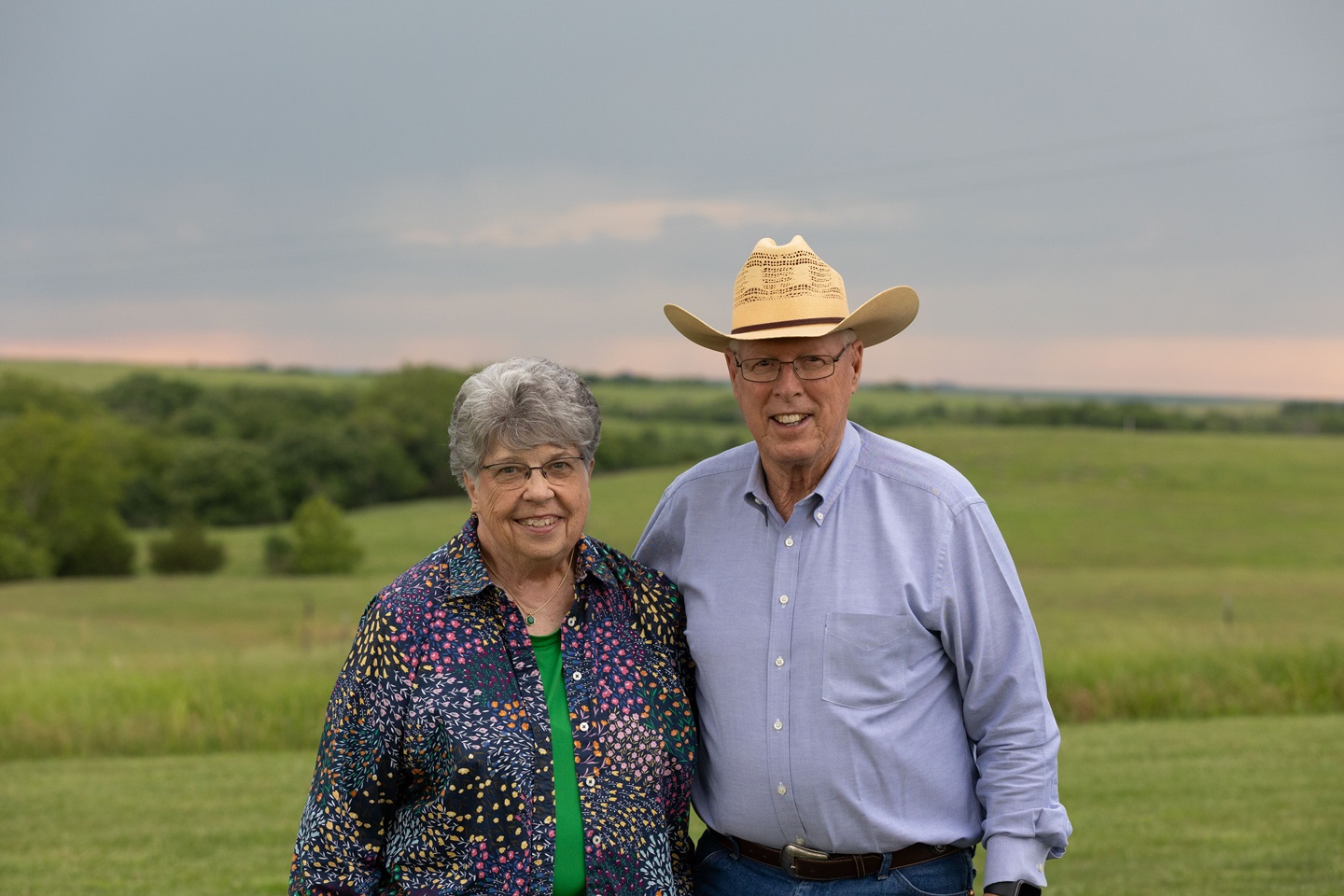

Tom and Carolyn Perrier of Dalebanks Angus both wear bright smiles as warm conversation surrounds their family’s dining room table. Whether it’s a gaggle of grandkids, friends from a local volunteer board or longtime colleagues in the cattle business, the couple enjoys sharing a good meal with those who share their servants’ hearts and a drive to make meaningful progress at whatever they do.
Nestled in the Flint Hills near Eureka, Kan., Tom and Carolyn follow a long line of Angus breeders at Dalebanks Angus, dating back to the early 1900s.
The couple has been leaving their own mark on the place for decades through their service to customers, their local community and trade organizations, commitment to data collection and leading their family by example. In their current season of life, they are able to both remain meaningful contributors and sit back at times to enjoy the fruits of their labor.
“I don’t have the day-to-day worries of going and feeding the cattle and treating something if it needed to be,” Tom says. “I get to be there when I want to be there, when we’re [breeding by artificial insemination] or we’re working cattle through a chute.”
Family ties
Their favorite part of their current work is seeing the next generations in action on the ranch and in their communities. Tom says he admires how they are advancing their herd and providing a quality product to their customers.
“Tom has a saying that they raise cattle, but they really are in the kid business,” says Amy Perrier, Tom and Carolyn’s daughter-in-law. “They love the time that they’ve spent raising their kids here; and now that our kids are here, they just really eat that up.”
Tom and Carolyn first raised three children of their own: Matt, Michele and Mark. All three now share ownership of Dalebanks Angus alongside their parents. Each has found success in their chosen career fields and with family.
Matt is the one full-time on the ranch, managing day-to-day operations. Collectively, the siblings have nine children.
“They’ve all got the Perrier traits: can’t sit still, want to do everything, want to be involved in everything,” Tom says. “They go in six directions at once.”
Carolyn says she finds it meaningful that her own children and grandchildren — and farm kids in general — get to be hands-on in learning how their family earns a living.
“The kids seemed to just grow up being a part of it,” she says. “Coming from the city, I really didn’t even know what my dad did. He had an office that he went to every day, as he worked for Folgers Coffee Company in downtown Kansas City; but I really didn’t know what he did.”
Carolyn’s parents had moved from parts of rural Missouri to Kansas City for work during the Great Depression. She says while she grew up in the city, both sides of her family still operated farms.
“Living on a farm or a ranch wasn’t as foreign to me as it might have been to other city girls,” Carolyn says. “I always thought there was lots more action, particularly in the summer, when I visited cousins.”
She and Tom met while students at Kansas State University.
“Everyone was giving me a bad time about ‘city girl and farm boy,’” Carolyn says. “I got a lot of grief from some of my friends, but we did have a good time and continued to see each other.”
Eager to improve
As Tom was finishing his undergraduate degree, he says he knew he loved the academics of school and was especially intrigued by his artificial insemination (AI) and reproductive physiology coursework. He decided to apply and was accepted to graduate school at the University of Maryland.
Timing wasn’t on his side though. This was the Vietnam War era, and his plans became complicated. Tom decided to sign up for the National Guard to try and salvage the possibility of going to graduate school. In the spring of 1968, his unit was called into active duty, ending that plan.
“Instead of staying on the ranch or going to grad school, I ended up in the army for another year and a half,” he says.
By the time his service was up, he decided he was “too old to go to grad school,” so the couple moved back to the ranch in 1969.
Amy says Tom has always been a researcher and has applied that mindset to his current work. She compliments both her mother-in-law and father-in-law on their ability to persevere through hard times, including the 1980s with the treacherous economic conditions of the Farm Crisis.
“The Angus business has been their life — not just their livelihood, not just their income, but it’s really just been their life,” she says. “They’ve committed everything to it. It was very difficult for them in the ’80s, making the transition from Tom’s father owning the ranch to Tom initially working with his brother and eventually just Tom and Carolyn being on the ranch.”
With each transition, she says they were strategic in their decision-making and applied great determination toward their goals.
“They’ve just always made a really good team,” Amy says. “They both have strong opinions, but they work it out and talk through it and decide on a plan; and one or the other of them makes sure that it gets done.”
She says it is these types of qualities that make them deserving of their 2025 induction into the Angus Heritage Foundation, which celebrates innovators and visionaries who possess drive and wise decision-making skills to better the breed and the industry.
“They are what the Angus breed is about,” Amy says. “They are all about good cattle and good family.”

Climbing to the top
Not taking the breed’s current position in the industry for granted, Tom remembers Angus being a smaller portion of the national cow herd during his upbringing.
“I was raised in the Angus breed, and I saw the advantages that Angus cattle had,” he says. “Even into the ’70s, our advertising campaigns were mainly to try to convince people to use Angus bulls; and then hopefully we could convince them to use a Dalebanks Angus bull.”
During the past 50-plus years, the Perriers have kept their focus on customers during the breed’s laborious climb to the top.
“Our customer base is the commercial cattleman, and we have to provide a product that works for him; and then he has to provide a product that works on down the line,” Tom says. “Every decision we make is with that man, that commercial cattleman, in mind.”
Typically more than 90% of their bulls are sold to repeat customers, and the Perriers continue to rise to the challenge of offering a phenotypic and genetic package that can go to work for the industry.
“We also know that the product we’re providing today is different than what it was years ago,” Tom says. “It’ll probably be different tomorrow, but some of the same traits that we’ve worked on for years and years, we want to maintain and just improve on everything. We’re not doing way-out stuff, but we’ve done a lot of things that we think should be done and try to do it as correctly as we can.”
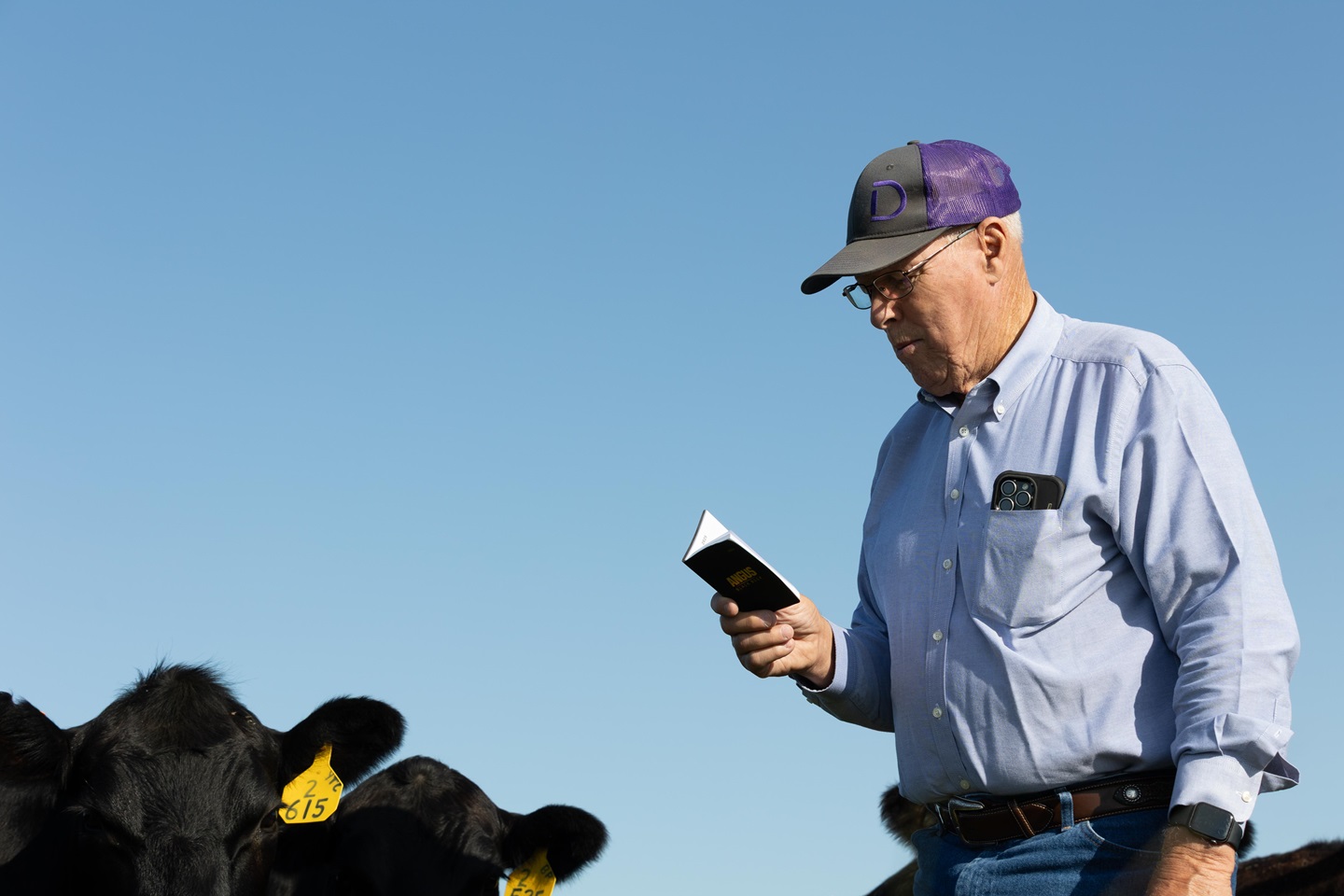
Tom is a well-known proponent of using data and data-fueled tools to help make improvements in their herd and meet the demands of every segment of the industry. Being in his 80s, he calls himself “semi-retired,” but a major contribution of his continues to be data submission and financial and accounting work.
Nationally, their herd stands out for their data contributions. Dalebanks Angus was recognized as a Gold Level Data Driven Herd in 2025 as part of the program’s inaugural year. To earn the top recognition level, Gold, herds must submit at least 12 traits, meeting the minimum number of required phenotypes for each trait and also earn Inventory Reporting MaternalPlus® status.
“We’ve concentrated on it and we’ve tried to find tools — and help the American Angus Association find those tools and develop those tools,” Tom says.
Evolutions in data
Tom credits his brother, Charles “Chuck” Perrier, as an early influence on their herd’s commitment to data collection.
“When my brother graduated from Kansas State University in 1963 and came back to the ranch, he decided we needed to do some things differently, because it was well known that Angus cattle didn’t have the growth rate that some other breeds had,” Tom says. “We decided to enroll our herd in the AHIR® (Angus Herd Improvement Records) program, which back then was in its infancy.”
At that point, it was more of an evaluation than a recordkeeping and submission program.
He continues, “When I got out of the army in late 1969, my brother and I looked at things and thought we needed to expand the traits that we were measuring.”
They expanded from collecting weaning weights to include yearling weights and then birth weights. Tom says at that point, the information was helpful in identifying cows that consistently weaned a light calf and in drought years provided information to help them cull cows. At the same time, their data was only in-herd comparisons.
“To actually make major progress and provide information to our customers, it really wasn’t doing enough,” he remembers.
Fast forward to 1972, and the Association decided to relax rules around AI. Tom says he jumped at the chance to work with these changes for two reasons.
“One is we could use some bulls that we couldn’t afford to use otherwise,” he says. “The second reason was the ability to make better comparisons outside of the Dalebanks herd.”
Just a few years later, Tom says they contributed their data to a research program with Iowa State University and the University of Nebraska, which would produce the 1980 AHIR Field Data Report. Tom identifies this as “the first meaningful sire evaluation,” because there were hundreds of bulls listed.
“It was a game changer both for our herd and for the herds of our customers, because we had more reliable information. We lobbied for that, and we continue to lobby ever since for more and better tools to help us and to help our customers,” he says.
Carolyn notes communication as the biggest change to their work since coming back to the ranch.
“The marketing of bulls on our ranch was much different then,” Carolyn says. “Tom could only contact prospective buyers by telephone in the evenings because no one had cellphones.”
Tom’s office was in one corner of their family room, and Carolyn remembers playing many games with the children in the evenings to keep them quiet during these customer calls. She also reflects on the revolutionary effect computers have had on their business. Tom was an early adopter of computer technology, purchasing their first PC in the mid-1980s.
“Somebody has to feed that information in, but then it’s just amazing what then comes out and how you can use that to analyze your operation and your cattle,” Carolyn says.
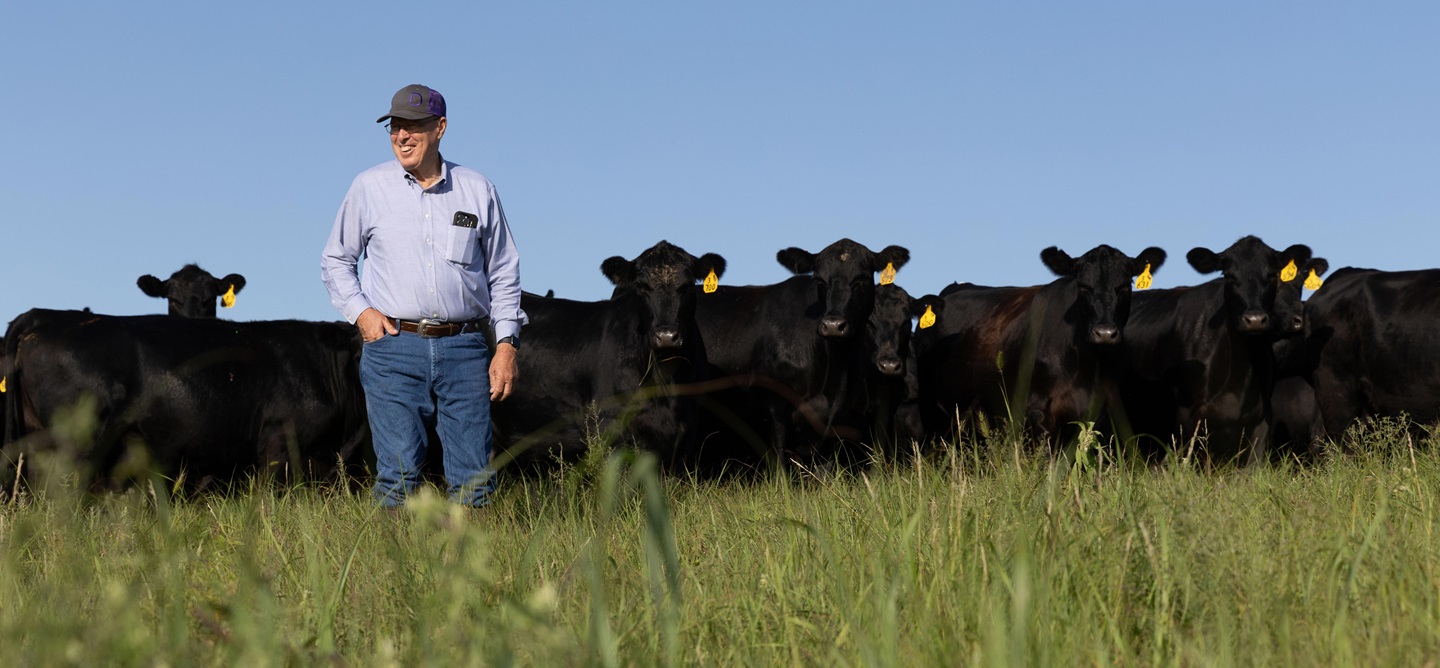

I was raised in the Angus breed, and I saw the advantages that Angus cattle had. Even into the ’70s, our advertising campaigns were mainly to try to convince people to use Angus bulls; and then hopefully we could convince them to use a Dalebanks Angus bull.” — Tom Perrier
While progressive in their management through the years, the Perriers have stayed away from fads in breeding.
“He laughed about [when] our cattle were too big by the 1950s standards, when they were wanting them belt-buckle high,” Matt says of his dad. “Then they blasted through that in the 1970s, ’80s and early ’90s, and our cattle were too small.”
He adds that breeders have become more centered again on valuing maternal characteristics and form and function in their cattle.
“All of a sudden, our cattle are kind of in vogue again.”
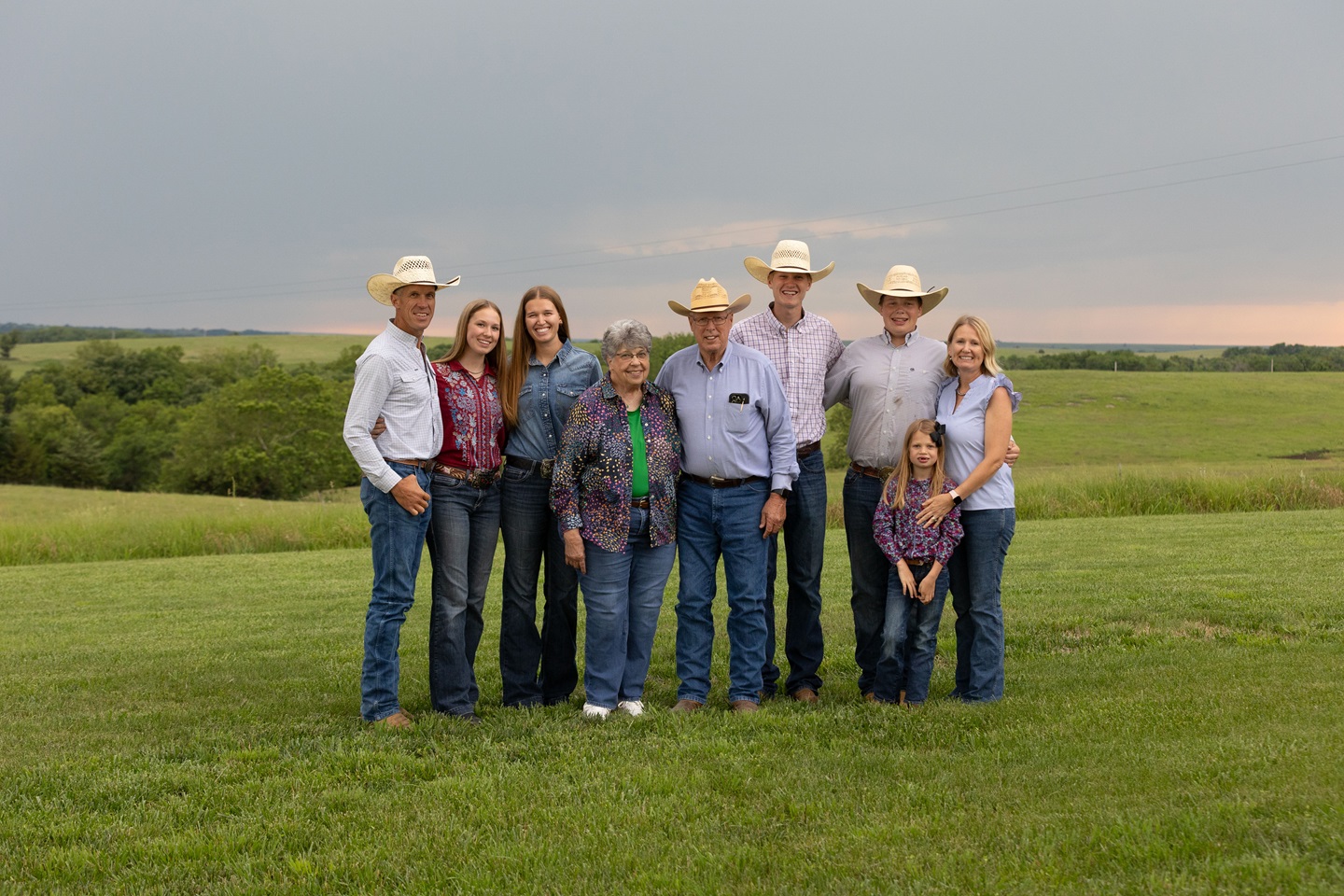
The Perriers (from left) are Matt, Hannah, Ava, Carolyn, Tom, Lyle, Henry, Hope and Amy.

Leading by example
Matt says “trendsetters” is the right label for his parents in the arena of civic mindedness and leadership.
“They love being involved in community organizations,” Matt says. “They’ve seen the needs. They’ve seen the opportunities, and they’ve figured out ways that they can be part of those solutions by leading civic groups.”
Tom says his father modeled these behaviors for him and his two brothers. Serving as part of local groups helped Carolyn become connected in the community during her early years on the ranch.
“I thought that’s what you did in a small town was join things and be a part of things,” she says.
Tom and Carolyn’s résumé as community leaders ranges from their county cattlemen’s association to Farm Bureau and the school board to the local fair board. In livestock circles, they have been active in the Kansas Angus Association and Kansas Livestock Association. Tom also served on the American Angus Association Board of Directors from 1989-1995.
A current Board member at that time approached Tom to ask him to run for the Association’s Board.
Tom recalls, “I said, ‘Oh, there’s several others that probably want the position.’ He came back at me hard and fast and said, ‘Yes, but we need you.’”
Tom says he had no real ambition to be a Board member. He considered his brother Chuck to be more well-known in Angus circles, but he had left Dalebanks Angus to pursue other agricultural interests at that time.
“I kind of ran on saying I didn’t have an agenda, but I did have a little agenda,” Tom says. “That was the data, and that was the performance programs.”
He says he thought the Association needed to continue developing those areas.
Carolyn remembers Tom’s time on the Board as one of her favorites, because of the women she connected with through his commitments.
“We understood the business, and we understood what everybody was going through,” she says. “We were the only ones that understood each other sometimes.”
Amy says for all their involvements — past and present, on the ranch and in the community — Tom and Carolyn make the hard work look easy and inspire others, including their grandchildren.
“My daughter made the comment the other day that she wants to continue all of the community activities that her grandmother, my mother-in-law, has been involved in,” Amy says. “They’re just out doing their things that they need to do every day, and usually with a smile and a positive attitude.”
Topics: Award winner , Member Center Featured News , Association News , Business , Industry News , News , Ranch profile , Success Stories
Publication: Angus Journal
Related Publications


Current Angus Journal
Keep up on the latest stories of the people and programs in the breed.

Latest Podcast Episode
Don’t miss conversations with breeders and industry experts.