




BY THE NUMBERS
Speaking the Language of DNA
Decoding cells’ alphabet to make genetic progress.
January 8, 2026
Turning the calendar over to 2026 brings forward new opportunities to make goals. Could this be the time to learn the “language” of DNA?
As living organisms, we all have built-in instructions on how we should grow, function and reproduce. Those instructions are written in our very own language housed in our DNA. Every living thing speaks using the same four letters: A, C, T and G.
These DNA letters form genes (i.e., the words) and ultimately dictate how an animal functions. Although built from only four letters, the bovine genome contains approximately 2.8 billion pairs of letters and 30,000 genes. Because of its complexity, it takes multiple steps to turn a simple DNA sample into an expected progeny difference (EPD).
Cracking the code
When a member sends a DNA sample to Angus Genetics Inc. (AGI), the customer service representative processes the sample, ensures order accuracy and mails it to the genomic laboratory. Provided only with the sample barcode as animal identification, the lab specialists will extract the DNA, and send the raw information and translate DNA from the ACTG alphabet to AB genotypes used by AGI as exemplified in Table 1.
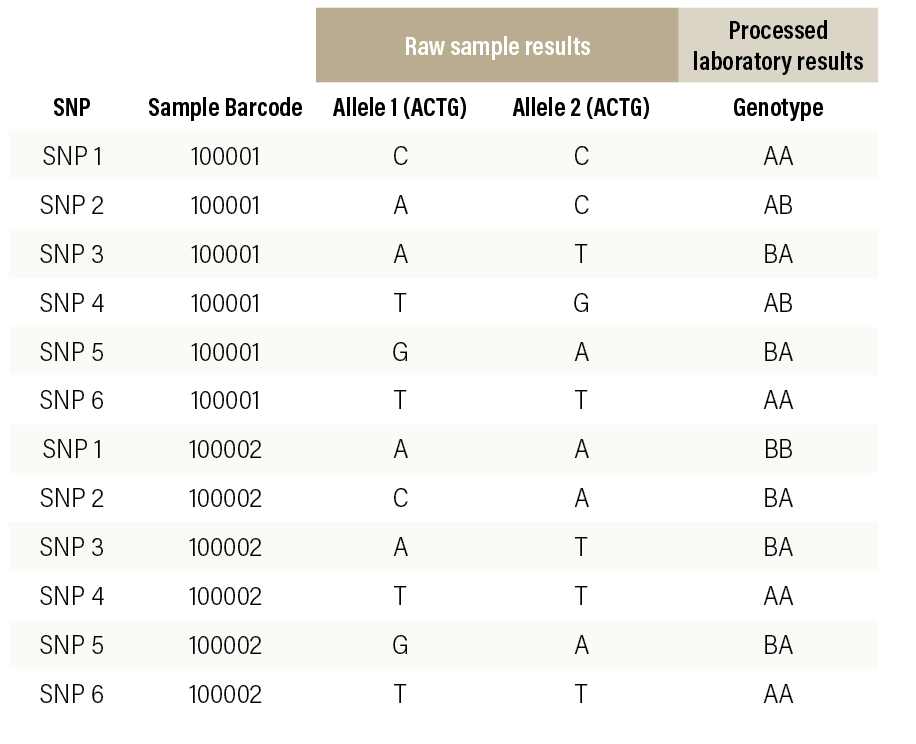
Table 1: Example of information extracted from two DNA samples submitted, displaying the alleles identified by the partner laboratory, and the genotypes received by AGI.
The genotypes are saved in the AB format to ease the interpretation and to save space by removing a character between the letters.

In other words, the lab scans the DNA to identify genetic markers — like finding “words” in a long instruction manual. They don’t interpret what those words mean; they simply create a digital copy of the animal’s genetic code and send that raw genotype data back to AGI. Once AGI receives the data, our team matches it to the correct animal and the analyzing begins.
After that, we geneticists have two jobs: perform research to decode and translate the instructions, and use the information to predict the performance of individuals.
AGI has a team that covers both phases. We decode the DNA and translate the information to a new trait, such as with the ongoing Fertility Haplotypes Project. Secondly, we apply what was found for prediction. The National Cattle Evaluation is an example of this type of activity.
Finding words that matter
DNA technologies have evolved drastically in past decades, and today each one serves a different purpose.
The 2.8 billion pairs of letters help with research about gene regulation, possible gene mutations, ancestry or functional traits. Using all this information at one time, however, is not recommended for genetic evaluation purposes, as not all DNA is informative or codes for a gene.
Therefore, most of the technology applied to assist with genetic selection on a routine basis uses only informative parts of the DNA, which are known to be related to a trait or are of interest for research.
The technology used by AGI today is called a SNP (read as “snip”), which stands for single nucleotide polymorphism. A SNP is a one-letter marker from a set, defined based on previous research. They are distributed throughout the genome and have economic or biological importance to animals of interest.
Because of that, devices made to read only markers of interest such as SNP chips are a good option. They help avoid parts of DNA that are either irrelevant, non-informative, or do not represent the genetic differences between individuals.
Yet, having more SNPs does not always equal more information or accuracy. The right number of SNPs is always a balance between reduced costs and accurate description of the genetic makeup of the population.
Although the composition of the SNP chips stays fairly constant over the years, the development of new phenotypes, research or technologies pushes us to periodically revise these tools to ensure samples are run using an up-to-date set of markers.
Genotyping vs. phenotyping
One of the most frequent reasons for genotyping is the ability to obtain a genetic evaluation for non-phenotyped animals. This is not only possible, but also a good way to obtain genetic progress for this class of individuals. It is especially appropriate for those traits that need to be captured later on in life (e.g., ultrasound carcass data) or those that are sex-limited (e.g., scrotal circumference or heifer pregnancy).
Another advantage explored by AGI is the use of genomic information to improve the estimation of relationship between animals. In pedigree-only evaluations, the relationship used is based on what is mathematically expected between relatives (e.g., 50% between parent/progeny, 25% between half siblings). With the genomic information, however, the actual proportion of DNA shared between individuals is measured.
Since 2017 AGI has been using the single-step method that combines both genomic and pedigree information to estimate accurate relationships. This method makes it possible to connect animals not tied by pedigree via genomic relationships. In such cases, the single-step assists with non-phenotyped animals by connecting them to the phenotypes of their genomic relatives.
Although it facilitates the estimations for specific groups, there are still compelling reasons to stand in support of the combination of genotyping and phenotyping all groups of animals.
Firstly, mutations may occur. Markers’ frequency in the population may change over time and become fixed, meaning all animals in the population have the same markers. The consequence is one of the SNPs used to differentiate the animals is then no longer useful at describing the differences between animals and may be removed from the analysis.
Secondly, what we currently know of how much each SNP affects a trait is dependent on the phenotypes used for the research. Without updating the information, predictions and estimates are stuck in the past. With the single-step method, current animals would be connected to outdated phenotype records, even when no pedigree connections are identified. Such effects could be suppressed, however, by records of the current animals.
Finally, markers assist in measuring the phenotype affected by genetics and in theory, these values would not change. For most of the established traits, research has good information to estimate the effect of markers on a population, covering different levels of selection and management.
However, even for well-recorded traits such as weaning weight, the environment piece of the genetic selection is affected with time. If we had stopped recording cow mature weight 10 years ago, would the management practices, contemporary groups and environment be the same?
The genotype-by-environment effect is a part well known by producers, but the other trick genetics play on us geneticists is called epistasis. Not only do genes interact with the environment, but they also affect each other. Without updated phenotypes, new interactions would not be detected in a research setting and could affect genetic predictions in the long term.
Regardless of the current or future DNA technologies, the phenotype = genetics + environment formula ingrained on breeders’ minds still carries a lot more than the genetic effect. The accuracy of any estimate will fade over the years if the phenotypes are stuck in time.
That’s why the Association praises members who collect information. Individual animals that are genotyped and phenotyped, or are closely related to the phenotyped population, are known to have a higher degree of EPD accuracy than those who are further removed.
Some may argue over replacing data recording with DNA sampling. Well, the phenotype is king, and the genotype was never meant to be a successor to the throne.

Larissa Novo, AGI Research Associate

Topics: Genetics , Member Center Featured News , Association News
Publication: Angus Journal
Related Publication Articles


Current Angus Journal
Keep up on the latest stories of the people and programs in the breed.

Latest Podcast Episode
Don’t miss conversations with breeders and industry experts.