




Grazing Stalks: Effective for Both Agriculturalists
Wintering cattle on harvested crop fields from a Midwestern perspective.
November 19, 2025
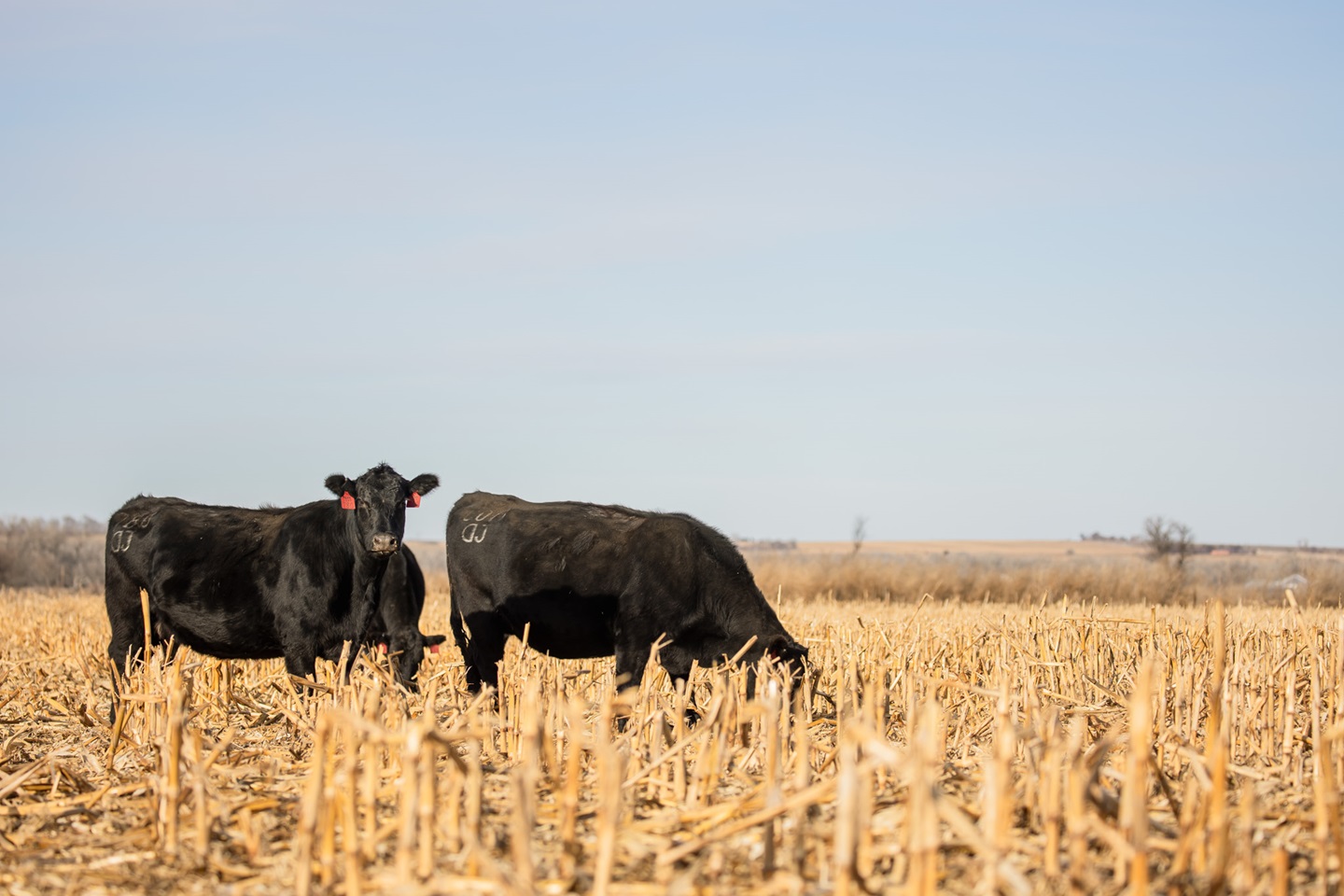

Temperatures drop, autumn leaves fall from trees and the stover-dusted combines cool their engines after another bountiful harvest — it’s a sigh of relief for most. However, the work isn’t done for crop-farming cattlemen. Their next task, happening just days postharvest, is moving cows to graze on residue left in harvested crop fields.
Normally in late October to early November, cows are moved from their summer-grazing pastureland to the typical corn and soybean or occasional milo field promptly after harvest is complete. The time frame for grazing varies based on weather during autumn months, according to Iowa State University beef extension specialist in northeast Iowa, Denise Schwab. She explains the main reason for grazing cows on harvested fields is the financial benefit to producers.
“It’s our least-cost option for feeding cows in the wintertime in Iowa, and probably in most states as well, because all of the cost for the forage that’s left behind has already been covered by the grain crop cost,” Schwab explains. “The only costs related would be if we have to haul water or put fencing up, and the labor to move cows, check them and potential things like that.”
She mentions the practice can even be labor-saving, especially for no-till crop farmers as it allows the next year’s crop seeds to germinate easier.
Brandon Meyer, owner of the family-run 4M Angus operation in Nebraska, would agree with the extension specialist.
“It helps us the following year, because cows get rid of some of that residue and [that] helps for spring planting,” Meyer says. “It warms the soil and just gets a better stand for our crops.”
Another upcycling opportunity is the manure left on-field by cows, saving producers from hauling fertilizer from a dirt or concrete lot to crop fields in the spring. He says cows work manure into the soil by exercising as they graze, but he cautions keeping cows on the same field for too long if moisture levels increase rapidly.
“With heavy rains or really any rain for that matter, you go through a field pretty quickly,” Meyer notes. “A cow will stomp residue into the ground, and then we need to try and take them off as we don’t want to create damage for the following year’s crops.”
Proof is in the field
On the flipside, soil compaction is a concern for many farmers. However, research completed by Iowa State University in southwest Iowa helps debunk some misconceptions relating to compaction problems when cows winter graze on fields.
“The data showed as long as the cows were pulled off the cornfield before we get spring moisture and thaw, we saw no compaction issues,” Schwab says. “That freezing-thaw action really helps to break up whatever compaction might have started during the fall.”
Both can agree producers are fortunate if they can keep cows on fields until early spring.
In those cases, Meyer says snowfall typically isn’t a problem for his resilient mama cows.
“If we’ve had a fresh three or four inches of snow, they’ll eat right through it,” he says. “A little snow doesn’t bother us, but ice becomes a bigger issue because cows can’t dig through it.”
The severity of winter weather is a determinant of when cows need to come back from grazing fields, but the greater factor remains in the quality of feed the crop residue provides as the season continues.
“We usually say when we run out of leaf and husk in a field of [corn] stalks, we will pull the cows off because the leaf and husk is the highest quality feed in the field,” Schwab explains. “We don’t want to make them eat only stalks, because it’s very low in feed quality.”
Other variables affecting the timeline of this winter grazing pattern include number of cows, field acres and the amount of residue available to the animals.
“Unless we have the ability to rotate into new fields, we probably don’t have enough feed quality to really keep cows out there with the assumption that’s their sole feed source,” Schwab notes. “We’ll have a lot of producers that will winter on cornstalks but supply supplemental feed past that late-December point.”
With more silage availability in Iowa, Schwab says it’s not uncommon for cattlemen to supplement it or deliver hay bales out to stalks.
“The combination works well because the silage is going to provide us our protein and energy, then cows can still keep grazing the last few husks left,” she explains.
Meyer says an additional energy source is the leftover corn from harvest that found its way to the ground, instead of a grain bin.
“In a perfect world, we would have no corn on the ground. But everybody everywhere knows that’s usually not the case,” he says. “You can have too much corn, but having some corn out there for an energy source for cows is good.”
With his set of January-calving cows, the extra corn energy keeps them content in their last trimester. In typical years, these cows graze on stalks until late December, right before coming home to start calving season. However, Meyer says mild winters may extend the stay for the late-calving females.
“There [are] years like last year, we had a really open winter here [in Nebraska] and it was warm without much snow,” he notes. “I know there were cows on cornstalks yet in March.”
Schwab says grazing cows on fields into early spring typically isn’t manageable without extra feedstuffs. As a result, Iowa State University has conducted thorough research on swath grazing in winter months to keep extra days onfeed for cows to a minimum.
“We’ll rake sudangrass into tall windrows and strip graze it so the cows can find the windrows easily,” she explains. “It doesn’t get quite as much weathering because it’s built up instead of spread out on the soil, so you can graze a little later with that.”
Iowa State’s research concluded that with a reasonable winter, cows can swath-graze up to March, too. In many cases though, Schwab says additional feed is normally required in the February time frame.
For more information on incorporating swath-grazing in your management system, she encourages producers to visit the Iowa Beef Center website forage section. The Cyclone credits the University of Nebraska–Lincoln and also encourages producers to visit their online publication titled Grazing Crop Residue with Beef Cattle for more overall winter grazing advice.
Meyer summarizes winter grazing on fields plain and simple: “It’s a cost-effective way to feed cattle.”
Whether you’re a rancher with some crops, or a farmer who’s renting out harvested fields to nearby beef producers, winter grazing on crop residue is a win-win for both agriculturalists.
Editor’s note: Megan Clark is a freelance writer from DeWitt, Iowa.
Topics: Association News , Feedstuffs , Health , Management , Member Center Featured News , Nutrition , Pasture and Forage
Publication: Angus Journal
Related Publications


Current Angus Journal
Keep up on the latest stories of the people and programs in the breed.

Latest Podcast Episode
Don’t miss conversations with breeders and industry experts.