


DATA DIVE
Are You a Data-Driven Herd?
Launched in August 2025, breeders can now earn one of three recognition levels — gold, silver or bronze — for their commitment to data collection and submission through AHIR’s Data-Driven Herd program.
August 20, 2025
Since Angus Herd Improvement Records (AHIR®) was established in 1958, Angus breeders have answered the call to collect and submit phenotypes on their herds. These phenotypes have been used to create numerous genetic selection tools for registered Angus cattle and continue to fuel the weekly genetic evaluation.
During the last several years, the American Angus Association Board of Directors has been discussing ways to better recognize herds who continue to contribute to the AHIR program. Data-Driven Herd highlights those committed to improving both their herd and the Angus breed.
Current AHIR Programs
The Pathfinder® program was established in 1978 to identify individual females that breed early as heifers and consistently remain in production while weaning above-average calves for the herd.
Inventory Reporting is the Association’s whole-herd reporting program that ensures complete production records on all females in a herd are reported annually. All herds participating in Inventory Reporting and its second tier, MaternalPlus®, are recognized on www.angus.org. Females who qualify for MaternalPlus also have displayed the logo on EPD (expected progeny diference)/Pedigree Lookup.
In 2021, phenotypic traits submitted for individual animals were listed on their registration certificate and EPD/Pedigree Lookup. The traits listed in bold indicate those phenotypes that are currently included in the genetic evaluation.
In August 2025 a new recognition program, Data-Driven Herd, was launched. This program aims to recognize herds who contribute to AHIR by submitting sets of phenotypes on a variety of traits each year. Qualifying herds will be recognized annually at one of three levels: bronze, silver or gold.
How to qualify
The first step to qualify for this recognition program is to participate in Inventory Reporting with at least five cows enrolled. Herds must be actively participating in whole herd reporting to establish their active inventory of females. The number of enrolled cows in your herd establishes the base for the minimum number of required phenotypes for each trait.
In addition, a herd’s registrations during the award year must equal at least 50% of the active cow herd inventory. For example, if a herd has 50 cows enrolled in Inventory Reporting, there must have been at least 25 animals registered during the award year.
To qualify for the bronze level, herds must also submit at least eight traits, meeting the minimum number required for your individual herd, which is based on the number of cows enrolled in Inventory Reporting.
To earn the silver level recognition, herds must report at least 10 traits, meeting the minimum number required for your individual herd.
To earn the top recognition level, gold, herds must also be earning Inventory Reporting’s MaternalPlus status, and submit at least 12 traits, meeting the minimum number of required phenotypes for each trait.
Each award year includes data submitted Oct. 1-Sept. 30. The period aligns with the Association’s fiscal year.
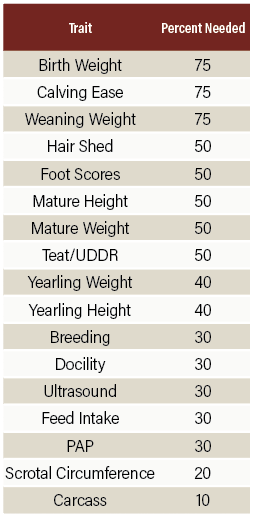 Table 1 lists the required percentage needed for each trait. For example, if a herd has 100 cows enrolled in Inventory Reporting, to meet the minimum requirements for birth weight, 75 birth weights would need to be submitted from Oct. 1-Sept. 30. This allows room for females that may not have a calf born because they were a donor, moved a calving season, a calf dies, etc.
Looking at another example, scrotal requires a minimum of 20%. For a herd with 100 cows enrolled, at least 20 yearling scrotal measures are required. Twenty percent is required for scrotal as we consider that approximately 50% of the calf crop will be bulls, and not all those bulls will remain in the herd until yearling age.
The percentages were set to be attainable to achieve, but also realistic regarding each specific trait and the number of records a herd may be able to collect. Keep in mind, while the minimum number of phenotypes were set for meeting the requirements of the program, submitting complete contemporary groups is still the best practice for genetic comparisons.
Complete contemporary groups are the best way to ensure that calves receive credit for their performance within the herd. If records are not reported, it affects all the calves within a group, not just the calf with a missing record.
For phenotypes to meet requirements for each trait, they must be collected within the appropriate age window for the individual trait. The program is designed to recognize herds that are contributing at an above-average level. The parameters for the program may be reviewed and updated as needed.
Herd recognition
Recognition will be awarded annually at Angus Convention. Herds earning the Data-Driven Herd status will also have access to the logo for use in advertising.
The first recognition will be awarded at the 2025 Angus Convention in Kansas City, Mo.
How to determine your status
To view your current status, you can visit your AAA Login account on www.angus.org. On the homepage in the AHIR widget, click on the green “New AHIR Data Driven Herd Recognition Program” button.
This will load a dashboard that lists details about the program as well as your herd’s current status. The current status of the herd is for data submitted during the fiscal year (Oct. 1-Sept. 30). Listed are the number of cows currently enrolled for your herd, the number of registrations since Oct. 1, 2024 and the number of completed traits.
There is also a table that lists the minimum number of phenotypes needed for each trait for your herd as well as how many are submitted. If a trait has a green check mark next to it, the minimum has been met for this program.
For decades, Angus breeders like you have been dedicated to collecting and submitting phenotypes. Due to this commitment, the Angus breed has the largest single beef breed database in the world.
These continued efforts support the genetic advancement of the breed and ensure seedstock and commercial herds have accurate selection tools for their breeding programs

Esther Tarpoff, Director of Performance Programs

Publication: Angus Journal
Related Publication Articles


Current Angus Journal
Keep up on the latest stories of the people and programs in the breed.

Latest Podcast Episode
Don’t miss conversations with breeders and industry experts.