




BY THE NUMBERS
The Value of Phenotypic Data and Genomics: Progeny Equivalent Refresher
Harnessing the power of phenotypic data and genotypes.
February 6, 2026
One of the most significant advancements in beef cattle breeding in recent years has been the addition of genomic information into genetic evaluations that produce expected progeny differences (EPDs). By adding genotypes from DNA data to an already extensive database of phenotypic and pedigree information, prediction accuracy has been dramatically improved, especially for young animals that haven’t yet produced calves.
Instead of waiting years for a bull or cow to accumulate progeny records, genotyping provides a similar level of accuracy to those achieved with progeny records earlier in life. This advantage is quantified through a concept known as progeny equivalents (PE). PEs measure how much additional information a genotype contributes compared to traditional pedigree and performance records. In short, genotyping doesn’t replace traditional methods and phenotypes; it complements them, improving selection accuracy of young animals and accelerating genetic progress of the beef herd.
When a young animal is genotyped, a network of other genotyped animals with individual phenotypes and progeny records is leveraged, specifically those animals closely related at the DNA level. By combining genotypes with phenotypes and the pedigree, we can predict EPDs with greater accuracy. This relationship boosts the accuracy of that young animal’s EPDs, even before progeny records can be recorded; which is useful for reducing selection risk when making selection decisions on young animals. This helps to make more accurate selection decisions earlier.
What do progeny equivalents represent?
Progeny equivalents tell us how many offspring with phenotypic records an animal would need to have in order to reach the same level of accuracy as provided by genotyping.
As an example, a non-genotyped bull would need approximately 25 progeny with weaning weight records, in proper contemporary groups, to reach a similar level of accuracy of a genotyped bull without phenotypic records (Figure 1). In other words, genotyping provides the same level of information equivalent to having about 25 calves, or a first calf crop, with weaning weight records. This level of information allows you as a producer to make more informed selection decisions without having to wait for the calf crop from that sire. With genomic technology, you can have a higher accuracy on EPDs for a young animal as early as a few weeks after the calf is born if samples are submitted shortly after birth.
Putting in context of a bull siring his first calf crop, if he is a year old when he first breeds females, he will be approximately 30 months old when the first calf crop he sired is weaned. In that time, he will likely have bred additional females. If his progeny are not performing well, that can be a lot of time and expense lost. Thinking about it for traits that are collected later in life or can only be collected on daughters in production, that extends the timeline for the investment.
Genomics allows the opportunity to know more about the individual animal prior to using in selection decisions. Progeny equivalents help to demonstrate the value of making the investment in genotyping.
What affects the number of progeny equivalents?
The number of PE varies by trait, based on its heritability, the amount of performance and phenotypic data included in the genetic evaluation for that particular trait, and the number of animals that have both genotypes and phenotypes. The more genotyped animals with indiviudal and progeny records, the better, and the more information is connected to and shared with other animals.
In general, traits with higher heritability require fewer progeny equivalents. That’s because when a trait is highly heritable, fewer performance records are needed to reach high accuracy in EPDs. In simple terms, the higher the heritability, the more each individual record tells us about the animal’s true genetics. This, however, does not diminish the importance of genomics. Even for higher heritability traits, genotyping allows a young animal to reach accuracies equivalent to those of animals with nine or 10 progeny, even before reaching puberty.
How do we maintain the value of genotypes and the accuracy of evaluations?
Adding a genotype to an animal only provides so much information because it better connects all the phenotypic records in the database. Meaning, genotypes only have the ability to increase accuracies of traits because of the large database of phenotypic records.
Fig. 1: Illustration example of progeny equivalents for weaning weight.
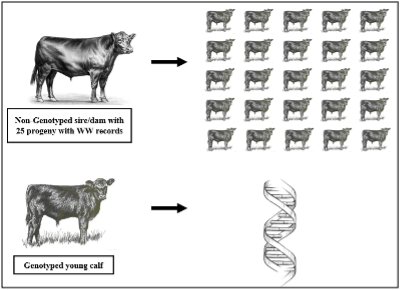

Table 1: Progeny equivalents (PE)
|
Trait 2025 |
PE |
|
Calving Ease Direct |
24 |
|
Calving Ease Maternal |
18 |
|
Birth Weight |
22 |
|
Weaning Weight |
25 |
|
Yearling Weight |
20 |
|
Yearling Height |
15 |
|
Dry Matter Intake |
12 |
|
Scrotal Circumference |
12 |
|
Docility |
10 |
|
Foot Claw Set |
13 |
|
Foot Angle |
12 |
|
Pulmonary Arterial Pressure |
7 |
|
Hair Shed Score |
10 |
|
Heifer Pregnancy |
28 |
|
Maternal Milk |
33 |
|
Mature Weight |
14 |
|
Mature Height |
9 |
|
Carcass Weight** |
13 |
|
Marbling Score** |
10 |
|
Ribeye Area** |
11 |
|
Backfat Thickness** |
11 |
|
Teat Size |
12 |
|
Udder Suspension |
13 |

Andre Lima, Angus Genetics Inc.

Topics: Genetics , Member Center Featured News , Association News , EPDs , News
Publication: Angus Journal
Related Publication Articles


Current Angus Journal
Keep up on the latest stories of the people and programs in the breed.

Latest Podcast Episode
Don’t miss conversations with breeders and industry experts.