April 30,
2010
FOR
IMMEDIATE RELEASE
For more
information contact:
Steve Suther, CAB Industy Information
director, at 785-889-4162 or ssuther@certifiedangusbeef.com
Photo available at: www.cabpartners.com/news/photos/FQF_photos/mccully_mark_mug.JPG

What the Choice-Select
Spread is Trying to Say
Premium Choice now carries the banner for quality
beef.
Cattle
are sold by the pound, but the price per pound can make as much difference as
total weight, when it comes to the bottom line.
That’s
why producers who aim for profit weigh everything that goes into that price.
The
Choice-Select spread has been a leading indicator for decades, but a current
analysis suggests it can mislead if taken at face value. A lot more commodity
Choice came on just as the economy was closing the menu on “middle-meat” steaks
cut from that commodity pool, which no longer represents much of an advantage
over Select.
Producers
today must lift their gaze to the relative values of premium Choice and Prime
beef if they want to monitor the market, says Mark McCully,
Certified Angus Beef LLC (CAB) assistant vice president for production.
McCully recently published a white paper
entitled, “Trends in the Choice-Select spread and implications to cattle
producers.” He explains that spread is simply the difference in price between
the boneless beef cutout from a USDA Select carcass and one that graded Choice.
“But the
difference may not be as simple as it first seems,” he adds. “Most of the upper
two-thirds Choice beef is committed to premium branded programs, and much of
the low-Choice product is also branded. That means it is separate from the
USDA-reported price, which is now derived from the ‘leftovers,’ a little more
than 15% of all Choice grade cattle.”
Why is
that an issue? Traditionally, the market relied on the published Choice-Select
spread as a barometer and a price-discovery point in value-based marketing, McCully says. More than 60% of fed cattle today sell on
some type of grid, formula or other method based partly on this spread.
In the
last decade, the Choice-Select spread has been wider than $20 to slightly
negative for a few weeks (See Table 1). On average, marketers have assumed that
a spread greater than $8 per hundredweight (cwt.) means strong demand for
high-quality beef. On the other hand, a spread of less than $3 per cwt. was
thought to signify weaker demand for quality.
“Those
assumptions don’t consider all factors in the equation,” McCully
points out. They don’t take into account the quantity or the makeup of
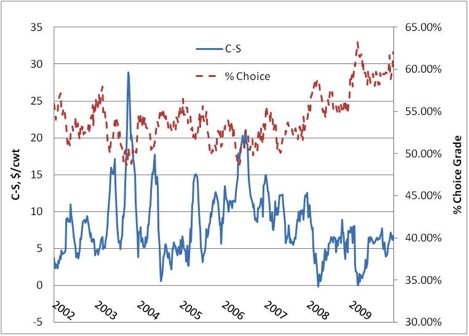
“Choice.” Not only is commodity Choice less worthy of a premium over Select,
but there has been a rapid increase in its supply (See Graph). USDA reports
show the percentage of fed cattle grading Choice has trended higher for nearly
four years.
It’s no
coincidence that the Choice-Select spread also has been on a declining trend
since 2006. But that doesn’t mean
consumers are turning away from highly marbled beef, McCully
stresses.
Correlation
analysis suggests the sole demand drivers of the Choice-Select spread are the
Choice rib and loin prices. And for the past two years, an economic recession
has curtailed dining out at the mid-level restaurants that feature such cuts.
Select cutout values since 2002 have had
essentially no effect on the spread. “That tells us a narrow Choice-Select
spread does not point to more demand for Select beef,” McCully
says.
Indeed,
consumer demand is chiefly linked to high-quality beef. A study last year by
beef industry consultant Julian Leopold found that the combination of Certified
Angus Beef ® brand price and volume showed at least a 27% demand advantage over
USDA Choice since 2005.
Since
then, demand has more than kept pace with record supplies of cattle that
qualify for the brand, up more than 20% for the first six months of the CAB
fiscal year that began Oct. 1, 2009.
“If
producers look only at the Choice-Select spread, they may venture down a
familiar road that led to overall long-term weaker demand for beef 30 years
ago,” McCully cautions. “Look at the next level. USDA
reported last year that a premium Choice carcass was worth $8 per cwt. more
than Select and the Prime premium was double that. On
an 800-pound carcass, that’s $65 to $130 more per head.”
Numerous
studies continue to indicate consumers buy beef because of the taste, and
nothing delivers that better than marbling. As the world’s economies recover,
mid- to upper-tier restaurant business is poised to recover, along with demand
for high-quality steaks. Moreover, the
recession and lower Choice-Select spread saw many retail stores trade up to
higher grading beef.
The U.S.
beef global trade advantage comes from its grain-fed and high-quality nature, McCully notes. Growing international market access and
stability will further support demand for Choice and higher quality beef.
For a complete copy of the white paper, visit http://www.cabpartners.com/news/research/
TABLE
1. Annual Choice-Select
spread average and ranges
|
|
2002 |
2003 |
2004 |
2005 |
2006 |
2007 |
2008 |
2009 |
Avg. |
||
|
Avg. |
$
6.10 |
$
11.60 |
$
6.85 |
$
8.46 |
$
13.49 |
$
9.28 |
$
5.17 |
$
4.70 |
$ 8.21 |
||
|
High |
$
10.98 |
$
28.90 |
$
17.69 |
$
15.09 |
$ 21.09
|
$
13.61 |
$
10.86 |
$
8.07 |
$ 15.79 |
||
|
Low |
$
2.29 |
$
3.80 |
$
0.56 |
$
2.67 |
$
8.59 |
$
5.48 |
$
(0.19) |
$
0.01 |
$ 2.90 |
||
|
Range |
$
8.69 |
$
25.10 |
$
17.13 |
$
12.42 |
$
12.50 |
$
7.28 |
$
9.81 |
$ 8.06 |
$ 12.89 |
||
|
|
|||||||||||
GRAPH. Historical relationship between the weekly
Choice-Select spread and % Choice grade
###